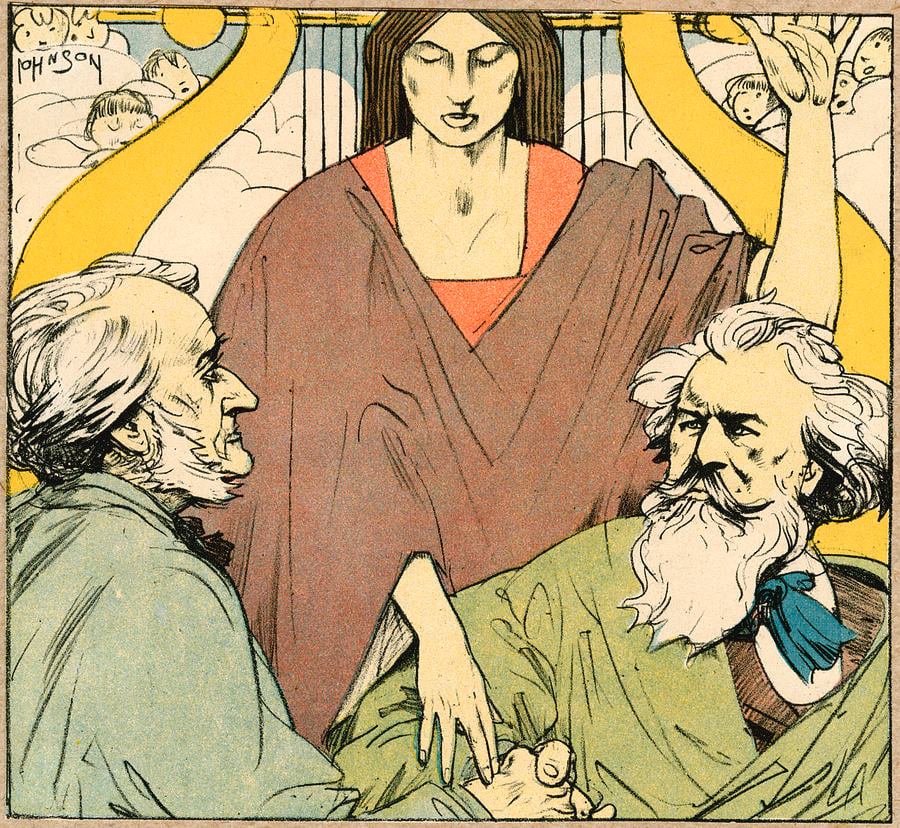
Brahms and Wagner may have been pitted against one another as exemplars of two conflicting schools of music at the height of the Romantic era, but Christmas is the season of peace on earth and goodwill toward men. With this in mind, we call a ceasefire on the War of the Romantics, if only for the next “Music from Marlboro.”
Though Wagner could be counted on to behave badly on just about any occasion, he did manage to pull off one of the most romantic gestures in all of classical music.
On Christmas morning, 1870, Wagner’s wife, Cosima – with whom he had become involved while she was very much married to conductor (and devoted Wagner advocate) Hans von Bülow – awoke to the tender strains of a new serenade.
Wagner had arranged to have 13 musicians seated along the stairs of their Swiss villa for the first performance of “Triebschen Idyll, with Fidi’s birdsong and the orange sunrise, a symphonic birthday greeting.”
Cosima was born on December 24, but she always celebrated on Christmas. Fidi was the nickname of the Wagners’ newly-arrived son, Siegfried. Of course, today we recognize the piece more simply as the “Siegfried Idyll.”
The work had been intended to remain in the Wagner family – from its original title, it’s obvious that it’s loaded with personal significance – but when Wagner ran short of cash, as he often did, he decided that maybe he had better have it published, after all. Some of the material later found its way into the third of the “Ring” operas (also known as “Siegfried”).
We’ll hear Wagner’s Christmas serenade performed at the 1971 Marlboro Music Festival. In the first chair will be Alexander Schneider, a violinist long associated with the Budapest String Quartet.
It’s all-too-easy to dismiss Brahms as crusty and gruff. This is the man, remember, who once notoriously wrecked a party by declaring, “If there’s anyone here I’ve failed to insult, I apologize!”
But Brahms could also be an old softy, with a very generous heart. He retained as especially childlike demeanor around Christmas. He always saw to it that the Schumanns were well-gifted and that his housekeeper’s family had their own tree.
Brahms’ “Zwei Gesänge” (“Two Songs”) for voice, viola and piano, Op. 91, from 1863, was originally intended as a wedding present for his friend, violinist Joseph Joachim (who also played the viola), and Joachim’s bride, Amalie (who was a contralto).
The second of the songs , “Geistliches Wiegenlied” (“Sacred Lullaby”), is a setting of Emanuel Geibel’s text, a cradle song sung by Mary, who requests that the angels silence the rustling palms because her Child is asleep. The viola quotes the Christmas melody “Joseph, lieber Joseph mein,” a sly reference on the part of the composer, who incorporates the carol’s text, so as to include Joachim’s given name.
We’ll hear a performance from 2011, featuring mezzo-soprano Jennifer Johnson Cano, violist Hélène Clément, and, at the keyboard, Marlboro co-director Mitsuko Uchida.
The balance of the hour will be devoted to a work by the long-lived Carl Reinecke, who became friendly with Brahms while an instructor at the Cologne Music School in the 1850s. Like Brahms, Reinecke was a frequent guest in the Schumann home. A prolific composer himself, Reinecke served as kapellmeister of the Leipzig Gewandhaus Orchestra from 1860 to 1895.
We’ll hear his charming Octet for Winds, Op. 216, which was published in 1892. It was performed at Marlboro in 2010 by oboist Nathan Hughes; clarinetists Anthony McGill and Moran Katz; hornists Rodovan Vlatkovic and Jill Bartles; and bassoonist William Winstead.
It’s a Christmas truce, on this week’s “Music from Marlboro.” The Marquess of Queensberry Rules need not apply, this Wednesday evening at 6, on WWFM – The Classical Network and wwfm.org.
Marlboro School of Music and Festival: Official Page
WAGNER AND BRAHMS: Gods and sinners reconciled
Leave a Reply