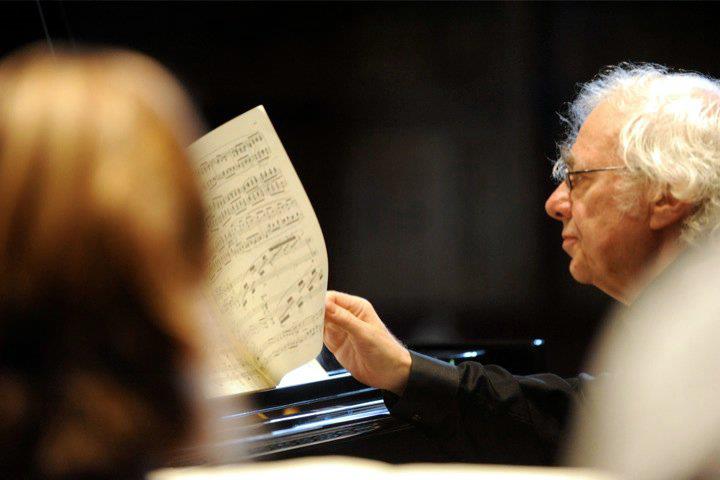
If it’s Goode, you know it’s got to be great.
On this week’s “Music from Marlboro,” we’ll celebrate pianist Richard Goode. Goode served as co-artistic director (with Mitsuko Uchida) of the Marlboro Music School and Festival, from 1999 to 2013. On and off, he’s been part of the fabric of Marlboro since he was 14 years-old.
We’ll sample his artistry in outstanding performances of music by Ferruccio Busoni and Johannes Brahms.
Inspired in part by Bach’s “Art of the Fugue,” Busoni composed his “Fantasia contrappuntistica” for solo piano in a flurry of inspiration in 1910. His arrangement for two pianos followed. I think you’ll agree, there’s no substitute for its thrilling antiphonal effects.
The work is built into one continuous span, but subdivided into twelve parts – a prelude and variations on the Bach chorale “Ehre sei Gott in der Höhe” (“Glory to God in the Highest”) – capped by a quadruple fugue. The laws of counterpoint are rigorously applied, in a manner that would have made even Max Reger smile.
The work was composed during a whirlwind tour of the United States. Busoni was especially proud of his ability to make every note of the fugue “sound.”
We’ll hear it performed on a Marlboro spin-off recording from 1964, with Richard Goode and Peter Serkin, making musical mincemeat of this vertiginous knuckle-buster. Goode was only 20 years-old at the time – and Serkin was 16!
Bach was also an important source of inspiration for Johannes Brahms. Following the death of his mother, the composer was discovered by one of his friends, weeping over the keyboard as he played through works by the Baroque master.
Also stemming from his loss was Brahms’ Horn Trio in E flat major, Op. 40. The horn, which takes the place of the cello in the traditional configuration of the piano trio, was a highly unusual choice for chamber music, but one which must have recalled for Brahms the lessons he had taken as a child.
Fortuitously, the instrument also has rustic associations. It was during a walk in the Black Forest that the composer first “heard” the trio’s opening theme. While the work is a celebration of nature, and in the last movement, perhaps even the hunt, the tempo marking of the third movement adagio is characterized as “slow and sad.” Brahms uncovers a well of emotion in the quotation of a German funeral melody, “Wer nur den lieben Gott läßt walten” (“If thou but suffer God to guide thee”).
Demonstrating the kind of continuity that makes Marlboro shine among summer music festivals, we’ll again hear Richard Goode, this time in middle age, joining hornist Marie-Luise Neunecker and violinist Mark Steinberg, in 1989.
We’ve never had it so Goode, on the next “Music from Marlboro,” this Wednesday evening at 6:00 EST, on WWFM – The Classical Network and wwfm.org.
Marlboro School of Music and Festival: Official Page
FOR THE GREATER GOODE: Richard Goode at Marlboro in 2011
Leave a Reply