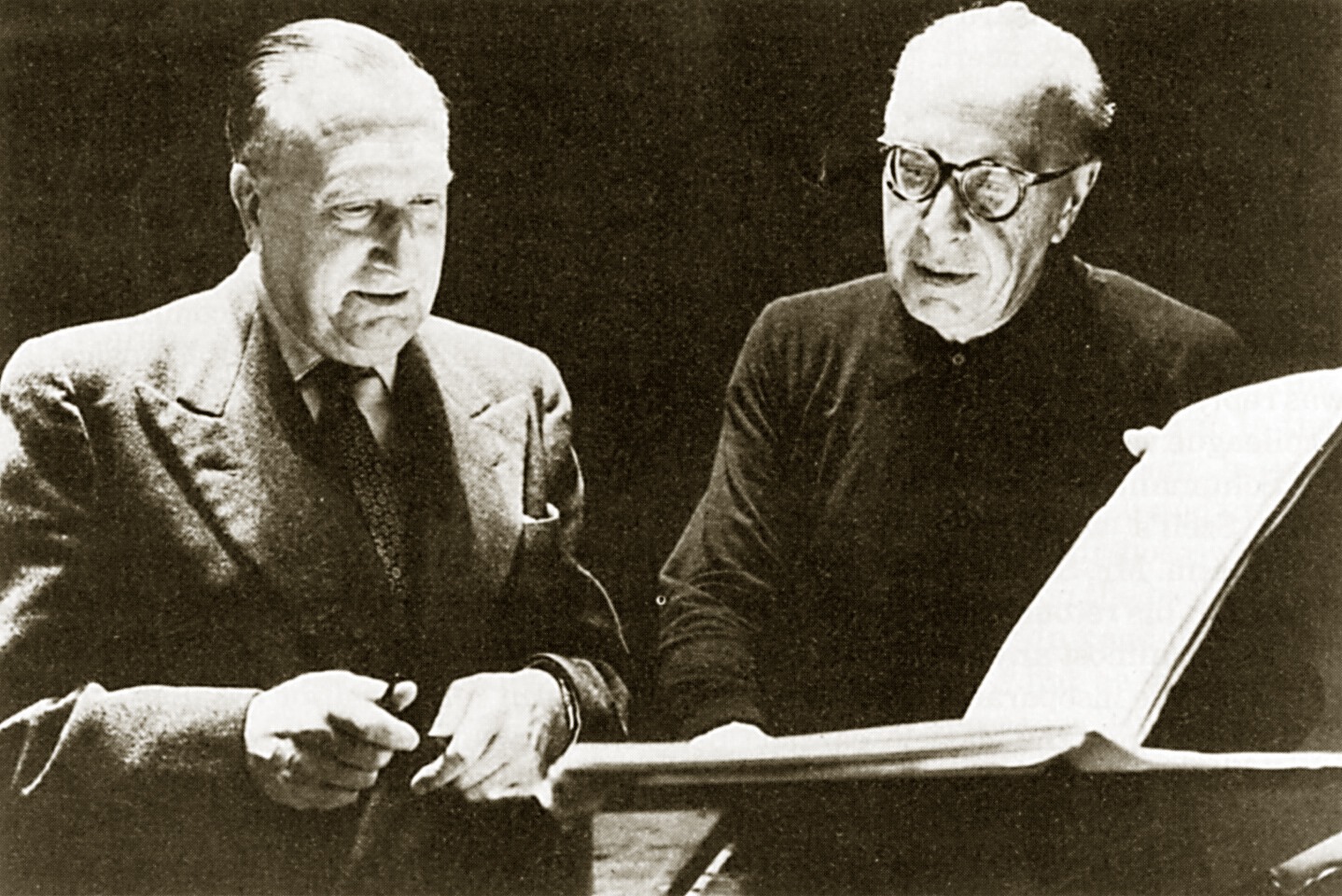
Sir William Walton is beloved for his coronation marches and film scores. But posterity has been woefully reductive. He also wrote operas, symphonies, concertos, chamber music, and choral works.
This Sunday night on “The Lost Chord,” we’ll hear two long-out-of-print recordings of works composed more than three decades apart.
At the time of the premiere of his Symphony No. 2, in 1957, Walton was perceived as something of a musical throwback. Indeed, despite the fact that it is more tightly argued, the piece has always been regarded as a poor stepsister of the Symphony No. 1, composed in 1935, a work full of grand gestures, written under the spell of Sibelius.
What apparently escaped critics of the day was the subtlety of its craftsmanship. The finale, in particular, is a set of variations based on a twelve-note row, a technique not unlike that employed in the kind of serial composition so much in vogue at the time.
George Szell (pictured, with the composer) gave the American premiere of the symphony, with the Cleveland Orchestra, in December of 1960. A few months later, they made the first recording.
More than three decades earlier, Walton was viewed as an enfant terrible, when he set Edith Sitwell’s poetry as an entertainment, titled “Façade.” The work was first performed publicly in 1923. The premiere was a succès de scandale, with Sitwell herself speaking her poems into a megaphone protruding from the mouth of a painted face by John Piper, Walton conducting an ensemble of six instruments.
The displeasure of performers, audience, and critics was evident, with Noel Coward ostentatiously marching out. However, the work quickly caught on, even becoming downright popular in a variety of arrangements. Within a decade, a purely orchestral version was choreographed by Frederick Ashton.
We’ll hear selections from a treasured recording, unavailable in this country for many years, featuring Dame Peggy Ashcroft and Paul Scofield as the reciters. Both were noted Shakespearean actors, who did much of their best work on stage. Ashcroft received an Academy Award for Best Supporting Actress in 1985, for her part in David Lean’s final film, “A Passage to India,” and Scofield was honored with an Academy Award for Best Actor two decades earlier, in 1966, for his performance in “A Man for All Seasons.”
I hope you’ll join me for “Will’s Wonders Never Cease” – rarely heard recordings of the works of William Walton – this Sunday night at 10:00 EDT, on WWFM – The Classical Network and wwfm.org.
Leave a Reply to บาคาร่าเกาหลีCancel reply