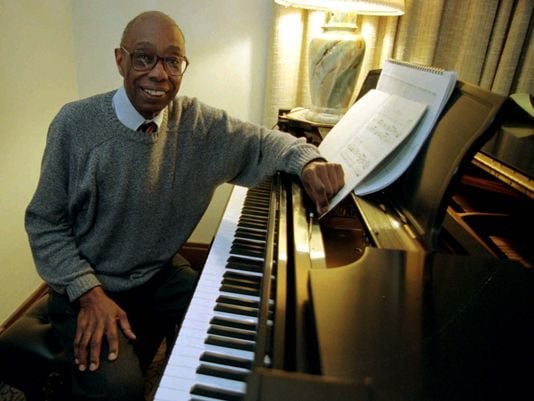
George Walker would have been 99 years-old today.
Walker was the first African-American recipient of the Pulitzer Prize for Music – as recently as 1996 – for “Lilacs for Voice and Orchestra.” He was the first black pianist to present a solo recital at New York’s Town Hall (in 1945). He was the first black performer to appear as soloist with the Philadelphia Orchestra (performing Rachmaninoff’s Piano Concerto No. 3). He was the first black musician to graduate from the Curtis Institute of Music (where he studied with Rudolf Serkin and Rosario Scalero).
Walker died on August 23, 2018, at the age of 96. This Sunday night on “The Lost Chord,” we’ll celebrate this trailblazing artist with a program of four of his original works, including his Piano Sonata No. 2 (with the composer himself at the keyboard), the award-winning “Lilacs” (after poetry of Walt Whitman), “Address for Orchestra” (his first major orchestral work), and “Lyric for Strings” (his most famous music, in its original version for string quartet).
Born in Washington, D.C., Walker was a longtime resident of Montclair, NJ. His father emigrated from Kingston, Jamaica, to study at Temple University School of Medicine; Walker’s mother supervised his first piano lessons. He was admitted to the Oberlin School of Music at the age of 14. He was then admitted to the Curtis Institute in Philadelphia, and later attended the Eastman School. For two years, he studied in Paris with famed pedagogue Nadia Boulanger.
Walker’s own academic career included posts with Dillard University in New Orleans, the Dalcroze School of Music, the New School for Social Research, Smith College, the University of Colorado Boulder, Rutgers University (where he served as chairman of the music department), the Peabody Institute of John Hopkins University, and the University of Delaware.
He was the father of two sons, violinist and composer Gregory T.S. Walker and playwright Ian Walker. His sister was the pianist Frances Walker-Slocum.
By his own assessment, Walker was a composer more interested in building “elegant structures” than in “creating beauty.” Depending on one’s sensibility, it could be argued that he achieved both.
I hope you’ll join me in “Perambulating with Walker,” this Sunday night at 10:00 EDT, on WWFM – The Classical Network and wwfm.org.
A fascinating interview with Walker by Frank J. Oteri, which, among other things, lends an added dimension to Walker’s most frequently performed music (the “Lyric”) and offers insights into his life and musical philosophy. Also, some great photos!
https://nmbx.newmusicusa.org/george-walker-concise-and-precise/
Do you enjoy exploring unusual and neglected repertoire like that offered on “The Lost Chord?” Whatever it is you appreciate about WWFM The Classical Network, we hope you will help support it with your contribution today. Make a donation through Wednesday, June 30 (the end of our fiscal year), and help balance our budget, at wwfm.org.
We couldn’t do it without enthusiastic and committed listeners like you. Thank you for all that you do to keep classical music on the radio!
Leave a Reply