Winston Churchill’s assessment of Russia in 1939 could have just as easily been applied to Arnold Schoenberg. He was a riddle, wrapped in a mystery, inside an enigma – a man cloaked in irony and contradiction.
For one thing, his very name, “Schoenberg,” translates as “beautiful mountain,” yet those who would characterize his music as such are distinctly in the minority.
He was the greatest prophet of dodecaphonic music, who claimed an artistic kinship with Johannes Brahms.
He preached the death of tonality, even as he orchestrated his share of Viennese operettas and arranged Strauss waltzes for performance by his friends.
He was a Jew, who converted to Lutheranism, but swung back hard to Judaism, in defiance of Hitler, with the rise of the Nazis.
He was probably the least “popular” composer in the world, but his tennis partner was none other than George Gershwin. The two also shared a love of painting.
Schoenberg was a triskaidekaphobe, who died on Friday the 13th. It was all right to count to twelve, apparently, but never to thirteen.
Adding to this beautiful mountain of contradictions, Schoenberg, like that other titan of 20th century music, Igor Stravinsky, wound up living in Hollywood.
Both men were suspicious of the movies (and each other), yet both were hoping to break into films. Stravinsky wrote cues for “The Song of Bernadette,” “Jane Eyre,” and “The North Star” (ultimately scored by Copland). None of his music was used in the pictures – Stravinsky was too slow and demanded too much money – but some of it was recycled in his concert works.
Likewise, Schoenberg was courted for a film adaptation of “The Good Earth,” but his proposed $50,000 fee put an end to that.
Twelve-tone music did eventually make it into the movies, thanks to composers like Leonard Rosenman and David Raksin. Rosenman’s landmark score for “The Cobweb” (1955) is credited as the first predominantly twelve-tone score written for a motion picture. Raksin, the composer of “Laura,” also employed a tone row in the Edgar Allan Poe mystery, “The Man with a Cloak” (1951).
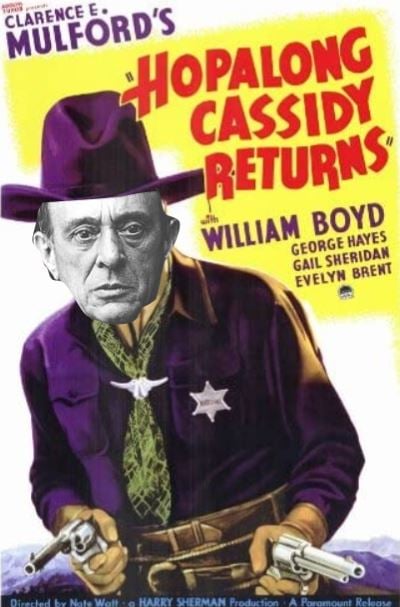
Interestingly, Schoenberg, the creator of “Pierrot Lunaire” and “Moses und Aaron,” was also a great fan of Hopalong Cassidy. Like Walt Whitman, an admittedly strange comparison, Schoenberg contained multitudes.
Happy birthday, Arnie!
“Variations for Orchestra,” conducted by Bruno Maderna
“Pierrot Lunaire”
With goats!
A kinder, gentler Schoenberg – the Suite for String Orchestra, given its premiere in Los Angeles in 1935:
Stravinsky in Hollywood
Schoenberg in home movies – on the tennis court, naturally – with Gershwin and others. (Gershwin appears around 2:20.)
Leonard Rosenman’s “The Cobweb”
Leave a Reply to ต่อผมแท้Cancel reply