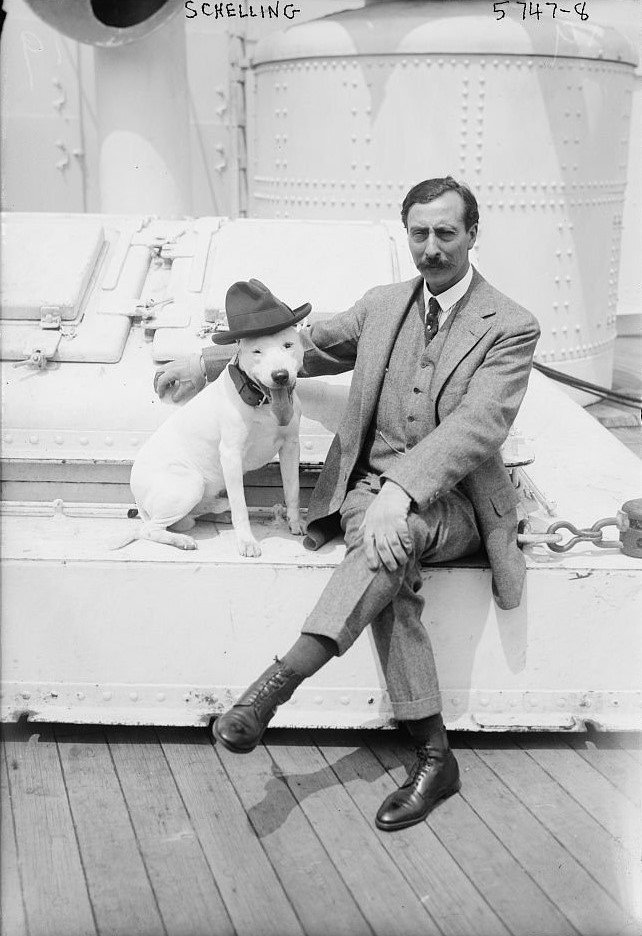
You might say that Ernest Schelling was a Jersey boy who made good. He also happened to be responsible, in part, for the death of Enrique Granados.
Schelling, a celebrated pianist who for a period of three years became the exclusive pupil of Ignacy Paderewski, was born in Belvidere, NJ on this date in 1876.
A child prodigy, he made his debut at Philadelphia’s Academy of Music at the age of 4. At 7, he was admitted to the Paris Conservatory. Among the other notable musicians he worked with were Hans Huber, Moritz Moszkowski, and Theodor Leschetizky. Leschetizky was the pupil of Carl Czerny, who of course studied with Beethoven.
As a conductor, Schelling became music director of the Baltimore Symphony Orchestra, which he led from 1935 to 1937. Well before Bernstein, he conducted the New York Philharmonic Young People’s Concerts, beginning in 1924. They were such a success, he took them on tour, with stops in Philadelphia, Los Angeles, London, and Rotterdam.
Schelling gave the U.S. premiere of Granados’ piano cycle “Goyescas.” In fact it was he who encouraged the composer to craft the music into an opera. Granados liked the idea, and “Goyescas” was given its first performance at the Metropolitan Opera in 1916.
It created such a sensation that Woodrow Wilson – former president of Princeton University and former governor of New Jersey – invited the composer to the White House, an offer Granados could hardly refuse. Granados postponed his homeward journey. A few weeks later, he was drowned in the English Channel, after his ship, the S.S. Sussex, was torpedoed by a German submarine.
Thanks a lot, Ernest Schelling – and by the way, happy birthday.
Schelling plays Liszt’s Sonata in B minor:
Willem Mengelberg conducts Schelling’s “A Victory Ball:”
A selection from Schelling’s “Suite Fantastique:”
PHOTO: Shipboard with Ernest Schelling and friend
Leave a Reply to fruit cocktailCancel reply