It’s September 1st, and I’m all Schoeck up!
On this day when the birthdays of Johann Pachelbel and Engelbert Humperdinck are generally observed, Othmar Schoeck is foremost in my thoughts.
Schoeck (1886-1957) may be largely forgotten now, but he once enjoyed international recognition for his art songs, which he composed prolifically. He also produced opera, orchestral, and instrumental works. His ambitious Violin Concerto – some 40 minutes in length – was composed at white heat, out of love for Stefi Geyer, the same violinist who captivated Béla Bartók and inspired Bartók’s Violin Concerto No. 1.
Schoeck was born in Switzerland and spent most of his life there, other than a brief period during which he lived in Leipzig, where he studied with Max Reger. He had considered pursuing a career in the visual arts, as had his father, before finally committing himself to music. He was fortunate enough to secure patronage so that he could compose more or less undisturbed.
When Ferruccio Busoni settled in Switzerland during the First World War, the two developed a friendship, despite some disagreements on certain artistic matters. In fact, Busoni provided the libretto for Schoeck’s opera “Das Wandbild” (“The Picture on the Wall”), marked by the kind of chinoiserie that characterized Busoni’s own “Turandot” (in no way to be confused with the later, more famous opera by Puccini).
Schoeck’s music experienced a stylistic shift as he became acquainted with the works of Alban Berg and Arthur Honegger. A torrid affair with the pianist Mary de Senger seems to have changed him for good. When their relationship ended, so did Schoeck bid farewell to his earlier, Romantic style.
Though he was no Nazi sympathizer, Schoeck had the bad judgment or naivete to attend the premiere of one of his operas in Berlin in 1943. This led to a lot of stress at home, with the Swiss unhappy with his actions. Schoeck suffered a heart attack, but continued to compose. He died in 1957.
I seem to recall his reputation was such that the writer Hermann Hesse referred to Schoeck in one of his books – I think it was “Journey to the East” – in the same breath as Richard Strauss. I suppose it didn’t hurt that Hesse and Schoeck were friends and Schoeck set some of Hesse’s poems (as did Strauss). Hesse pitched the idea of an operatic collaboration, and even wrote a libretto, but the proposal never came to anything.
Here is Schoeck’s lovely “pastoral intermezzo,” as the composer described it, “Summer Night.” It tells of a summer harvest, during which field hands come to the aid of a widow and work all night in order to get in her crop, before embarking on their own day jobs.
Here’s a song, “Summer Night,” on a text of Hesse, with Dietrich Fischer-Dieskau
https://www.youtube.com/watch?v=AflKXAZaUsY
And the composer’s Violin Concerto
Happy birthday, Othmar Schoeck!
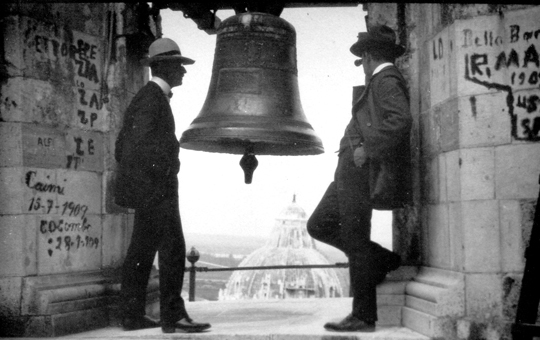
HATS IN THE BELFRY: Hermann Hesse and Othmar Schoeck
Leave a Reply