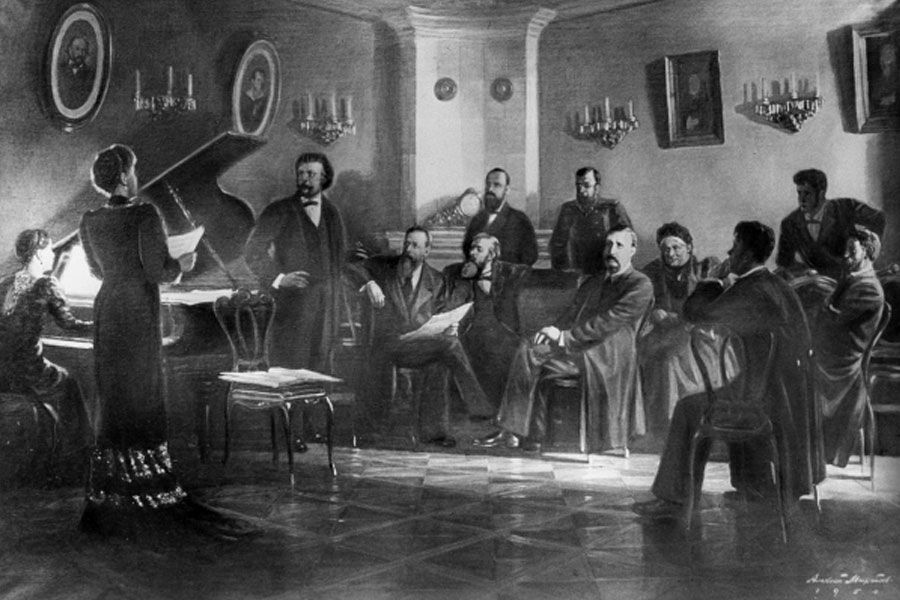
Among the followers of Mily Balakirev that collectively came to be known as “The Mighty Handful” or “The Five,” unquestionably the least well-known is César Cui. Nikolai Rimsky-Korsakov, Modest Mussorgsky, and Alexander Borodin all went on to attain a kind of immortality in Russian music, each having left his indelible mark.
Cui wrote 15 operas, believe it or not – one of them, “William Ratcliff,” earning the highest praise from Franz Liszt – but today, he is remembered, if at all, as a miniaturist, or perhaps as a composer of art song, and at that, the least Russian-sounding of the five.
He shared in common with the others the fact that for him music was an avocation. He paid his bills as a military engineer. Beyond that, however, he was a bit of an outsider – born in Vilnius (now in Lithuania) to a father who had been a general in Napoleon’s army, who stayed and married a local. In addition to Russian, Cui grew up speaking French, Polish and Lithuanian. Perhaps this broader cultural perspective led to a more cosmopolitan approach to music.
As a critic, he was prolific, and he could be blistering in his sarcasm. Perhaps most notorious was his reception of Rachmaninoff’s First Symphony:
“If there were a conservatory in Hell, and if one of its talented students were to compose a program symphony based on the story of the Ten Plagues of Egypt, and if he were to compose a symphony like Mr. Rachmaninoff’s, then he would have fulfilled his task brilliantly and would delight the inhabitants of Hell. To us this music leaves an evil impression with its broken rhythms, obscurity and vagueness of form, meaningless repetition of the same short tricks, the nasal sound of the orchestra, the strained crash of the brass, and above all its sickly perverse harmonization and quasi-melodic outlines, the complete absence of simplicity and naturalness, the complete absence of themes.”
The assessment plunged Rachmaninoff into a two-year depression, during which he was unable to compose until being lifted out of his funk by hypnotic therapy. Of course, today everyone knows Rachmaninoff’s music (if not his First Symphony). How many, I wonder, know Cui’s?
On the anniversary of Cui’s birth, enjoy his “Deux morceaux” for cello and orchestra.
25 Preludes for Piano, Op. 64
Nocturne in F-sharp minor
Suite No. 3 “In modo populari”
Cui’s greatest hit? Perhaps “Orientale” from his collection for violin and piano “Kaleidoscope,” for many years a popular encore. Here are two contrasting treatments.
Efrem Zimbalist
and Midori
Finally, the Carmen Dragon treatment
A work that’s received a lot of notice since Covid: the one-act opera “A Feast in Time of Plague”
Happy birthday, César Cui!
IMAGE: With so many whiskers in the room, you know you must be in the company of The Five. Center, left to right: Modest Mussorgsky (standing, by the piano), Nikolai Rimsky-Korsakov, critic and champion Vladimir Stasov (seated), Mily Balakirev (standing behind), César Cui (standing, with spectacles), and Alexander Borodin (seated).
Leave a Reply to สล็อตเว็บตรงCancel reply