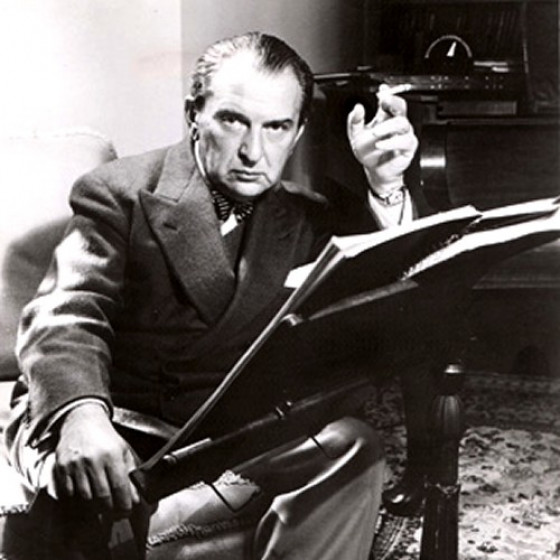
Is it better to be feared than loved?
I note that ‘tis the season not only to be jolly, but for births of great conductors who reached full flower during the hi-fi era.
Arthur Fielder’s birthday anniversary was on December 17. For 49 years, Fiedler (1894-1979) was music director of the Boston Pops. He was not the Pops’ first music director – the group was founded in 1885 as an offshoot of the Boston Symphony Orchestra (which Fiedler joined as a violinist in 1915) – but he was certainly its best-known and arguably most-beloved.
Fiedler built the Pops into one of the best known and bestselling orchestras in the United States. He made his first recordings with the group in 1935. With the rise of PBS, he became a regular presence in American living rooms on “Evening at Pops” telecasts, beginning in 1970.
Allegedly, the Fiedler-Pops partnership yielded more recordings than any other conductor-orchestra combo in the world, with album, single, tape, and cassette sales exceeding $50 million.
Because of his phenomenal success as a light classics and crossover conductor, Fiedler’s talent in the more respected classical music repertoire was often overlooked. There’s a lot that he never conducted or that was never recorded, but in Liszt, Rimsky-Korsakov, and even Darius Milhaud, he was never less than first-rate. And as an accompanist to soloists like Earl Wild, he oversaw a number of popular (Gershwin) and cult (Paderewski) classics.
I myself once underrated him, but my long experience in radio set me straight. Once you filter out the kitsch, you’ll find the man made some truly marvelous recordings. On the evidence of these, in a certain kind of music, he could stand toe-to-toe with any conductor in the world. I remember just randomly airing his recording of the “Nutcracker” suite one morning and being struck by how satisfying it was on every level.
As for the splashy arrangements of showtunes and movie themes, and the amusing album covers (Fiedler surrounded by leotard or taffeta-wearing babes, or the one on which he dons Travolta’s iconic white disco suit for a program featuring arrangements of Bee Gees hits), the man knew how give the public what it wanted. How much he believed in the kitsch and how much was canny showmanship, I have no idea. I believe he laughed all the way to the bank, but if so, he did it wholly without contempt for his audience.
Fritz Reiner (1888-1963), on the other hand, is the last person I would ever imagine on the dance floor. Reiner, born on December 19, was one of the most dreaded conductors, from a musician’s standpoint, in an era when tyrants of the podium still very much roamed the earth. With a glower that could make Karloff quake (though he resembled more Bela Lugosi), Reiner was forged in Hungary at the twilight of the Austro-Hungarian Empire. Hungary at the time had quite the reputation for churning out great conductors. George Szell, Eugene Ormandy, Antal Doráti, Ferenc Fricsay, Sir Georg Solti, and István Kertész all achieved considerable international success.
Among Reiner’s own teachers was Béla Bartók, with whom he studied piano. Reiner would later repay the favor with what many consider to be the benchmark recording of Bartók’s “Concerto for Orchestra.” He also worked closely with Richard Strauss in Dresden, and his recordings of Strauss’ works are equally revered. All in all, the Chicago Symphony under Fritz Reiner was a surefire choice to give the ol’ hi-fi a good workout in the early days of stereo.
In 1928, Reiner became a naturalized American citizen. He began to teach conducting at the Curtis Institute of Music in Philadelphia, where among his pupils was Leonard Bernstein. His first American post was as principal conductor of the Cincinnati Symphony. He took over the Pittsburgh Symphony for a decade, beginning in 1938. Then he spent several years at the Met. But it was as music director of the Chicago Symphony that he attained legendary status.
For a master interpreter of some of the largest and most challenging works in the repertoire, his baton technique was notable for its precision and economy. Much of what he achieved, unfortunately, was through the brutality he exuded in rehearsals. Reiner emerged from an Old World steeped in aristocratic privilege. At the top of their profession, conductors then were regarded as gods-on-earth. When drive and ego were bolstered by absolute power, working conditions could become downright perilous. Before strong musicians’ unions, conductors exercised the authority to fire anyone on a whim. So when musicians played for Reiner, they played as if their lives depended on it – or at the very least their livelihoods.
Did it make for better musicmaking? You can’t argue with the excellence of Reiner’s Chicago Symphony. Unless, of course, you look to Fiedler and the Boston Pops.
Reiner conducts Beethoven
Big band Bach
Benchmark Bartók
Strauss’ “Salome”
And, to keep it seasonal, “Waltz of the Flowers” from “The Nutcracker”
https://www.youtube.com/watch?v=mgaS9CZ7KsQ
Fiedler’s benchmark Gershwin with Earl Wild
Conducting Liszt’s “Mazeppa”
Rimsky-Korsakov’s “Le coq d’or” (“The Golden Cockerel”)
Paderewski Piano Concerto with Wild and the London Symphony Orchestra
https://www.youtube.com/watch?v=O-ZLIXCSZ70
Perhaps one of Fiedler’s least-known recordings: Paul Hindemith’s “Der Schwanendreher,” with the composer as viola soloist
Handel’s organ concertos with Carl Weinrich
Fielder conducts “Waltz of the Flowers”
Leave a Reply