The Mozart-related rediscoveries continue!
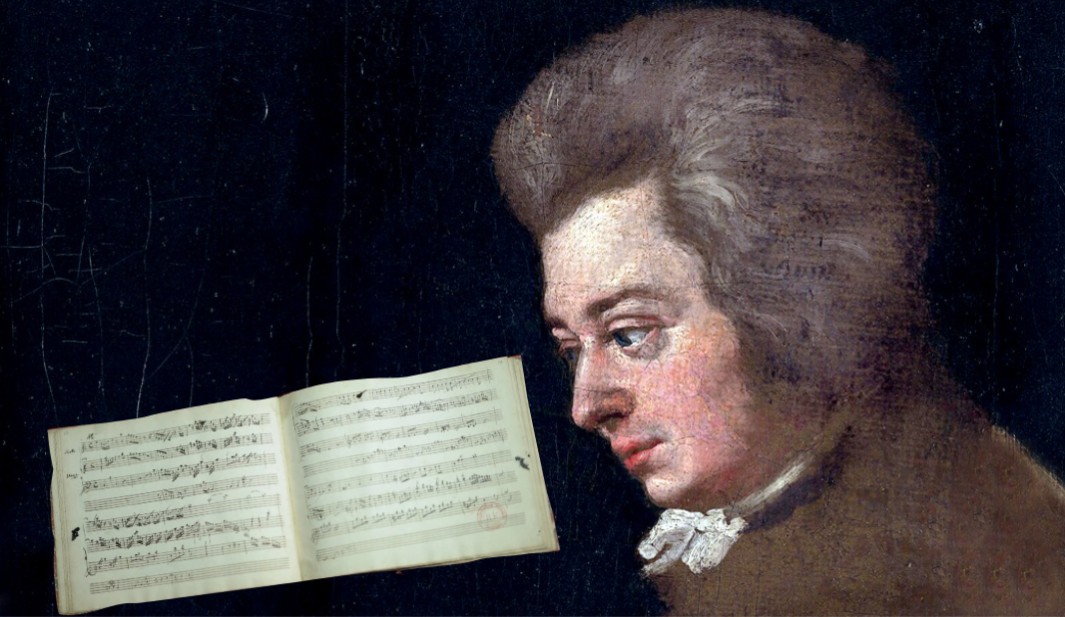
Last week, a 248-year-old notebook housed at France’s National Library was identified conclusively as having belonged to Mozart, when he was 22. The notebook, containing material set down between May and July 1778, was kept by the composer while he was employed as a music tutor in Paris for Marie-Louise-Philippine de Bonnières de Guînes. Her father, the Duke de Guînes, a highly-regarded flutist, commissioned Mozart’s Concerto for Flute and Harp, which you can’t help but encounter weekly if you ever listen to classical radio.
The notebook contains daily exercises for Mozart’s harp-playing protegée and seven original works for flute and harp, written under Mozart’s supervision. Mozart being Mozart, it appears he penned a substantial portion of the music himself. Presumably, these were designed to be played by Guînes and her father. The pieces were performed in public for the first time only yesterday at the library.
With the outbreak of the French Revolution, the Duke, a confidant of Marie-Antoinette, fled the country for England. Apparently, he stiffed Mozart for his work. In absentia, he authorized a butler to pay the composer half of what he was owed. Offended, Mozart refused to take it. Eat the rich!
As is so often the case, the rediscovery occurred when sorting through a pile of documents already stored at the library. A few years ago, somebody knocked over a stack at yet another library and discovered Stravinsky’s “Funeral Song,” a 12-minute orchestral piece composed in memory of his teacher, Nikolai Rimsky-Korsakov. It’s very important for librarians to catalogue their holdings well!
At any rate, the Mozart rediscovery is deemed to be a major one, a significant window into the mind, world, and creative and pedagogical processes of the 22 year-old master.
You’ll recall just the other week, a treasure trove of Salieri’s music was rediscovered. This seems then like an especially fortuitous summer for the Bard Music Festival to be focusing on “Mozart and His World” (to be held at Bard College in Annandale-on-Hudson, NY, August 7-16).
The thesis doesn’t mean it’s all Mozart. There will be works by his influences, his contemporaries and associates, and those he himself influenced and inspired; but as always at Bard, the real magic resides in the manner of the music’s presentation – the context, the juxtaposition of pieces, the pre-concert talks, and the scholarly panels. These are things you won’t find anywhere else.
The Bard Music Festival is part of the college’s larger celebration of the arts, Bard SummerScape (June 25-August 16), which encompasses opera, theater, dance, and cabaret at the campus’ Spiegeltent. If Mozart doesn’t really float your boat, there will be a fully-staged production of Richard Strauss’ opera “Die ägyptische Helena” (“The Egyptian Helen,” July 24-August 2). When’s the last time you heard that?
If I’m a little behind on sharing news of the discovery of the Mozart notebook, I take solace in the fact that the New York Times is only just getting around to reporting on it today as well! Read more about it at the link.
https://www.nytimes.com/2026/06/22/arts/music/mozart-music-flute-harp.html?unlocked_article_code=1.sFA.YSkW.l46NoRKsVayu&smid=url-share
For tickets and information about Bard SummerScape, the Bard Music Festival, and “Mozart and His World,” visit https://fishercenter.bard.edu/.
Concerto for Flute and Harp in C major, K. 299
Rediscovered pieces for flute and harp!
Leave a Reply