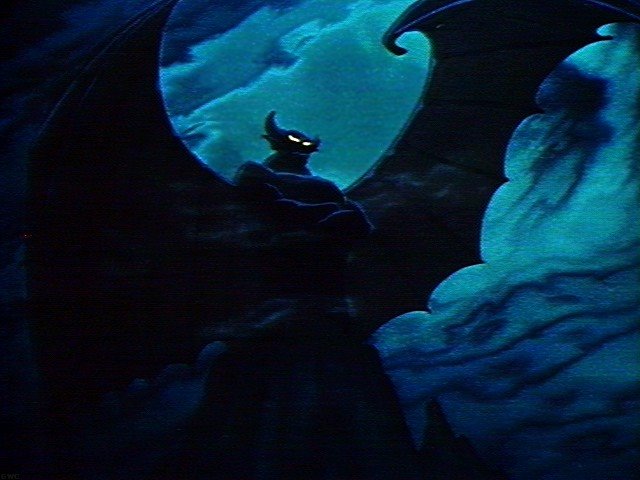
Even though the solstice was on Sunday, the longest day, a lot of Europeans celebrate the height of the season tonight, St. John’s Eve. For the record, that’s when the demon Chernobog is supposed to emerge from Bald Mountain – regardless of what Disney may think. (The narrator of “Fantasia,” Deems Taylor, says it’s supposed to be Walpurgis Night, April 30, the eve of May Day.)
In England, June 23 is Midsummer’s Eve, the setting of Shakespeare’s most famous comedy. I have a soft spot for the 1935 film version of “A Midsummer Night’s Dream,” overseen by Viennese impresario Max Reinhardt and featuring a real hodgepodge of actors from the Warner Bros. stable, including crooner (and later tough guy) Dick Powell as Lysander, Olivia de Havilland as Hermia, James Cagney as Bottom, and yes, 14-year-old Mickey Rooney as Puck.
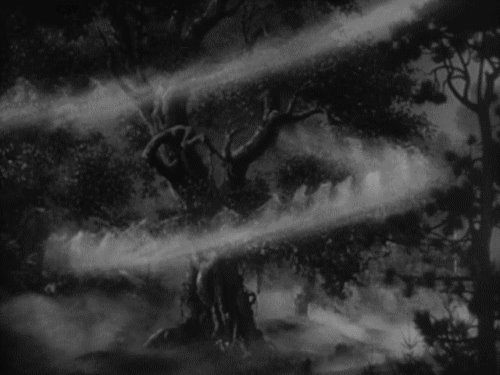
But it’s the technical achievement that really puts it over. The opulent film (spun off from an extravagant Hollywood Bowl production) sports an effervescent score by Erich Wolfgang Korngold, woven together with dewy gossamer from the compositions of Felix Mendelssohn, enthralling production design and art direction by Anton Grot, with an especially delightful sequence of fairies ascending a woodland mist encircling a tree, and poetic choreography by Branislava Nijinska. There’s so much poetry in this movie it even sustains the ridiculous antlered crown worn by magnificent Victor Jury (soon to play John Wilkerson, the unsavory overseer in “Gone with the Wind”), putting his superior elocution to impressive use as Oberon.
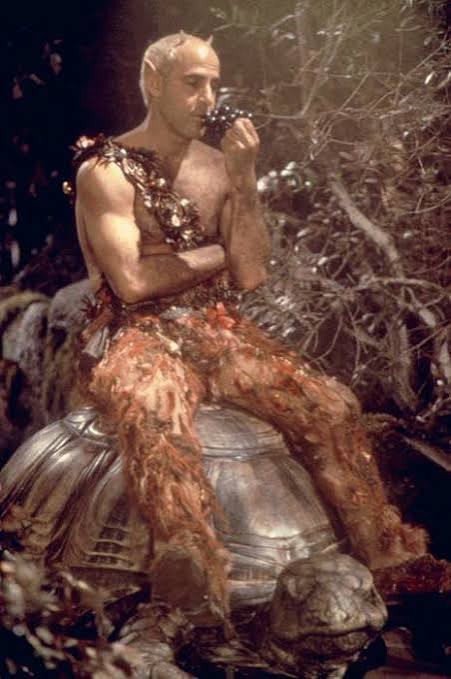
“A Midsummer Night’s Dream” has been filmed many times, of course. (I’m still trying to forget a middle-aged Stanley Tucci as Puck, riding a turtle, from the frustrating 1999 version, also starring Michelle Pfeiffer and Kevin Kline.)
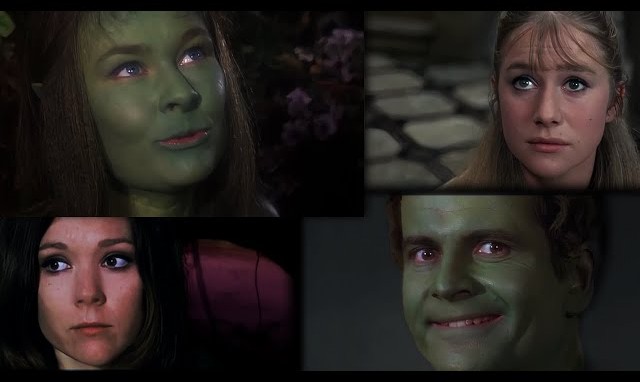
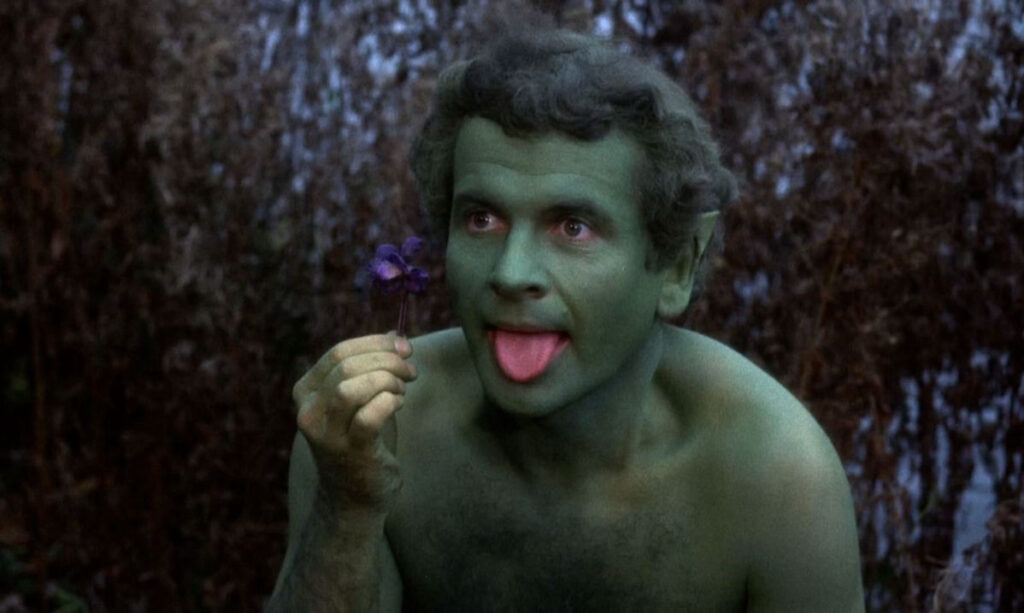
One I find especially unpleasant sports perhaps the most impressive pedigree of them all – a 1968 version that stars, among others, Judy Dench, Helen Mirren, Diana Rigg, David Warner, and Ian Holm, in green body paint, as perhaps the creepiest Puck in history. Also, for “Star Wars” aficionados, one-time Annakin Skywalker (before George Lucas scrubbed him out) Sebastian Shaw as Peter Quince. To think, the film is directed by theatrical deity Peter Hall! With such an assemblage of talent, how could it miss?
Well, it *was* 1968, and there were certainly more attractive, more lucid eras. As I recall, the film is uningratiating – ugly and claustrophobic, with hand-held cameras and “Kung Fu Theater” style editing, little concern for the beauty of the language, and perhaps Holm’s only bad performance (with that damn tongue).*
I disliked it so intensely, in fact, that it’s one of those instances in which I feel surely it couldn’t be as bad as I remember. This is the most dangerous kind of bad, because there’s a good chance I will wander back to it, lured beyond my will by curiosity and fey enchantment.
I must say, at least the print at the link is in the best resolution I have ever seen. I’m used to encountering it in transfers from grainy VHS. Here it is. Don’t say I didn’t warn you!
Then check out the 1935 version, for the production, especially. It really is like a dream. Perhaps it won’t hit you the same way it does me, but I find it to be pure enchantment. Here’s a taste.
It’s unfortunate I couldn’t find a crisper transfer.
Americans might question why Midsummer would fall at the beginning of the season. Traditionally, in much of Europe, summer began on May Day. Under the Julian calendar, the calendar employed the Roman Empire that traveled to Anglo-Saxon England, summer began on May 9. So Midsummer is June 24.
Yeah, they got it wrong, but when in Rome…
Happy Midsummer Night!
———-
*EDIT: Okay, maybe I went too far in my savaging of the 1968 version with “little concern for the beauty of the language.” This is one cleanly-articulated text. I’ve been noticing of late how nobody these days enunciates. So the readings were actually quite refreshing. The problems (the rapid-fire delivery and disruptive editing) don’t really kick in until the fairies show up. Holm must have had a thermos of coffee and a kilo of cocaine every morning on the way to the shoot. It’s still an ugly movie, but if you just listen to the words, it’s actually quite good. And of course, you can’t dismiss it out hand with that cast!
Leave a Reply