With enormous appetites to rival his formidable musicianship, a larger-than-life reputation, and an eccentric, much remarked-upon manner of walking, George Frideric Handel was affectionately nicknamed “The Great Bear.”
Handel is fondly remembered for his “Water Music” and “Music for the Royal Fireworks,” his epic oratorios, his florid operas, and his copious concertos and chamber music.
Though by many accounts a kind-hearted man with a good sense of humor, he was also prone to an explosive, bear-like temper. I imagine this would have gone unnoted during the several years he spent in Italy, but in England people tended to take heed.
Music historian Charles Burney recalled Handel berating a chorister during rehearsals for “Messiah.” “… Handel let loose his great bear upon him; and after swearing in four or five languages, cried out in broken English….”
During rehearsals for the opera “Ottone,” he once grabbed the soprano Francesca Cuzzoni and threatened to toss her out a window. Cuzzoni, looking to make the best impression with her London debut, had roused “the Bear” by pressing him for a replacement aria, the better to showcase her unique talents.
But Cuzzoni could give as good as she got. During a Handel production of Giovanni Bononcini’s opera “Astianatte,” she and her costar, Faustina Bordoni, flew at one another in a fury and began tearing at their costumes. They had to be dragged off stage.
Some years earlier, as a young man of 19, Handel was filling in as conductor at the premiere of Johann Mattheson’s opera “Cleopatra.” Mattheson also sang the tenor role of Antony, so while he was on stage, Handel was to sit at the harpsichord and keep order among the musicians.
Trouble arose when Mattheson returned to the orchestra and Handel refused to cede his place. A power struggle ensued, as Mattheson sought to regain control, but Handel insisted on continuing to conduct. The performance was interrupted when Mattheson suggested the two take the quarrel outside. Swords were drawn, and one of Mattheson’s thrusts glanced off a button near Handel’s heart. This had the effect of dousing the combatants with cold water, and the two reconciled to become lifelong friends.
It wasn’t all claws and teeth, to be sure. Ursine Handel could also be a bit of a teddy bear, and a generous one. One of his more enduring works, “Messiah” – penned in a mere 24 days – was given its first performance in Dublin, on April 13, 1742, as a charitable event. It benefited two hospitals and liberated 142 men from debtor’s prison.
Eight years later, Handel revived the work at London’s Foundling Hospital, a recently-instituted home for abandoned infants and children. He had already donated an organ to the hospital’s chapel, and the year before, recycled the “Hallelujah Chorus” as part of his “Foundling Hospital Anthem.” Again, Handel’s oratorio raised a ton of money. The charitable presentation became an annual event, with the composer returning every year for the rest of his life. Handel’s relationship to the institution was cemented with an honorary title. After his death, he left the rights to the oratorio to the hospital.
When Handel finally did die, blind but rich, in 1759, at the age of 74, his funeral was attended by 3,000 people. He never married, but filled his hours with composing – leaving 30 oratorios and 50 operas – and of course living the good life, with plenty of beer and food. He was interred at Westminster Abbey, a very great honor indeed.
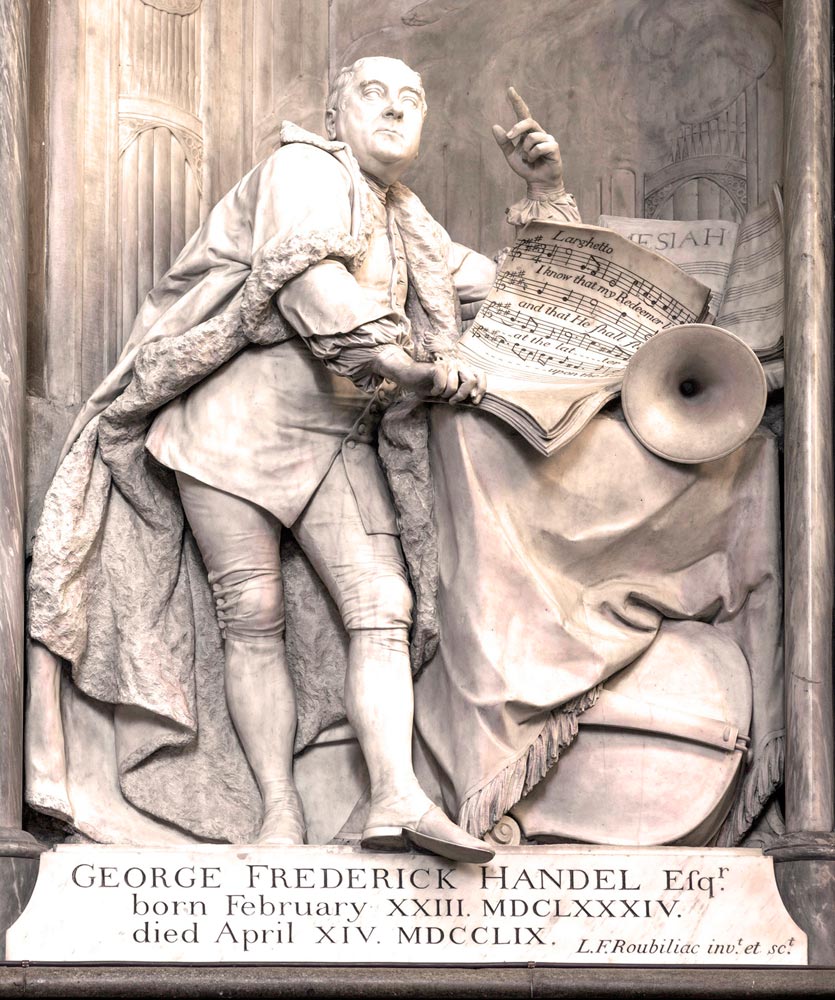
Above his grave, there is a monument, a sculpture of Handel in the act of composing his cash cow, the oratorio “Messiah.” The bear may now be in hibernation, but every Christmas – and sometimes Lent – his music lives on.
Happy birthday, Handel!
CLOCKWISE FROM LEFT: Handel memorial at Westminster Abbey; unkind caricature of the composer as a fat boar (Joseph Goupy, “The Charming Brute,” 1743); Handel threatens to throw Francesca Cuzzoni out a window (Peter Jackson, “When They Were Young: Handel the Musician,” 1966); Handel crosses swords with Johann Mathesson (Andrew Howat, “Strange Tales,” 1977)
Leave a Reply