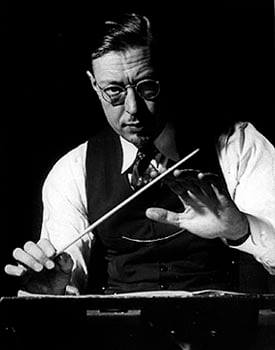
Howard Hanson, you incurable Romantic, you.
For 40 years, you were director of the Eastman School of Music. You were the recipient of the Pulitzer Prize in 1944, for your Symphony No. 4, “Requiem,” dedicated to the memory of your father.
You championed innumerable American composers, as conductor of the Eastman-Rochester Orchestra, an ensemble you founded. The lucky ones made it onto your now highly-collectible recordings for the Mercury label.
Undoubtedly, your best-known music is the Symphony No. 2, “Romantic,” composed in 1930. The trademark “Hanson sound” is one of heart-on-the-sleeve lyricism, with wistful melodies arrayed in lambent orchestration.
The Symphony No. 2 has been a great favorite in Hollywood, at least since the 1970s. How else would you have turned up in the end credits of “Alien” (1979), or been evoked in the bicycle chase and finale of “E.T.” (1982), or, most recently, been cribbed for “The Boss Baby” (2017)?
Romantic Hanson in “Alien”:
Hans Zimmer borrows for “The Boss Baby”:
John Williams’ most glorious music, for the last 15 minutes of “E.T.,” would not have been the same without your influence.
As it’s heard in the original:
“E.T.” is a brilliant score, but clearly Williams was a fan of your “Romantic Symphony.”
Happy birthday, Howard Hanson!
Romantic Symphony (complete)
Piano Concerto
“Elegy in Memory of Serge Koussevitzky”
Koussevitzky conducts Hanson’s Symphony No. 3
“Pastorale” for Oboe, Harp and Strings
Hanson conducts Henry Cowell’s Symphony No. 4, a recording that never made it to compact disc
Leave a Reply