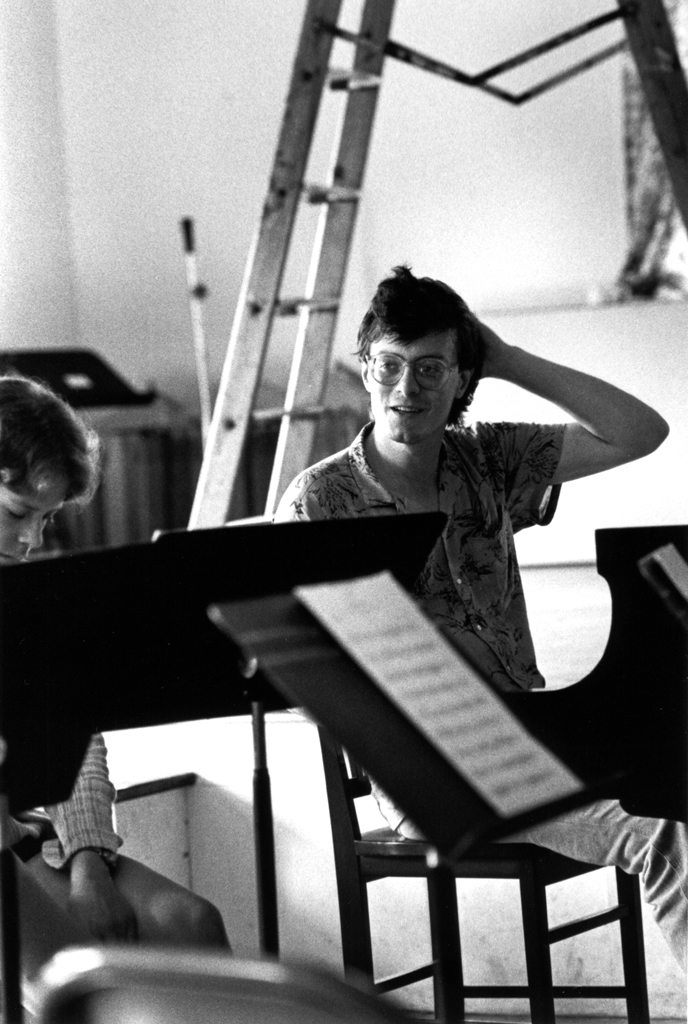
With the passing of Peter Serkin on Saturday at the age of 72, a major voice of the Marlboro Music Festival has fallen silent. On this week’s “Music from Marlboro,” we’ll pay tribute to this extraordinary artist.
Serkin was barely beyond a toddler when his father, Rudolf Serkin, and maternal grandfather, Adolf Busch, co-founded the Marlboro Music School and Festival in 1951. Rudolf Serkin, of course, was one of the great pianists of the 20th century. Busch, his frequent recital partner, was the noted violinist, composer, and anti-fascist. As you can imagine, that’s quite a legacy to have to live up to!
Naturally, the younger Serkin was absorbed into the family trade and soon developed into a brilliant musician in his own right. He was already performing in public at the age of 12. At 19, he was recognized with a special Grammy Award.
But in his early 20s, the business of making music began to ring hollow. He became frustrated with the grind of being a performer and disagreed with the way in which musicians’ interpretations were being evaluated. He decided it was time to do some serious soul-searching.
In the late ‘60s, he turned his back on the concert platform to confront bigger questions in his own life. He dropped out, traveled to India, and moved to rural Mexico to seek peace with his wife and daughter.
Then one Sunday morning, he happened to overhear Bach being broadcast over a neighbor’s radio. It was then that he felt the tug back to his true calling.
When he returned, it was with a freshness of purpose. Serkin employed his intelligence and introspection in probing more deeply into the classics and in exploring new frontiers with contemporary music.
Of all the great chamber ensembles that had their roots in Marlboro, few were more adventurous than Tashi, a group Serkin co-founded. It was a Marlboro performance of Messiaen’s “Quartet for the End of Time” that inspired him to form the group, alongside Ida Kavafian, Fred Sherry, and Richard Stoltzman. Their recording of the quartet is still venerated as the benchmark.
Among composers who wrote works specifically for Serkin were Luciano Berio, Oliver Knussen, Peter Lieberson, Bright Sheng, Toru Takemitsu, and Charles Wuorinen. He was also an ardent champion of the music of Stefan Wolpe.
We’ll celebrate Peter Serkin this evening, with two recordings tied to his Marlboro experiences.
An affection for Max Reger is something Peter held in common with his father and grandfather. He recorded Reger’s Cello Sonata No. 4 in A minor, with Mischa Schneider, at Marlboro in 1963. The composer’s characteristic tension between Baroque polyphony and fin de siècle chromaticism holds no terrors for either musician. Serkin was only 16 when he sat down before the microphones.
Then Peter will join Rudolf Serkin for an ebullient performance of Mozart’s Concerto for Two Pianos, recorded in New York the previous year, with the Marlboro Festival Orchestra conducted by Alexander Schneider.
PLEASE NOTE: This Peter Serkin tribute is too great to be confined within a single hour. Because of the musical content of this evening’s program, “Music from Marlboro” will begin FIVE MINUTES EARLIER THAN USUAL, at 5:55 EST. Set your watches and dial us up early to enjoy my scintillating intro, on WWFM – The Classical Network and wwfm.org.
Marlboro School of Music and Festival: Official Page
Leave a Reply