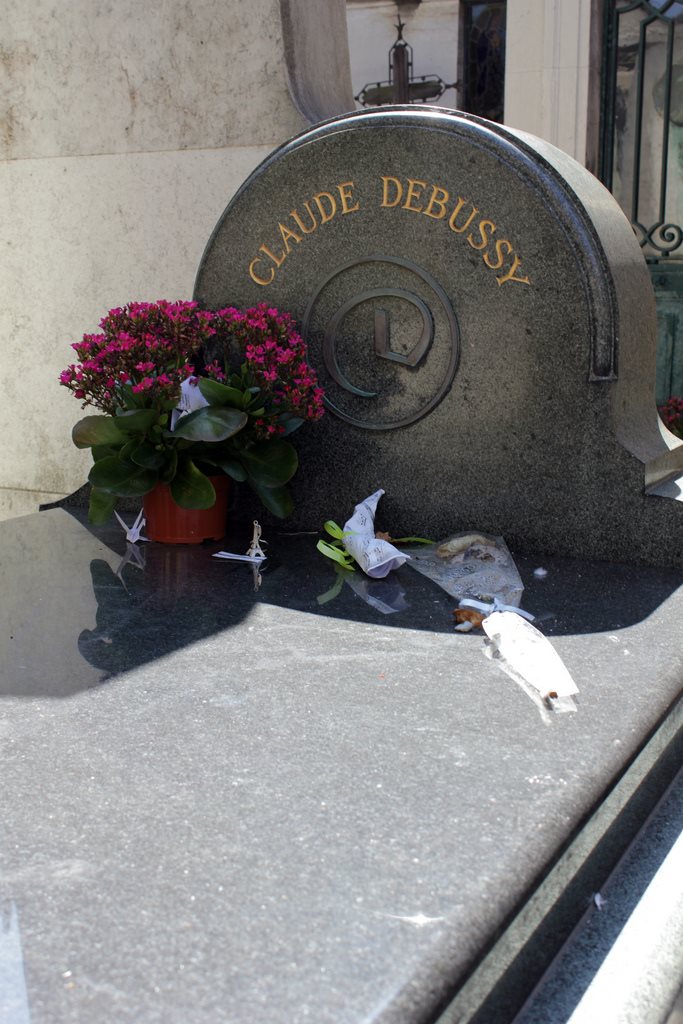
Of the two most trumpeted classical music anniversaries being observed this year, the centenary of the death of Claude Debussy has been far overshadowed by the centennial celebrations for the birth of Leonard Bernstein. I suspect this is because, in part, it’s a little perverse to celebrate somebody’s death.
Be that as it may, this week on The Classical Network, as Lenny Mania builds to fever pitch, we’ll give Debussy his due on two Noontime Concerts, when flutist Mimi Stillman, artistic director the Philadelphia-based Dolce Suono Ensemble, will join WWFM’s David Osenberg.
The programs will include music not only by Debussy, but also by some of his French contemporaries, as well as works by later composers Toru Takemitsu and Andrea Clearfield that bear his influence. In addition, there will be two world premieres, courtesy of Jan Krzywicki and Thomas Whitman.
Both concerts take their names from Debussy’s own words: “Pleasure Is the Law” will air on Tuesday (today), and “Between the Notes” will follow on Thursday. Both will commence at 12 p.m.
The broadcasts will frame Debussy’s birthday, which is tomorrow, August 22; NOT the anniversary of his death, which fell on March 25.
Then we’ll shift focus between 1:30 and 4 this afternoon, as I present Bernstein’s recording of Harold Shapero’s beautifully executed – though absurdly neglected – “Symphony for Classical Orchestra,” in which the composer succeeds in fusing the seemingly disparate worlds of Beethoven and Stravinsky. Shapero is another one of those tragic figures (tragic for us) who worried so about the power of his own muse that ultimately he abandoned composition in order to devote himself to teaching.
While Shapero’s symphony is clearly modeled on Beethoven’s 7th, the Swiss-born French composer Arthur Honegger alludes to Beethoven’s 6th, the “Pastoral,” in his own bucolic meditation “Pastorale d’été” (“Summer Pastoral”), which Bernstein will also conduct.
Finally, with the fall of the Berlin Wall, Bernstein arranged for a performance of Beethoven’s Symphony No. 9 at the city’s Schauspielhaus, inaccessible to the West behind the Iron Curtain for over 40 years. For the occasion, musicians drawn from East and West Germany joined players from representative orchestras of America, Russia, France, and Great Britain – all of which maintained a post-war presence in the divided city – for a grandly symbolic statement on Christmas Day, 1989.
Bernstein elected to swap out the word “freude” in the climactic singing of Schiller’s original text, already an ode to universal brotherhood, in favor of “freiheit,” to further underscore the entire enterprise as a grand celebration of freedom. It’s a performance that transcends criticism.
I hope you’ll join us for observations of two of the year’s biggest musical anniversaries, today between 12 and 4 p.m. EDT. Bernstein Mania is also reflected in many of our specialty shows this week. The celebration will reach its glorious apex this Friday and Saturday, on WWFM – The Classical Network and wwfm.org.
PHOTOS: Debussy at rest (left); Bernstein chips away at the Wall
Leave a Reply