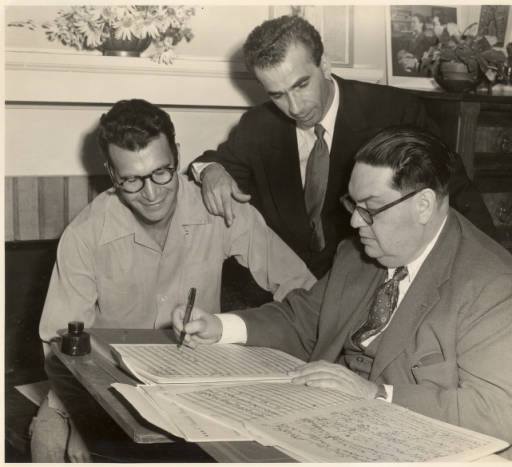
We all recognize Dave Brubeck as one of the titans of jazz. What is perhaps not so widely known is that Brubeck (like Burt Bacharach and the Grateful Dead’s Phil Lesh) was a pupil of Darius Milhaud. He also took a few private lessons with Arnold Schoenberg, though ultimately they didn’t see eye to eye.
When Brubeck disbanded his famous Quartet at the end of 1967, it allowed him more time to focus on extended orchestral and choral works. In 1968, he composed an oratorio, “Light in the Wilderness.” The next year, he wrote “The Gates of Justice,” a cantata on Biblical and Hebrew liturgical texts and excerpts from the speeches of Martin Luther King, Jr. African-American spirituals also provided inspiration, as did the words of the Jewish sage Hillel. Brubeck’s wife, Iola, supplied additional lyrics.
Brubeck was distressed in the late 1960s by what he saw as strained relations between blacks and Jews, after all that had been accomplished by the Civil Rights Movement. Following the assassination of Martin Luther King, there was much anger, fear and distrust. In general, it was a turbulent time, with the war in Vietnam and riots on university campuses lending fuel to political, generational and racial tensions in American society.
Brubeck described “The Gates of Justice” as humanistic and universal, his plea for tolerance and understanding. Brubeck himself was not Jewish, but rather a devout Catholic, from 1980 onward. However, it was his experiences in the Second World War that really triggered a spiritual awakening. He believed profoundly in the brotherhood of man, and set himself the mission of building a musical bridge between what he saw as parallel cultures.
This Sunday night on “The Lost Chord,” we’ll hear a recording of “Gates of Justice,” from the Milken Archive of American Jewish Music, on the Naxos label. Brubeck himself appears as pianist, in improvisatory passages with the rhythm section of his quartet.
There are obvious Hebraic flourishes all over the piece, including several shofar blasts at the work’s opening. It was Brubeck’s desire that, whenever possible, the tenor should be sung by a cantor, and the baritone by a black singer steeped in the tradition of spirituals and blues. The Milken recording features Cantor Alberto Mizrahi and baritone Kevin Deas.
I hope you’ll join me for “Just Brubeck” – Dave Brubeck’s “The Gates of Justice” – this Sunday night at 10:00 EST, on WWFM The Classical Network and wwfm.org.
PHOTO (left to right): Dave Brubeck, Michael Random, and Darius Milhaud
Leave a Reply