Tag: Darius Milhaud

  • Everything Old is New Again on “The Lost Chord”

    Everything Old is New Again on “The Lost Chord”

    This week on “The Lost Chord,” what’s old is new again, as we enjoy a program of 20th century music by French composers who look back to their illustrious forebears.

    In the 1870s, following France’s defeat in the Franco-Prussian war, there was a rise in musical nostalgia, with composers doing their part to mend the wounded national dignity by looking back to the galant style of the Ancien Régime – an idealized Golden Age which stood outside of Gallic history, full of shepherds and shepherdesses, panpipes and periwigs. The movement gave rise to such works as Camille Saint-Saëns’ Septet and the “Suite dans le style ancien” by Vincent d’Indy.

    50 years later, a renewed fascination with music of the 18th century took root in the 1920s, in no small part because of Stravinsky’s sudden shift to neo-classicism. This was concurrent with the rise of Les Six, a loose collective of composers who had begun to flourish in Paris. We’ll hear three of their works that sprang from a shared affection for music of the Baroque.

    One of the group’s more prominent members, Darius Milhaud, composed his “Suite d’après Corrette,” a piece for winds after 18th century composer Michel Corrette (with tell-tale “cuckoo” finale), in 1937. Eleven years later, he followed it with “L’Apothéose de Molière,” the title evocative of the spirit of Jean-Baptiste Lully. However, in this instance, the source material was culled from works by the lesser-known Baroque violinist and composer Baptiste Anet, a pupil Corelli and an elite musician in the service of Louis XIV. We’ll hear both Milhaud pieces, presented back-to-back.

    Then we’ll have a work by one of his colleagues, the only female member of Les Six, Germaine Tailleferre. In 1964, Tailleferre paid tribute to the Baroque keyboard master Jean-Philippe Rameau, on the occasion of the bicentennial of his death. “Hommage à Rameau” falls into three movements and is scored for two pianos and percussion.

    Finally, we’ll turn to Jean Françaix, who was NOT a member of Les Six, although his musical aesthetic would have fit right in. Had he been born twenty years earlier, we might be talking about Les Sept! Françaix’s “Duo Baroque,” composed in 1980, is scored for the unusual combination of double bass and harp. It pays tribute to no specific composer – in fact, for the most part, it doesn’t even sound particularly Baroque – though it does share a certain charm, wit, and elegance characteristic of music of the 18th century.

    I hope you’ll join me for “Everything Old Is New Again,” on “The Lost Chord,” now in syndication on KWAX Classical Oregon!

    ——–

    Clip and save the start times for all three of my recorded shows:

    PICTURE PERFECT, the movie music show – Friday at 8:00 PM EST/5:00 PM PST

    SWEETNESS AND LIGHT, the light music program – Saturday at 11:00 AM EST/8:00 AM PST

    THE LOST CHORD, unusual and neglected rep – Saturday at 7:00 PM EST/4:00 PM PST

    Stream them, wherever you are, at the link!

    https://kwax.uoregon.edu

  • Atreus’ Fall: Music of Vengeance and Fate

    Atreus’ Fall: Music of Vengeance and Fate

    For some of us living here in the Northeast, autumn brings with it the pleasures of baked goods, homemade soups, colored leaves, moody skies, carved pumpkins, black-and-white horror movies, used book shopping, sweaters, Brahms, and cozy cups of tea. But for the House of Atreus, “fall” meant something completely different.

    This week on “The Lost Chord,” we’ll hear music inspired by “The Oresteia,” a trilogy of surviving plays by Aeschylus that relates the impact of a curse on the House of Atreus. Dating from the 5th century B.C., the overall story arc reflects the shift from perpetual vengeance to the formation of a rational social justice system – the thinking being that man cannot hope to build a progressive civilization if he is engaged in unremitting bloodshed.

    However, along the way to that all-important message, the audience gets to have its cake and eat it, too, as it is treated to such lurid incidentals as human sacrifice, incest, adultery, filicide, fratricide, mariticide, matricide, and cannibalism. The name of the cycle derives from Orestes, who avenges the murder of his father, Agamemnon, who in turn was killed by his wife, Clytemnestra, and her lover, Aegisthus.

    The subject was a popular one with the playwrights of antiquity – it was also treated by Sophocles and Euripides – and it continues to have resonance in the present day. It is certainly very well represented in the classical music world.

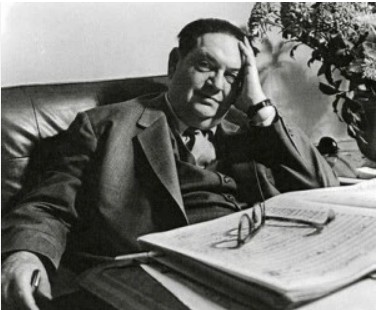
    Darius Milhaud treated all three surviving plays in the Aeschylus cycle, as “The Oresteia of Aeschylus,” which he composed over a ten year span. Combined, the cycle runs to three hours and involves over 300 singers and players. Allegedly, Milhaud considered it his greatest work.

    The second part is titled “Les Choéphores,” or “The Libation-Bearers,” referring to the women who offer up ritual sacrifices at Agamemnon’s grave. The story, the familiar one, concerns the victorious Agamemnon returning from the Trojan War, only to be murdered in his bathtub by Clytemnestra and Aegisthus.

    They go on to rule a resentful populace, with Agamemnon’s daughter, Electra, consumed by her thirst for vengeance, which is delivered eventually, upon the secret return of her brother, Agamemnon’s son, Orestes. In the meantime, Clytemnestra, racked by guilt and haunted by nightmares, attempts to appease her husband’s ghost and avert her fate by sending an offering of libations to his tomb.

    Milhaud worked with poet, playwright and frequent collaborator Paul Claudel to structure Aeschylus’ play, the second of the trilogy, into seven scenes, beginning with a threnody and concluding with a plea for justice.

    We’ll round out the hour with incidental music written by Dutch composer Alphons Diepenbrock, inspired by Sophocles’ “Electra.”

    Comedy tomorrow, tragedy tonight! Join me for “Fall at the House of Atreus.” That first step’s a doozy, on “The Lost Chord,” now in syndication on KWAX, the radio station of the University of Oregon!


    Clip and save the start times for all three of my recorded shows:

    PICTURE PERFECT, the movie music show – Friday at 8:00 PM EDT/5:00 PM PDT

    SWEETNESS AND LIGHT, the light music program – Saturday at 11:00 AM EDT/8:00 AM PDT

    THE LOST CHORD, unusual and neglected rep – Saturday at 7:00 PM EDT/4:00 PM PDT

    Stream them, wherever you are, at the link!
    https://kwax.uoregon.edu/


    PHOTO: The fall has seldom been so grim

  • Shana Tova & Milhaud’s Jewish Music

    Shana Tova & Milhaud’s Jewish Music

    Shana tova! Wishing a sweet 5786 to all who celebrate.

    As a classical music radio host, I’ve had many opportunities to broadcast selections from a fascinating 50-CD box set assembled from the Milken Archive of American Jewish Music for Naxos Records. (I believe these were also issued separately.) I do not own the box, but over the years, I’ve managed to collect most of the individual discs for my own library. Of course, the set was not intended to be comprehensive – how could it be? – but Milken (founded in 1990) continues its mission to document, preserve, and disseminate a vast body of music related to the American Jewish experience – including, among others, historical and traditional music associated with synagogue and seder, songs of a more secular nature for the Yiddish theater, and classical concert music.

    One Milken revelation was a string quartet by Darius Milhaud, best known in classical music circles as one of the group of iconoclastic French composers that gained notoriety in Paris in the 1920s as “Les Six.” This loose collective followed in the footsteps of Erik Satie in subverting the pretensions of the concert hall. Les Six pushed back against miasmic Wagnerism of the fin de siècle era, employing the lighter textures and lucid forms of neoclassicism, and often emulating the breezy, contemporary ambience of café, boulevard, and circus. In Milhaud’s case, he also really leaned into the popular music of Brazil, which he encountered while serving as secretary to ambassador Paul Claudel. Another enthusiasm was the music of his native Provence (hence, the “Suite provençale”).

    Less well-known is his connection to his Jewish heritage. Milhaud was born into a long-established family of the Comtat Venaissin (County of Venaissin, an enclave surrounding the city of Avignon), with roots traceable to the Middle Ages. The Comtat’s Carpentras synagogue, built in the 14th century, is the oldest in France. Interestingly, Milhaud’s lineage on his father’s side was neither Ashkenazi nor Sephardi, but rather uniquely Provençal – possessing its own historical and cultural traditions – as the settlement dates to the early Common Era. Milhaud’s mother was partly Sephardi on HER father’s side, by way of an Italian forebear.

    Milhaud wrote several works on Jewish themes. His “Études sur des themes liturgiques du Comtat Venaissin” (“Studies on Comtat Venaissin Liturgical Themes”) incorporates melodies from the region’s Rosh Hashanah and Yom Kippur observances. It was composed on a commission from the Braemer Foundation of Philadelphia. In light of his unusual heritage, Milhaud was asked to distill his memories of family celebrations and services at the synagogue in Aix-en-Provence into a string quartet. The work received its premiere at Congregation Adath Jeshurun in Elkins Park, just outside Philadelphia, in 1973. Milhaud died in 1974 at the age of 81.

    Enjoy the music here:

    Learn more about it:

    https://www.milkenarchive.org/music/volumes/view/intimate-voices/work/etudes-sur-des-themes-liturgiques-du-comtat-venaissin/

    More from the Milken Archive:

    https://www.milkenarchive.org/

  • Bruckner Milhaud Same Birthday Opposites

    Bruckner Milhaud Same Birthday Opposites

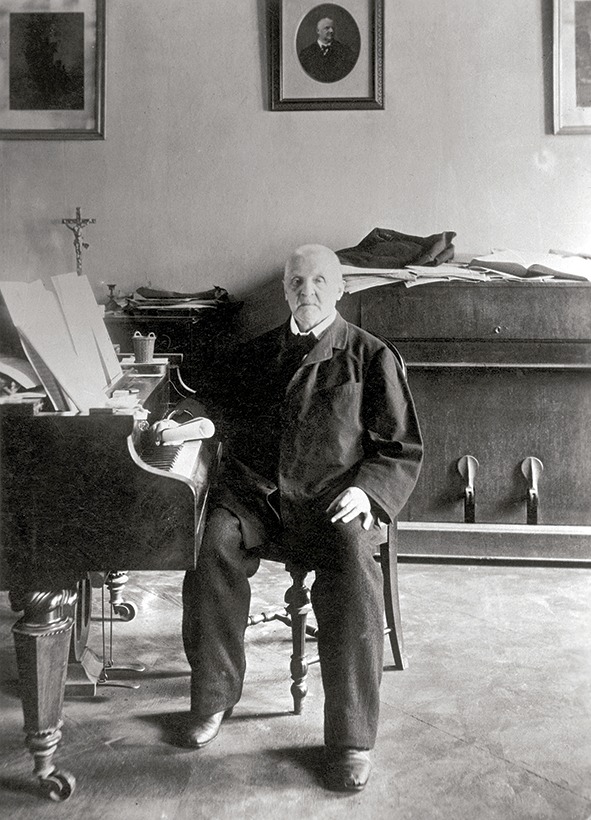
    I never had much truck with astrology. Otherwise, how do you explain Anton Bruckner and Darius Milhaud being born on the same date?

    Bruckner (b. 1824), socially awkward and profoundly devout, always aspiring to the sublime in his music, mostly through grand forms such as the symphony and the mass; and Milhaud (b. 1892), bon vivant, a member of Les Six, churning out hundreds of pieces, against the better judgment of classical greybeards embracing a wide variety of often “lowly” influences (café music, jazz, folk song).

    These are generalizations, of course – Bruckner dabbled in piano quadrilles and Milhaud wrote some pieces inspired by the Jewish liturgy – but by the most casual assessment, the men and artists were opposites. And thank goodness for it. The world of music would be a colorless place, if it were all church pews or boeufs-sur-les-toits.

    Artistic temperament, dear Brutus, is not in our stars, but in ourselves.

    Happy birthday, Anton Bruckner and Darius Milhaud.


    Barenboim’s brassy Bruckner in Chicago

    Buoyant, bearded Bernstein conducts “Le boeuf sur le toit”

  • Happy Birthday Robert Moran Composer & Friend

    Happy Birthday Robert Moran Composer & Friend

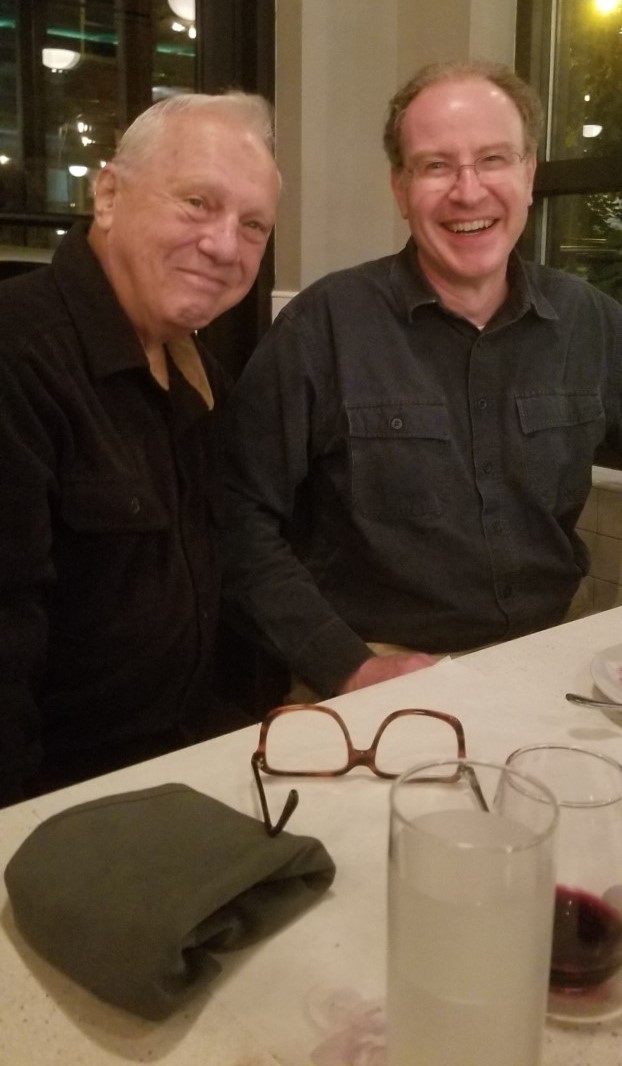
    Today is the birthday of my good friend and steadfast companion for Mahler concerts at the Philadelphia Orchestra, composer Robert Moran. A pupil of Darius Milhaud, Luciano Berio, and Hans Erich Apostel, Bob’s experimented with all kinds music, from city-encompassing performance art “happenings,” to collaborations with Philip Glass, to commissions from Houston Grand Opera, Scottish Ballet, and Trinity Wall Street. Throughout his career, he’s often been fascinated by spatial effects in music. This is one of his more recent works, “Solenga,” from 2023:

    Bob, if you see this, I’ve been trying to contact you. My computer died the other week and my email account is now over the storage limit, so I can’t write. I’ve been trying to phone, but of course you don’t have voice mail. (Come to think of it, neither do I!) But you can call me, text, or private message me on Facebook, if you are so moved. There’s a dinner invitation in it for you. Happy birthday!


    An aria from Bob’s Beauty and the Beast opera, “Desert of Roses”

    Selections from “Trinity Requiem,” for the tenth anniversary of 9/11

    Flying high over Albania

    “Alice” for Scottish Ballet

    Looking groovy and introducing his “Lunchbag Opera” for the BBC

    “Buddha Goes to Bayreuth,” Part 1

    “Buddha Goes to Bayreuth,” Part 2

    “Modern Love Waltz” by Philip Glass, arranged by Robert Moran for accordion and cello

    “Waltz. In Memoriam Maurice Ravel”

Tag Cloud

Aaron Copland (92) Beethoven (95) Composer (114) Film Music (123) Film Score (143) Film Scores (255) Halloween (94) John Williams (187) KWAX (229) Leonard Bernstein (101) Marlboro Music Festival (125) Movie Music (138) Opera (202) Philadelphia Orchestra (89) Picture Perfect (174) Princeton Symphony Orchestra (106) Radio (87) Ralph Vaughan Williams (85) Ross Amico (244) Roy's Tie-Dye Sci-Fi Corner (290) The Classical Network (101) The Lost Chord (268) Vaughan Williams (103) WPRB (396) WWFM (881)

DON’T MISS A BEAT

Receive a weekly digest every Sunday at noon by signing up here


RECENT POSTS