They say that still waters run deep.
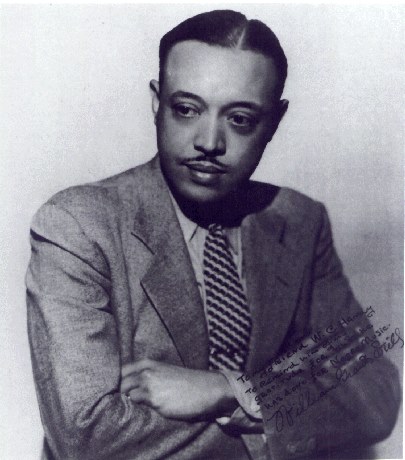
William Grant Still, the so-called “Dean of Afro-American Composers,” composed a lot of attractive music, much of it informed by the black experience. This Sunday night on “The Lost Chord,” we’ll hear Still’s delightful Symphony No. 2, subtitled “Song of a New Race,” and a more serious work fueled by racial considerations, “And They Lynched Him on a Tree,” for double-choir, narrator and orchestra.
Still, who lived from 1895-1978, emerged from unlikely circumstances – born in Woodville, Mississippi; raised in Little Rock, Arkansas – to become a major force in American music. Having abandoned a career in medicine for studies at the Oberlin Conservatory of Music and the New England Conservatory in Boston, where he studied with George Whitefield Chadwick, Still was a “first” in many respects.
His Symphony No. 1, the “Afro-American Symphony,” was the first written by a black composer to be performed by a major orchestra (the New York Philharmonic). He was the first to be given the opportunity to conduct a major orchestra (the Los Angeles Philharmonic, at the Hollywood Bowl). His opera, “Troubled Island,” became the first to be produced by a major company (the New York City Opera). Another of his operas, “A Bayou Legend,” was the first to be performed on national television (as late as 1981). His works were performed internationally by the Berlin Philharmonic, the London Symphony Orchestra, the BBC Symphony, and the Tokyo Philharmonic.
Perhaps the least likely pupil of Edgard Varèse, he incorporated jazz and blues elements into his concert music. He cut his teeth writing arrangements for Paul Whiteman, W.C. Handy and Artie Shaw. According to Eubie Blake, one of Still’s improvisations in the pit band during Blake’s revue “Shuffle Along” became the basis for Gershwin’s hit tune “I Got Rhythm.” Still didn’t appear to be bitter about the appropriation (which Blake conceded was probably inadvertent), and in fact Still and Gershwin were on friendly terms and made it a point to attend performances of one another’s music.
Pay particular attention to the second movement of Still’s Symphony No. 2, first performed in 1936 by Leopold Stokowski and the Philadelphia Orchestra, and see if you agree that Gershwin would have killed to have composed its second movement.
We’ll follow that with a very different piece, Still’s choral ballad “And They Lynched Him on a Tree,” composed in 1940. The libretto is by the poet Katherine G.C. Biddle, the niece of Charlotte Mason, the so-called “Godmother of the Harlem Renaissance.” The work calls for a contralto soloist, as the mother of the victim, a “white chorus” to depict the mob, a “black chorus” to discover the lynching, a narrator, and a small orchestra. The composition is almost exactly contemporary with Abel Meeropol’s “Strange Fruit.” It was given its first performance by the New York Philharmonic, conducted by Artur Rodzinski.
There will be just a few minutes left at the end of the show, during which we’ll decompress with Still’s miniature “Summerland.”
I hope you’ll join me for “Still Runs Deep” – an hour of music by William Grant Still – this Sunday night at 10 ET, with a repeat Wednesday evening at 6; or that you’ll listen to it later as a webcast at wwfm.org.
Leave a Reply