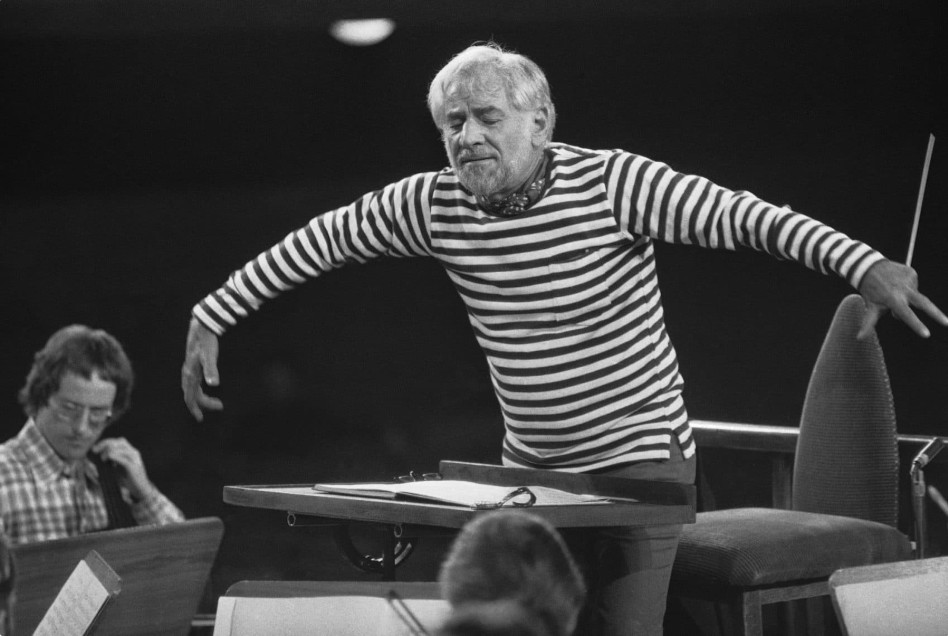
I’m not sure elegance is near the top of anyone’s list when they consider the attributes of Dionysian Leonard Bernstein. I mean, he could cut a dapper figure, especially during the “matinee idol” years of his youth and early middle-age. He spoke well, and at concert time or before the cameras, he was invariably well-dressed, with that hair and that cigarette, seductively cool in black and white. But by the 1970s, he started to let it all hang out. That’s when he would show up at rehearsal dressed like a French wharf rat, all stubbly, in a striped sailor shirt and neckerchief. You be you, Lenny.
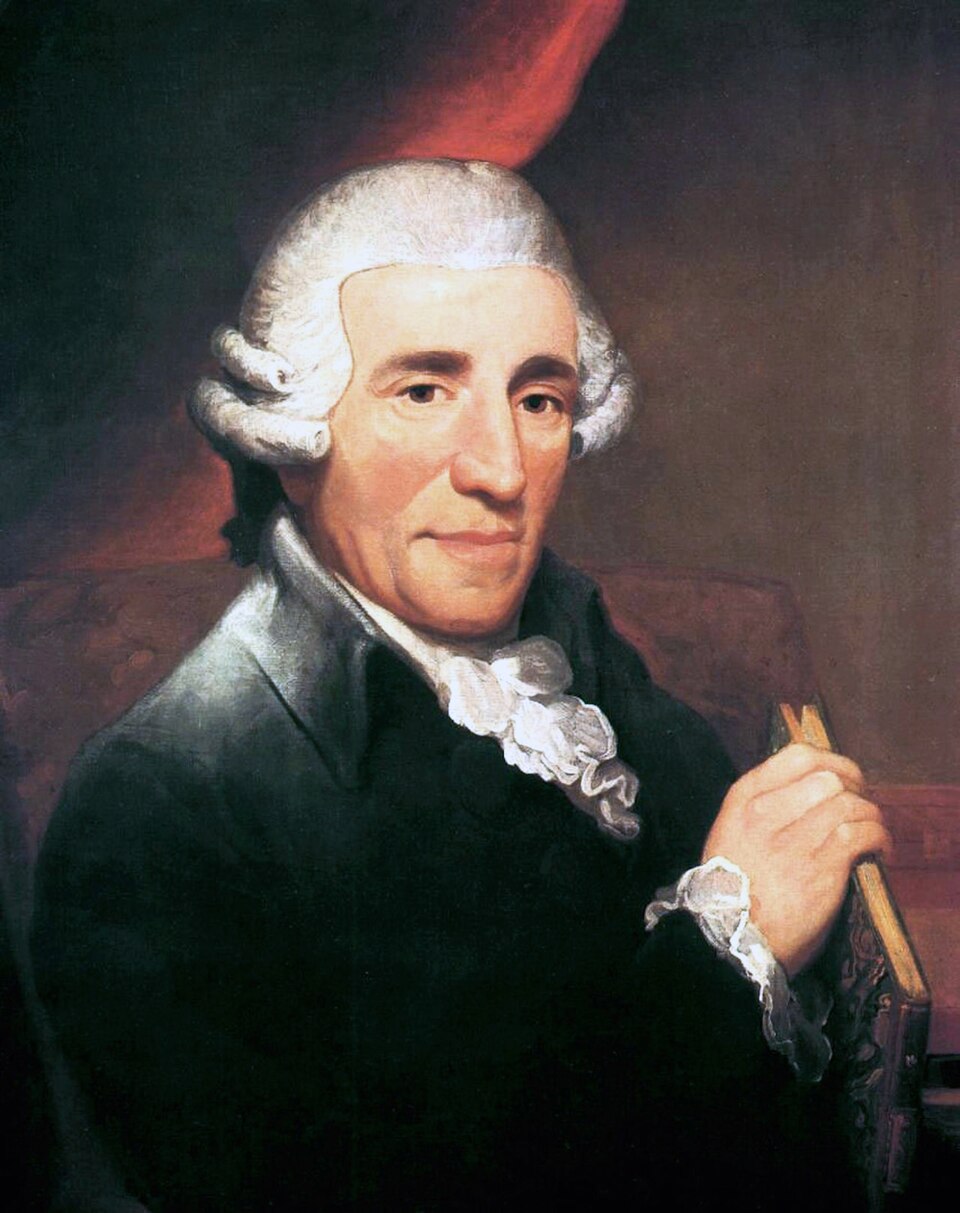
But a strange synergy occurred whenever he conducted the music of Franz Joseph Haydn. Haydn, that most elegant of composers – except when he wasn’t (cue flatulent bassoon jokes) – virtually invented the modern symphony, or perfected it anyway. During the Classical era, it adhered to some pretty strict rules – which Haydn would then either humorously or dramatically manipulate or subvert.
In the arts, it was once common knowledge that the way to freedom was through order. Once you internalize the rules and master the technique, you can pretty much do whatever you want. And no one knew his way around the symphony better than Haydn. He composed at least 106 of them (104 of them numbered) over a period of about 40 years. That’s an astronomic level of devotion to a single form, and it was far from Haydn’s exclusive focus. (He’s also credited as the father of the modern string quartet.)
Bernstein, of course, developed a reputation for bringing great energy and involvement to highly subjective interpretations of music by composers such as Gustav Mahler. At his most thrilling, his identification with the composer could be so complete, it was as if he was creating the music himself. That doesn’t always mean his “identification” was exactly what the composer had in mind. But, totally unexpectedly, this celebrated proponent of some of the most flamboyant music in the repertoire turned out to be an outstanding Haydn interpreter.
Bernstein’s Haydn is marked by great fluency and fun. He just GOT him, and I suspect there wasn’t a hell of a lot of analytical thinking behind it. The way we all just click with certain people and not with others – that’s how it was with these two. The high priest of emotional truth saw past the formal principles of the 18th century to Haydn the man and totally grokked where he was coming from. Haydn at his best is not a dry or boring “textbook” composer. He was a living, breathing human being, full of clever ideas, subject to a range of emotions, and brimming with good humor.
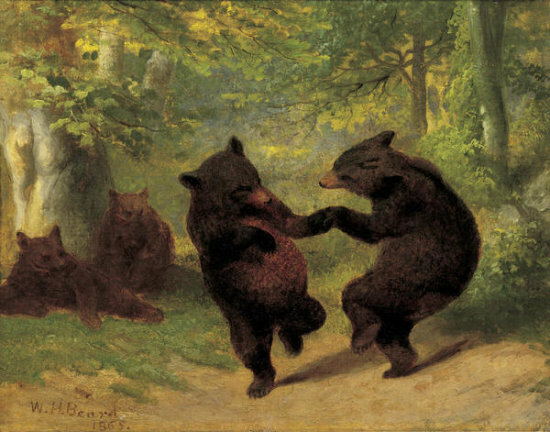
Whenever I need a lift, I need look no further than Lenny’s recordings of the “Paris” Symphonies. Of these, the Symphony No. 82, subtitled the “Bear,” is perhaps my favorite. Bernstein’s “Bear” (not to be confused with a Berenstain Bear) is a treasure, energetic, lyrical, and exhilarating.
FUN FACTS: The first performance was conducted by Joseph Bologne, Chevalier de Saint-Georges. Saint-Georges was a talented athlete, a respected swordsman, and the first classical composer of African descent to achieve widespread acclaim in Europe.
The symphony’s nickname, the “Bear,” was bestowed not by Haydn, but by someone else, picking up on the repeated drone in the work’s finale. In those days, dancing bears were accompanied by bagpipes as a popular form of street entertainment. See if you can hear the dancing bear in the fourth movement of Haydn’s symphony.
https://www.youtube.com/watch?v=3SjNmqj0czM
When it comes to Lenny’s Haydn, there’s also this precious document, in which he conducts the last movement of the Symphony No. 88 – with his eyes! Of course, he does it as an encore. For the complete performance, you can scroll back to the beginning of the video.
https://www.youtube.com/watch?v=bXEldU1UC70&t=1511s
Want more? Here you go: the “Paris” Symphonies (82-87), the Symphony No. 88, and from the “London” Symphonies, the Symphony No. 93 (with a flatulent bassoon joke in the slow movement), the Symphony No. 94 (the famous “Surprise” Symphony), and the Symphony No. 95. The collection starts with the “Bear.” You can either skip over it or revel in it all over again.
https://www.youtube.com/watch?v=VOrjmUI5f9Y
Happy birthday, Haydn!
Leave a Reply