As the greatest pianist of his day – in fact, the inventor of the modern piano recital – Franz Liszt was so “Hollywood” before there was such a thing. A master showman, he mesmerized audiences with superhuman transcriptions and paraphrases, whipping them into frenzies. Ladies forgot their manners and rushed the stage. Skirmishes broke out, as they wrestled for his gloves and cigar butts, carelessly, calculatedly, left behind. He enjoyed enormous fame, accumulated staggering wealth, and engaged in prodigious love affairs.
That’s not to say he lacked substance. He knew he was more than a vulgar showman, and he was eager to explore other avenues. He may have been a man who savored the privileges of celebrity, but he was also an intellectual and an artist of the spirit. At the age of 35, he simply walked away. The most legendary keyboard titan of the Romantic era would reinvent himself as one of the most innovative musical thinkers who ever lived.
He pioneered a technique known as thematic transformation, a radical departure from Classical sonata form. He is also credited with having created the symphonic poem. Without Liszt, there would have been no Wagner as we know him. In fact, Romantic music would have had to find its own way. His later works at times anticipate the experiments of the 20th century, by composers as diverse as Debussy, Scriabin, and Schoenberg. “My sole ambition as composer,” he once pronounced, “is to hurl my lance into the infinite space of the future.”
He was also extraordinarily generous. He never took payment from any of his pupils. He programmed the operas of Wagner and Berlioz, when nobody else would touch them. He selflessly promoted the works of Grieg, Smetana, Debussy, Saint-Saëns, Fauré, Borodin, and many others. He was lured back to the concert stage only for charitable purposes – for the relief of victims of fire and flood, in support of political refugees, and to raise money for a Beethoven monument in Bonn.
For his pains, he was unrelentingly lambasted by critics and intrigued against by jealous rivals. At various points throughout his career, he was dismissed for pandering to the mob, ridiculed as a charlatan and a hypocrite, and shunned for his long-term relationships with two women who fled troubled marriages.
Yet there is a depth and spirituality in his greatest music that defies all charges. Liszt may have been something of a glamor puss, but he was not a shallow man. He was an intellectual, and he was also devoutly religious, even to the point of taking minor orders and living in a cell in Rome. In all, he was a fascinating amalgam of charlatan and visionary, sinner and saint, peacock and messiah.
Is it any surprise that such a figure would capture the imagination of filmmakers? And yet seemingly few – perhaps none – have done him justice.
Many actors have played him, among them Dirk Bogarde (“Song without End”), Henry Daniell (“Song of Love”), Julian Sands (“Impromptu”), and most notoriously, Roger Daltrey (“Lisztomania”).
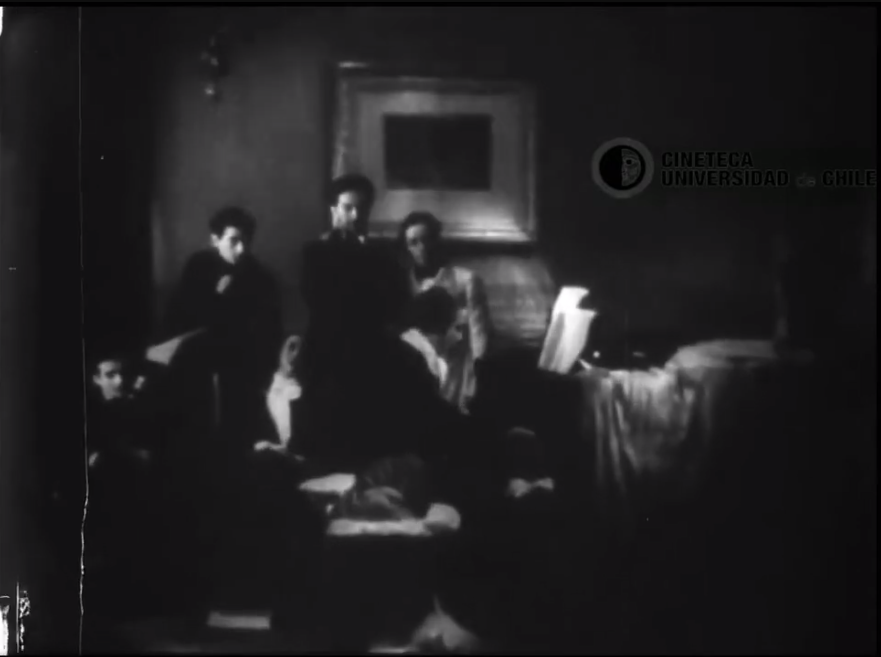
Here’s a remarkable discovery that perhaps at last succeeds: the pianist Claudio Arrau plays, as in acts the part of, Liszt in a 1935 Mexican film, “Sueños de Amor” (“Dreams of Love”), the title a translation of the composer’s famous piano work of the same name, the third of three collected as “Liebestraüme.” Keep in mind, this was only 49 years after Liszt’s death!
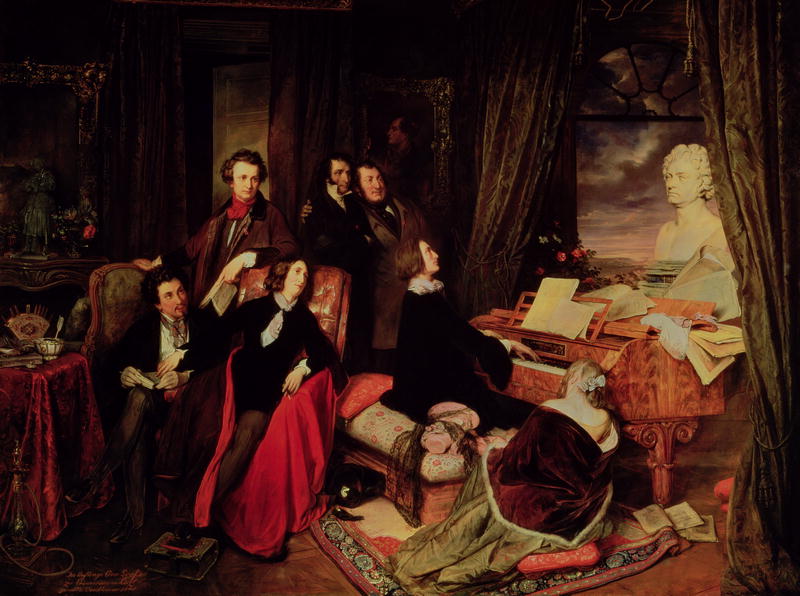
In this clip, Arrau performs “Un sospiro” (“A Sigh”), in character, in a scene evidently meant to recall the famous painting, “Liszt at the Piano,” by Josef Danhauser.
I’ve yet to watch it, but here’s the complete film.
Arrau was not the only world-class pianist to play Liszt in a movie. A couple of years ago, I posted about Sviatoslav Richter, one of the great Liszt interpreters, who played him in a Soviet film about Mikhail Glinka.
https://rossamico.com/2024/10/22/liszt-on-film-richter-bogarde-daltrey-more/
A couple of months after that, I posted some reflections on Danhauser’s painting
https://rossamico.com/2024/12/16/liszts-piano-beethovens-ghost-romantic-salon/
Arrau plays Liszt’s “Liebestraum No. 3”
Liszt, who studied with Carl Czerny (who in turn studied with Beethoven), taught Martin Krause, who taught Arrau. It’s crazy how short history is.
Happy birthday, Franz Liszt!
Leave a Reply