If you needed a reminder of just how good an orchestra the Princeton Symphony Orchestra is, you needed look no further than this past weekend’s concerts, in which the ensemble played two new works with such commitment that you would have sworn that they are standard repertoire.
“Extra(ordinarily) Fancy,” composed in 2019-20 by Princeton alumnus and Curtis graduate Viet Cuong is so much fun, it would not have been out of place among the riotous offerings on a Hoffnung Music Festival concert. Except, unlike the works on those overtly comedic outings, the piece never descends into parody. What we have are two oboe soloists, positioned before a chamber orchestra, complete with harpsichord continuo, embarking on what seems like a piece of ersatz Baroque music, but soon engaging in a battle of wills as one of the oboists decides to spice things up with multiphonics (an extended technique in which the player produces multiple tones at once).
The contagion creeps across the entire orchestra, augmented by xylophones, Leroy Anderson “Sleigh-Ride” style slapsticks, and bass drum. It also ramps up the dance inflections inherent in the ordinarily somewhat lugubrious Baroque passacaglia (itself with roots in courtly dances of 17th century Spain). The soloists, PSO principal oboist Lillian Copeland and Erin Gustafson struck just the right tone, metaphorically speaking, with first rate musicianship and some playful reactions to the discords, employing just enough restraint to get the humorous point across without distracting from the music with too much mugging. Furthermore, at ten minutes, the piece does not outstay its welcome. It’s a great curtain-raiser and deserves wider popularity.
That was followed by the world premiere of a new harpsichord concerto by Princeton resident Julian Grant. The title, “Vaudeville in Teal,” is meant to tip us off not to expect a three-movement concerto in the classical mold, but rather a kind of sequence of varying moods and character that Grant sees as musically analogous to the vaudevilles that were popular around the turn of last century.
As he described it to me when we discussed it last week, “It’s rather like a show with lots of disparate acts. You know, like the old-fashioned vaudevilles used to be. You’d have someone come on and do bird impressions, there’d be a flea circus from Russia, Anna Pavlova would do ‘The Dying Swan,’ you know. Some singer would come on and sing ‘O sole mio.’ I just imagined that the piece would be kind of slightly random sections.”
The movements are given one-word titles, some of them rather whimsical especially in relation to the content: “Curtain,” “Tarantella,” “Threesome,” “Fairies,” “Spiel,” and “Follies.” These flow into one another without break.
Despite the droll concept, you’d have to listen hard to detect anything arch or campy in the music itself. For all Grant’s playfulness, there’s no question it’s a serious piece. Moreover, it is a much more cohesive work than the “vaudeville” conceit would suggest. At the core of Grant’s musical output are 20 operas. So attuned is he to a sense of line that I think it must have carried over to his episodic concerto.
The work is ingeniously scored for harpsichord, string orchestra, obbligato bass clarinet, and bassoon, as the handling of these self-imposed “restrictions” proved masterful. Who knew there could be so many colors to be drawn from such a limited palette? (Speaking of color, the use of “Teal” in the title is much less mysterious than it might at first be assumed: it’s the color of Grant’s harpsichord!) Furthermore, the composer deploys his forces in such a way that he repeatedly sidesteps a major pitfall in writing for such a conversational instrument, as it could easily be drowned out by a modern orchestra. It was fascinating to observe all the ways he managed to address this potential limitation. Even so, the harpsichord was unobtrusively amplified.
Principal clarinetist Pascal Archer (on the bass clarinet) and principal bassoonist Brad Balliett played, alone and in tandem, with gorgeous, often ruminative expressiveness throughout. In fact, everyone was given ample opportunities to shine. The work begins and ends with a figure on double bass, played on the weekend concerts by PSO principal John Grillo. Grillo also had a significant part in “Threesome,” as one third of a trio with bassoon and harpsichord. Concertmaster Basia Danilow was required to step up, figuratively speaking, for glinting solos in “Tarantella” and “Follies.” Periodically the atmospheric strings would snap into focus for satisfying passages that seem to share a spiritual kinship with Béla Bartók and Benjamin Britten. “Spiel” was a spotlit moment for harpsichord alone.
The bass contribution was not the only recurring signpost. There was also a unifying three-note motif to help orient the listener and a kind of recitative played on the harpsichord, notably at the beginning of “Threesome” and again toward the end of the piece.
The eminent harpsichordist Mahan Esfahani was seated in profile to the audience. (Often in Baroque music, the instrument is at the center of the orchestra, with the player facing forward, the keyboard hidden, as was the case in Cuong’s piece.) Esfahani did not play the fabled teal harpsichord, but rather another instrument from the same company, black on the outside, but the raised lid revealing a painted maritime scene.
This was not your great-great-great-great-great-great-great-great-great-great-grandparents’ harpsichord concerto. Esfahani played with the commitment and intensity of a piano soloist, several times rising in the bench as if it were a saddle on a galloping horse because of the expressive demands of the piece. Virtuosic fingerwork on two manuals produced subtle shifts in timbre, especially in moments when he played croisée (depressing notes on the two keyboards at the same time) or repositioned stop levers, kind of like an organist, making the instrument sound more like a lute or a harp. In addition, he frequently adjusted the upper keyboard to engage the instrument’s coupler mechanism (that couples the manuals together).
I should mention, the concerto was actually commissioned by the Manitoba Chamber Orchestra and its music director Anne Manson, who will perform the work with Esfahani this Wednesday (tomorrow) in Winnipeg. That Princeton was granted the premiere was due to a combination of logistics, Esfahani’s flexibility, and Manson’s generosity, as well as her long relationship with the composer.
It says something about how stimulating the music and performances were on the concert’s first half that Igor Stravinsky’s “Pulcinella” – presented after intermission in its rarely-heard complete form – came across, to this listener anyway, as somewhat anticlimactic. Don’t get me wrong: I love “Pulcinella.” As I’ve commented before, this is Stravinsky for people who don’t like Stravinsky, a ballet based on what the composer thought were tunes of Baroque master Giovanni Battista Pergolesi (since found to be misattributed). It’s endlessly melodic, frequently buoyant, and ultimately uplifting music. Stravinsky brings the 18th century source material up to date through the playful use of 20th century rhythms, cadences, and harmonies. It is indeed a felicitous, time-hopping marriage.
Even so, the composer took all the best music and put it into a more frequently-performed concert suite (which the PSO has done in the past), and I can’t say the vocal parts really add all that much to it. That’s not to cast shade on the concert’s soloists, soprano Aubry Ballarò, tenor Nicholas Nestorak, and bass-baritone Hunter Enoch, who did well with what they had to do. Ballarò has a lovely voice, which she employs beautifully, but the words were somewhat lost, even in the intimate setting of Princeton University’s Richardson Auditorium, in a pastoral solo about a pining shepherdess. (The text is in Italian anyway, and there were supertitles throughout.) However, she blossomed in duets or trios with the men’s more powerful instruments.
Ballarò and Nestorak are veterans of the Princeton Festival. She sang Fiordiligi in “Cosi fan tutte” in 2024, and he appeared as Supreme Court Justice Antonin Scalia in Derek Wang’s “Scalia/Ginsberg” in 2022 and as Spoletta in “Tosca” last year. Next month, Ballarò will sing Violetta in “La traviata” at Opera Columbus, with the PSO’s Rossen Milanov in the pit. Earlier this season, she performed Strauss’ “Four Last Songs” under Milanov’s baton with the Chautauqua Symphony Orchestra. Ballarò and Nestorak will reunite with Milanov and the Columbus Symphony in May to perform Carl Orff’s “Trionfo di Afrodite” (“Triumph of Aphrodite).
Nestorak has been on the roster of the Metropolitan Opera since 2021. Enoch, with his pleasingly resonant voice, recently sang in Fabio Luisi’s “Ring” Cycle with the Dallas Symphony Orchestra, even stepping in for Mark Delavan to cover Wotan! The “Ring” performances are being prepared for commercial release.
Back in Princeton: It was a joy to have Copeland and Gustafson, the oboe soloists in Viet Cuong’s piece, back in the woodwind section for “Pulcinella.” They engaged in a few duets there, as well, and Copeland brought an extra degree of elegance to her solos. All of the winds and brass had their moments, but the trombonist, Connor Rowe, really stole the show, thanks in no small part to Stravinsky’s writing, but he definitely brought something extra to it.
Milanov conducted with his usual fluency, at his best possibly in Grant’s piece, which, as a world premiere, had to be deciphered and put together very quickly. It required an opera conductor’s sense of spontaneity and flow to really allow the solos and the interplay with the various instruments to really breathe. It was expertly managed. “Pulcinella” was well-played and, again, a very good performance, but I have heard others with more snap. This is not a technical criticism, merely an interpretive observation. The piece was presented with clarity and grace, wholly befitting its Baroque antecedent, but with less emphasis on Stravinsky’s obsessive rhythmic precision and bite.
All quibbling aside, this might just have been the most stimulating of the PSO’s concerts this season. To paraphrase “Henry V,” those who missed it (still a-bed on account of the time change, perhaps?) should think themselves accursed and hold their manhoods cheap.
The PSO will conclude its season at Richardson on May 9 & 10, with Aaron Copland’s “Letter from Home,” Camille Saint-Saëns’ Cello Concerto No. 1 (with soloist Maja Bogdanović), and Sergei Prokofiev’s Symphony No. 5.
For more information and a look at the orchestra’s 2026-27 offerings, visit princetonsymphony.org. (See the dropdown menu under “Tickets and Events.”)
Category: Concert Reviews
-

Beguiling New Music with the Princeton Symphony Orchestra
-
John Williams’ Piano Concerto at the New York Philharmonic
It wasn’t until 6 p.m. Saturday that it occurred to me I might have a concert in New York City on Sunday. The thought popped into my head as I was adjusting some magnets on the refrigerator in order to lift the page on the calendar and have a glimpse at March.
Huh. No musical events listed until the weekend.
But I knew I had committed to see Emanuel Ax perform John Williams’ new piano concerto at the New York Philharmonic, and I thought it was sometime around the beginning of the month. So I went to the calendar I carry with me in my computer bag, and lo and behold, there it was, scrawled on March 1, at 2 p.m. Somehow I had missed it when copying over my appointments to the other calendar!
How could that possibly happen? If you’re wondering why it didn’t pop up on my Google calendar, then you really don’t know Classic Ross Amico. I still chisel all my commitments onto stone tablets.
Be that as it may, my mind immediately shifted into business mode. Should I drive or take the train? What time should I leave? What do I need to do in the morning? If I drive, where do I park? Where should I grab lunch? What should I eat, and when, in order to satisfy hunger without inducing drowsiness during the performance? How should I time my afternoon coffee? Shouldn’t I be thinking about getting to bed?
In the end, I decided to drive. Meters are free in New York on Sunday, and it turned out to be a lovely day, weather-wise, despite a chance of rain and snow in the morning forecast. So I zipped in, in about 70-75 minutes, Giuseppe Sinopoli conducting the “Enigma Variations” on my CD player, and parked on the street, a stone’s throw from Lincoln Center, at around 12:30. A grab-and-go lunch later, I had strolled as far north as Verdi Square, to have a glimpse at the monument in the March Sunday sunshine, despite a chill in the air, its warm glow promising the imminent arrival of spring. I visited the Strand Bookstore at its satellite at 2020 Broadway to grab a cup of coffee and run my eye over the sidewalk stalls, and then headed back down to Geffen Hall by 1:30.
There, I met my concert companion, H. Paul Moon, who was very kind to make all the ticket arrangements, and we made our way to our seats on the second tier, stage right (the left side of the auditorium). How narrow and perilous the path was, with a single row of seats angled for an easier view of the stage and a low rail beckoning me to just end it all already.
But I resisted.
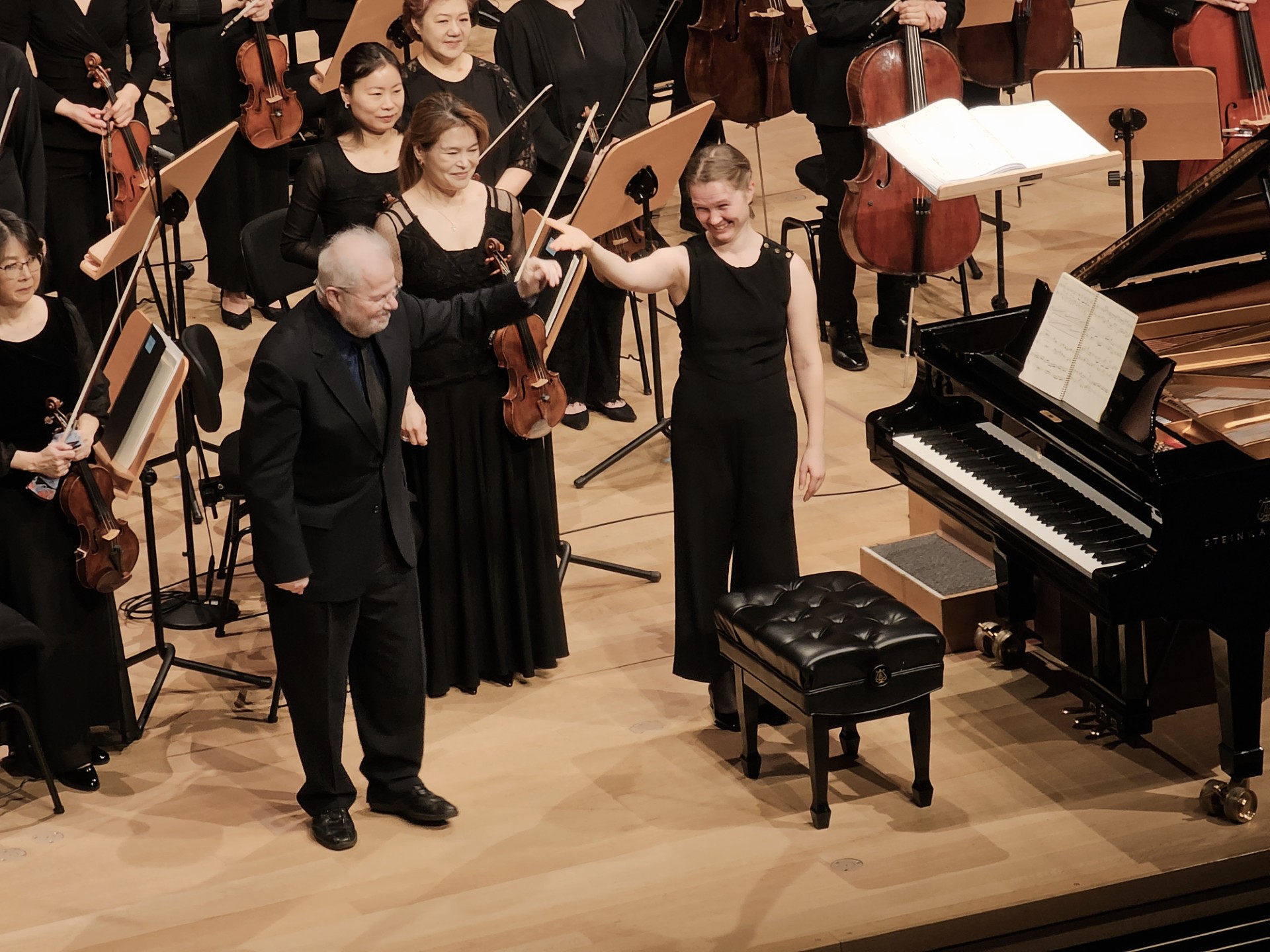
The conductor of the program was the somewhat elfin Lithuanian Mirga Gražinytė-Tyla, a Dudamel protégée in Los Angeles, who spread her wings as music director of the City of Birmingham Symphony Orchestra. Youthful and expressive, at times capricious even, she manages to stay tethered to reality, with interpretive decisions that seem grounded in practicality. It’s afterward, as she acknowledges the musicians, that she extends an open palm to the various sections and players, as if to offer them fey honey cakes.
The concert opened with Ralph Vaughan Williams (yay!): his “Fantasia on a Theme by Thomas Tallis,” with nine string players sequestered upstage, behind the larger body of musicians, the better to achieve the work’s antiphonal effects.
The work suggests the interplay of sacred voices in a cathedral, evocative of Renaissance church music, yet at the same time manages to convey kind of a transcendent radiance that lends it a certain timelessness. The music sways and swells in its Phrygian modality, alternating between austerity and a certain lushness that parallels the bygone English countryside so often celebrated and idealized by the pastoral school. Hearing it again only confirms its greatness. There’s a reason it’s Vaughan Williams’ most famous piece (alongside “The Lark Ascending”).
Gražinytė-Tyla’s interpretation was gorgeous without teetering into sentiment. Hers was a holistic approach. Unlike some, she didn’t attempt to whip the music into ecstasies. But as with all the great works, the piece stands up to different interpretive philosophies.
Stepping off the podium to acknowledge the musicians, the conductor was again full of smiles and asides to the first chair players. She seems to be a positive force, and though the Philharmonic has been known to be notoriously jaded, they responded well to her.
Here’s an excerpt of Gražinytė-Tyla conducting Vaughan Williams in Birmingham.
Next came John Williams – no relation to Vaughan Williams, though based on some of his film scores, the composer clearly admires English music.
It’s probably safe to say that few from the “Star Wars”/”Harry Potter” crowd that attend performances of Williams’ concert works are going to come out of them feeling wholly satisfied. Not that there aren’t touches in his concert music that could betray the voice of the composer to those exceptionally well-versed in his film scores. But there are no heroic marches or sweeping love themes. More often, the music is impressionistic, rather than cinematic.
In this new work, Williams also risks disappointing the jazz crowd, as each of the three movements is tied to an admired jazz pianist – Art Tatum, Bill Evans, and Oscar Peterson – all of whom Williams heard live. It might be perceived as another bait-and-switch, as there is very little “jazz” in it. Or when there is, it’s been internalized, processed, and given back as something else. Williams takes as his starting point his memories of the essence of each of these keyboard titans.
He certainly gives the soloist plenty to do, in a cadenza-heavy first movement and another virtuosic cadenza at the end. Of course, there’s more to classical piano than leaping technical hurdles and playing fast and loud, so there are also introspective passages and reflective interludes throughout. Emanuel Ax played the piece with the safety net of sheet music, but he did so with such confidence that it made you wonder why he thought it necessary.
When it comes to Williams’ concert music, which he has been writing since the 1960s, prior to his blockbuster successes as a film composer, one almost feels as if he protests too much, and for as much as I love just about every note this guy ever wrote (with a few exceptions), I sometimes wish he would indulge his natural melodic gift more in his concertos. I would recommend the Tuba Concerto as a good starting point for the uninitiated. His other works have lyrical passages – some more than others – but few will leave you humming.
For me, the work under consideration becomes more appealing as it progresses. In the second movement, the piano supports the principal viola (here Cynthia Phelps), who is given a substantial lyrical passage, before the movement gradually expands into the woodwinds and then the lower strings. Ax ruminates, until eventually the strings begin to swell. The woodwinds return, somewhat ethereally, and then the viola reappears to round off the movement.
I also like how Williams builds up to the end of the piece. For as large as the orchestra is – with no less than six percussionists, another piano within the orchestra, and a celesta – it’s remarkable just how restrained and precise the composer is in conjuring the different timbres. Say what you want about John Williams, he’s a master colorist and the guy really knows his way around the orchestra. More viscerally, he does give us a race to the finish and a satisfying “bang” to let us know when to applaud.
That Williams, who turned 94 on February 8, still has the intellectual rigor to pull off a work on this scale is astonishing. The concerto was introduced by Ax at Tanglewood last summer. Word is that a recording was made for commercial release. If you’re interested in checking it out, the premiere performance is posted on YouTube.
If you want to hear it live, Ax will be bringing it to the Philadelphia Orchestra next season.
The piano has always been Williams’ own instrument. He studied seriously with Juilliard’s Rosina Lhévinne, while also playing jazz piano and serving as a session pianist for innumerable singers. From well before he was a household name, you can hear him playing on the soundtracks to “Peter Gunn,” “Breakfast at Tiffany’s,” “West Side Story” (the film), “The Big Country,” “To Kill a Mockingbird,” and so many others. This is a man who’s had nine creative lives.
One wonders what kind of concerto he would have written for the keyboard had he tackled it 40 years earlier. But what we’ve got is a good one, even if it will never enter the public consciousness the way his film scores have. At least it was written with dignity and craftsmanship, and it never teeters into kitsch.
Even so, I can’t help but wonder what one of his concertos would sound like if he had he been writing a hundred years ago, when a significant number of major composers were still creating vital music in a tonal idiom. I’m all for composing a work that reveals more and more on repeated listening, but the surest way to get repeat performances is to be sure to give listeners something the first go-round that they’ll want to hear again.
For an encore, Ax offered Schubert’s “Ständchen” (“Serenade”), which was beautifully played, an ideal palate-cleanser, even if some nearby idiot thought it necessary to hum along off-key.
The second half of the program was devoted to the Symphony No. 5 by Mieczyslaw Weinberg, yet another composer who walked a perilous line in Soviet Russia. Weinberg fled the Nazi invasion of Poland – his parents and sister were killed – and throughout his life, even in “safety,” there were periods during which he weathered harrowing encounters with anti-Semitism and Stalin’s dangerous whims. Weinberg’s father-in-law was murdered by the secret police and he himself was arrested. His friend and colleague, Dmitri Shostakovich, went above and beyond, putting himself at risk to defend Weinberg to Stalin himself. Who knows what would have happened to Weinberg had Stalin not died unexpectedly.
While clearly laboring under the same tense reality as Shostakovich and many of his peers, Weinberg’s creative voice is very much his own. It is notable in his symphony that he actually supplies some melodic material to the piccolo, as opposed to merely using the instrument expressively, to pierce the listener’s eardrums, as Shostakovich is prone to do. Furthermore, Weinberg doesn’t descend into grotesquerie. Even so, despite having been composed under Krushchev’s “thaw,” it is a gloomy work. Following the somber, unsettled adagio that forms the symphony’s second movement, I noted at least six people heading for the exits on the ground floor. It is certainly worthwhile music, however, and in its way, often quite beautiful.
I probably have more Weinberg recordings in my library than most, but before yesterday I confess I had not heard the Symphony No. 5. There are a number of recordings of it on YouTube.
Gražinytė-Tyla has been a steadfast Weinberg champion. Her first recording for Deutsche Grammophon was of Weinberg’s Symphonies Nos. 2 & 21. A subsequent release documents her performances of his Symphonies Nos. 3 & 7 and his Flute Concerto.
Yesterday’s was quite a significant program – the last of a four-concert series, at that. Hats off to the New York Philharmonic for investing in such serious fare. Gražinytė-Tyla will continue with the orchestra, conducting music by György Kurtág (who just turned 100 last week), his “Brefs messages,” Elgar’s Cello Concerto (with soloist Vilde Frang), and Schumann’s Symphony No. 1 (the “Spring” Symphony), March 5-7.
For those in search of unusual and neglected repertoire, with a welcome appetizer in the form of a delectable modern classic, this was one Sunday matinee that very much satisfied.
Bravi, Mirga Gražinytė-Tyla and Emanuel Ax, and thank you, New York Philharmonic!———
Photo of Emanuel Ax and Mirga Gražinytė-Tyla, courtesy of Paul Moon
-
The Return of “Kavalier & Clay” – to the Met and at the Movies
“The Amazing Adventures of Kavalier & Clay” is the first opera I’ve seen that plays more like a movie. A triumph of production design, in some respects it realizes the Wagnerian ideal of Gesamkuntswerk, the synthesis of disparate elements into a “total work of art,” here employing technology of a sort Wagner couldn’t possibly have imagined. That’s not to say Mason Bates’ music is anywhere near the same exalted level, which probably, in this case, is not such a bad thing. As a piece of pop art, “Kavalier & Clay” works. Mostly.
The inspiring story of two Jewish cousins – one a Brooklyn native, the other a refugee from Nazi-occupied Czechoslovakia – who channel their hopes, heartbreaks, and thirst for justice into the creation one of the comic’s bestselling superheroes – is back at New York’s Metropolitan Opera with all its whiz-bang dazzle. I caught it earlier in the season, in the fall, but The Met had a special on tickets around the holidays, so I’m going to see it again with a friend next month. The production will run through February 21.
Can’t make it to New York? You’ll have a chance to experience it at select movie theaters this Saturday, January 24, and next Wednesday, January 28, as part of “The Met: Live in HD” series, presented through Fathom Entertainment. (Look for the link below.)
As a fan of Michael Chabon’s Pulitzer Prize winning novel, I knew going in that concessions would have to be made. Even at its most surfacy, Chabon’s book (which I read for a second time to prep for the opera) is simply too grand – even with the Met’s stagecraft being as wondrously vertiginous as it is – and too epic to be conveyed even on the boards of the world’s largest opera palace. It also happens to be beautifully and characterfully written. There is only so much of that (the story is told from a third person omniscient perspective) that is going to survive translation to the theater.
In the end, this panegyric to the power of comic books and the role of popular culture in the American Dream at an especially dynamic time in this nation’s history – while simultaneously exploring comics as an outlet through which the artists grapple with their personal demons and grasp for redemption – can never hope to serve as more than “Classics Illustrated.” So definitely read the book.
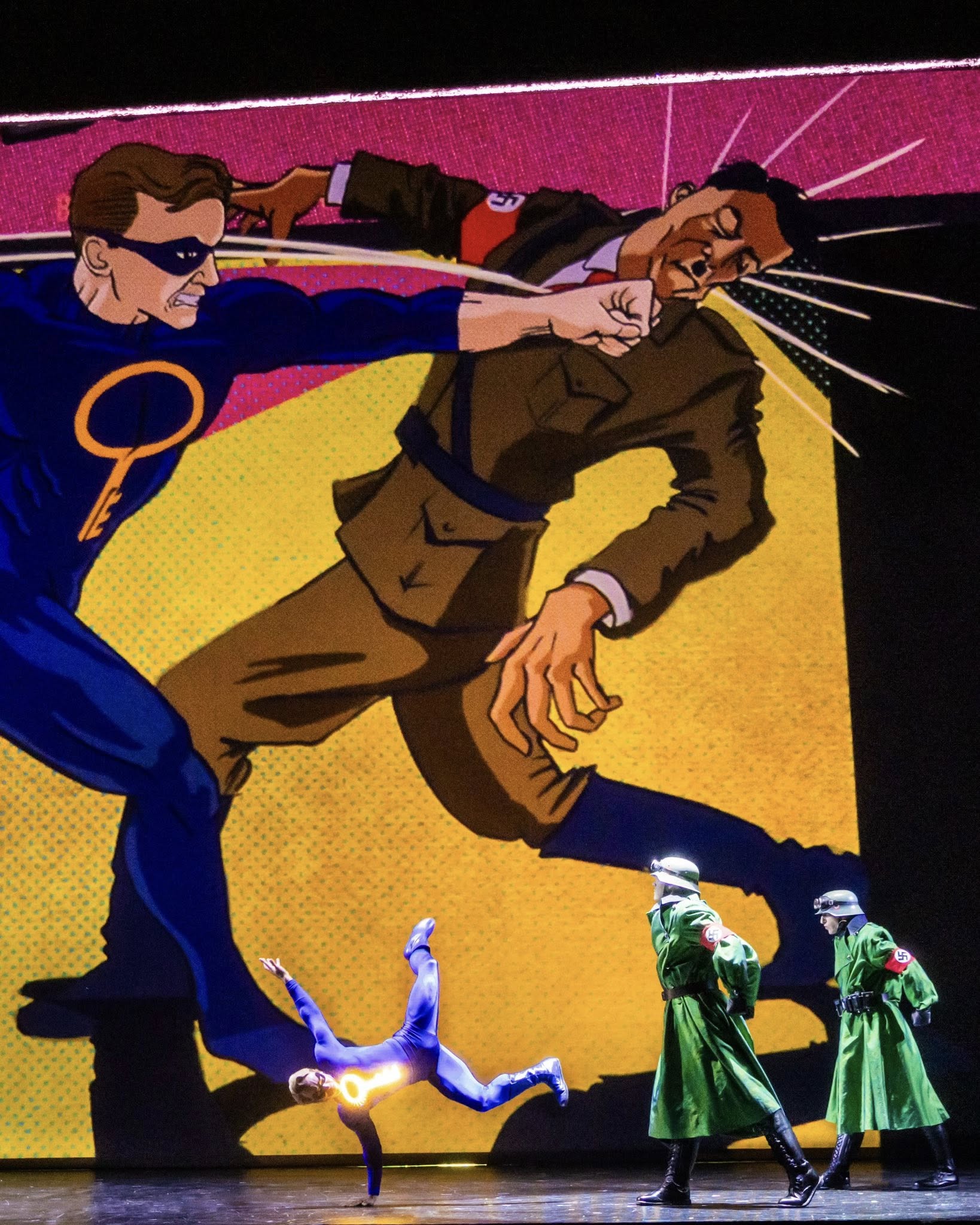
But the opera recreates a great escape from the bottom of the Moldau, a superhero, called The Escapist, punching out Nazis in the best Jack Kirby tradition, Salvador Dali in a diving suit, a thunderstorm over the observation deck of the Empire State Building, and a final act, with the stage in its full, mechanized glory, that departs significantly from the action of the book, but contains a touch of poetry and grace courtesy of another one of the cousin’s heroic creations. I do miss the business with the Golem, the World’s Fair, the entire Antarctica segment, the cameo by Orson Welles, and the recurring allusions to Polish composer Karol Szymanowski. Only Chabon could have written it. (Gene Scheer is the opera’s librettist.)
Opera as a genre rises and falls on its writing for voice, at its most powerful, arousing overwhelming emotions. At its most magnificent, there really is nothing else like it. From a purely musical standpoint, “Kavalier & Clay” never achieves that level of irrational grandeur, but as I indicated at the start, this may be the rare instance in which that’s okay. It would have been nice had it cracked the extraordinary, but the music does actually serve as but one component, and an equal one, in the three-hour entertainment. It’s almost like underscore, breezy in the New York street scenes and rhythmically driving in flights from the Nazis. There’s a spiritual kinship to film music. The emotional moments are lower-voltage than I would have liked – pretty, but hardly indelible – and the hard-driving action scenes and scenery changes sound like John Williams with a bit of a John Adams gloss.
Manhattan street and office scenes sport “jazz” inflections of a Gershwinesque variety, there’s a bawdy dance party that bristles with Bernstein, and at times in the European scenes, you could make out the inclusion of a mandolin – not necessarily the first instrument I associate with either Czechoslovakia or Jewry, but it is an instrument with a long folk tradition that reaches across the continent. I concede, this particular observation could simply reveal a blind spot in my own education.
Bates’ much-vaunted electronic additions (he experiments with electronica and even DJs on the side) really don’t add up to very much. That element of the score barely registers in the opera’s first act. In the second, it could just as easily not have been there. It’s just another element of seasoning.
The work’s real energy comes in its frequent, dizzying set changes and eyepopping set pieces, propelled by technical/technological wizardry. A great escape at the opera’s start prepares the audience for the synthesis of opera, movie, and even comic book, to come. There are entire montages that conjure the layout and dynamism of a comic’s page.
It’s insane to even consider that “The Amazing Adventures of Kavalier & Clay” could be made into an opera, and I’m not sure that it actually succeeds as one. But I am unshakeable in my conviction that it is a hell of a good show.
See it at the Met, February 17-21
https://www.metopera.org/season/2025-26-season/the-amazing-adventures-of-kavalier–clay/
Or at the movies, January 24 & 28
https://www.fathomentertainment.com/releases/the-metropolitan-opera-the-amazing-adventures-of-kavalier-clay/ -
Salterello Vivace to the Philadelphia Orchestra for John Williams’ Tuba Concerto
It’s rare to encounter a soloist standing before an orchestra with an instrument as cumbersome in appearance as the tuba; but that is the precisely what happened this weekend, when principal tubist Carol Jantsch took the stage of Marian Anderson Hall at the Kimmel Center of the Performing Arts to join the Philadelphia Orchestra for three performances of John Williams’ Tuba Concerto. And so as not to keep you in suspense, Friday afternoon’s concert, which I took in from the center of Row C in the Orchestra Tier (on the ground floor toward the back of the hall, but out from under the balcony) was superior in every way.
The tuba is an outlandish instrument that comes with a lot of baggage, from polka and marching bands to Tubby the Tuba and Jabba the Hutt. It looks heavy, and it can sound heavy. But the instrument is actually nimbler than one might think, especially in the hands of John Williams and his soloist. The composer, who professed to play the tuba “a little,” describes it as “agile” and compares it to “a huge cornet.” It certainly is lither than any outsider would ever expect.
I don’t know the specifications of Jantsch’s instrument, but a concert tuba can weigh from ten to twenty pounds. There is no chin-rest, strap, or pin to rest it on. You hold the thing and you play it, in this case for 18 minutes. It’s not only an impressive display of dexterity but also stamina. Furthermore, in the grand 19th century tradition, Jantsch lent her own embellishments to the work’s first movement cadenza, working in sly references to Williams’ “Imperial March” and “Jurassic Park.” Not interpolations I would want on a recording, necessarily (it was not Williams’ plan to include these in the concerto), but fun in the moment.
Cumulatively, Jantsch stunned with lung power, breath control, color, and finger work. I sensed many in the audience had no idea what to expect, but they sat in rapt, riveted silence throughout. The music and performance made an electrifying impact, as well they should have.
As if that weren’t enough, Jantsch demonstrated she had plenty in reserve, when, after being called back a couple of times to acknowledge the hoots and applause, she strolled over to join musicians at a keyboard and drum kit stage left, for a cover of “Beastly” by the American funk/soul band Vulfpec, which if anything was more rigorous and virtuosic than the concerto!
She was not gasping afterwards and she never broke a sweat. Unbelievable musician, on the unlikeliest of instruments. But that’s how one gets to be a principal player in the Philadelphia Orchestra.
Williams’ concerto is one of his most immediately accessible and an ideal bridge for fans of his film music. Moreover, the work itself is of very high quality, expertly orchestrated, with the tuba playing with or against various sections or solo players, like a kind of aural kaleidoscope, yet never obscured. The concerto shows off a player’s command of lithe finger work and leather lungs. And it never flags for 18 minutes. (Its three movements are played attacca).
Ralph Vaughan Williams’ is the Tuba Concerto most classical music people are likely to know, but for as much as I love RVW, this one, frankly, surpasses it. Perhaps a less contentious statement would be that if you want to make the short list of most effective tuba concertos, you’ve got a leg-up if your name happens to include “Williams.”
Conductor Dalia Stasevska was midway through her final series of concerts on a multi-week visit to Philadelphia, and quite a visit it’s been. Only days ago, she led the orchestra in a one-off performance of Dvořák’s Cello Concerto – with Yo-Yo Ma, no less. I was not present for that concert, but I was there last Friday for the program of John Adams’ “Short Ride in a Fast Machine,” Samuel Barber’s Violin Concerto (with Augustin Hadelich), and Gustav Mahler’s Symphony No. 4 (with soprano Joélle Harvey). That concert was up to the Philadelphia Orchestra’s usual fine standards, but I did not find it exceptional. (A couple of other online reviewers were more impressed, though I’m not sure on what day they attended.) For this one, however, Stasevska pitched a perfect game.
The program opened with the Symphony No. 2 by Julius Eastman, a talented and sensitive musician, who attended Philadelphia’s Curtis Institute of Music (Mieczyslaw Horszowski was among his teachers) before pursuing experimental music in Buffalo at the invitation of Lukas Foss. There he worked alongside leading avant-gardists Morton Feldman and Pauline Oliveros. But as a Black man and a homosexual, he faced a lot of impediments, both professional and personal. And he didn’t always address them in the healthiest ways. Among other things, he struggled with substance abuse. For a time, he was homeless. The titles of several of his works include slurs that, if anything, stir even greater outrage now than they did then, so that even to name them would be to risk virulent backlash and an almost-certain ban from Facebook. He was angry and he wanted to shock audiences awake. He had his share of angst, and who can blame him?
Many of his works include experimental touches. His output embraces the disparate influences of aleatory, minimalism, jazz, and popular music (even disco!). None of these are reflected in his symphony.
The Symphony No. 2 was the product of a dying love affair. The composer wrote it at white heat and handed it off to the man he loved. It is a painful, confessional work, introverted and bleak, but also heartfelt and absorbing. It does not outstay its welcome. Most importantly, it reflects the composer’s humanity, which is one of the highest services of music. It doesn’t matter who you are, or what color you are, or who you love, if you have the tools to express yourself articulately in music you can put yourself out there and connect with receptive listeners of all backgrounds. Eastman, at least in this work, does so very well. It’s probable he didn’t actually intend it for public performance. But as a spontaneous outpouring of grief, vulnerability, and tenderness, it is raw and communicative.
Stasevska has been an advocate for the work, and before the performance, she addressed the audience, articulately, informatively, and persuasively, about Eastman and his music. The manuscript of the symphony was rediscovered in a trunk of its dedicatee, the composer’s former lover. It was not in any sense complete, but rather more of a sketch, in 2018 filled-out into a performance edition by Luciano Chessa. How much is Eastman and how much is Chessa, I do not know. A detail that had me raise my eyebrows was an indication in the program that the duration of the piece in performance could be anywhere from 12 to 24 minutes. Not having seen score, I can only guess at the reasons.
I can say that, in Stasevska’s performance, it did not outstay its welcome. I did not check the time at her downbeat, but a recording she made of the work clocks in at around 14 minutes. The music is scored to emphasize lower instruments, employing three bass clarinets, three contrabass clarinets, three bassoons, three contrabassoons, three trombones, and three tubas. A melody suggestive of romantic loss and resultant grief opens onto a desolate soundscape. Instruments drone, but the orchestration is varied and full of interest. The strings wander, but with intensity of purpose, and the orchestra roils. In the original score, Stasevska says, Eastman marked one of the passages “Like Wagner.” Was Eastman recalling “Tristan und Isolde”? Or searching for catharsis in tragedy and grandeur? Whatever his intent, the work is as poignant as it is sonically expansive.
Eastman died in 1990 at the age of 49. His cause of death was given as cardiac arrest, possibly due to complications from HIV/AIDS. It’s said that he was on the verge of starvation. The concert’s programming, perhaps unwittingly, led me to reflect on Eastman’s struggle in comparison with the success of John Williams, his near-contemporary, wildly successful and still active, even as he is about to turn 94.
After a knock-out first half – for many in the hall, I’m sure, full of worthwhile surprises – I felt a bit going into the second half of the concert like a baseball fan entering the ninth inning of a no-hitter. Will the magic hold, or will the charm be broken? I’m not sure if it made me more concerned that the music was Felix Mendelssohn’s beloved “Italian” Symphony, which every classical music enthusiast knows so intimately. A mediocre performance, it would not go unnoticed.
But I needn’t have worried. Musicians of a major orchestra can likely play this one in their sleep. And hey, come on, this is THE PHILADELPHIA ORCHESTRA. Needless to say, the musicians played it like it was in their blood. With Stasevska at the helm, the first movement was chipper, at a pace that was on the edge, but didn’t push too hard. (All too often, interpreters mistake rushing somehow for being more upbeat and exciting. It is not always!) It might be Italy, but at the time Mendelssohn visited the Maserati hadn’t been invented yet. It was a pleasure to see the conductor smiling as she oversaw an orchestra playing with such vigor and precision.
The second movement is said to have been inspired by a religious procession the composer witnessed in Naples, but I have never heard anyone take it at a convincingly solemn pace. Thank God for that! I’m not sure Mendelssohn even intended it to be played so. Mendelssohn is the master of flow, and his pilgrims and holy men had just enough espresso to keep it moving at a walking pace, no lollygagging.
“Flowing” even better describes the third movement’s pleasing zephyrs and bird songs. The horn interludes always put me in mind of Mendelssohn’s music for “A Midsummer Night’s Dream.” If I were to characterize the symphony from the perspective of this movement alone, I would have no hesitation in calling it his “Pastoral” Symphony.
Except then comes the manic saltarello of the fourth movement, which propels the music relentlessly to the double-bar. By this point, the musicians were playing almost as if they were in a trance, the concentration was so intense. The music glided, fleet, nimble, and cleanly. It was some fancy footwork!
Even before the audience erupted into applause, I found myself marveling anew at what an underrated master Mendelssohn was. He deserves so much better than the enduring slight of a child prodigy who allegedly never fulfilled his promise. Any composer would be elated to have Mendelssohn’s success rate. There aren’t a lot who have so many works in the active repertoire. Will his name pack a house like Mozart’s? That’s not my concern. His best music always speaks to me, and I for one welcome the enchantment of his Romantic creations, which are full of atmosphere and feeling, sometimes touched with gentle melancholy but always without angst.
I am self-aware enough to recognize that any number of internal and external factors can influence my perceptions of a given performance – traffic, weather, the parking garage, an ill-timed email, my blood sugar level, how I slept, whatever else is going on in my life. The list is a lengthy one. I am a delicate instrument! But when the stars align, I have a pretty good ear, or at any rate an experienced one, and if I can keep my brain and my stomach silent, I can give a fair assessment of what I heard.
With that in mind, this concert had a lot stacked against it, as it was only on Friday morning that a glance at the calendar reminded me that I had a 2 p.m. performance. And I still had to get the last of my radio shows in for the weekend! This I produced in near-record time. (I wish I had had more.) Still, it was nearly 12:30 by the time I was able to shave and shower, including a hair wash, probably TMI. Then I had to refresh the bird feeders and hit the road.
Since there was no time for anything else, it meant the old coffee and banana lunch, consumed behind the wheel on I-95. Thankfully, and unusually, the highway was blissfully clear of stopped traffic. I don’t know how I did it, but I managed to make the leap from Princeton to Philadelphia and was seated in the hall well before the start of the concert. Furthermore, I was able to stay focused and attentive throughout. An MLK Weekend miracle!
Even with all that, nothing could dampen my appreciation of this truly fine event. Bravi to Carol Jantsch, Dalia Stasevska, Julius Eastman, John Williams, Felix Mendelssohn, and the Philadelphia Orchestra!
——–
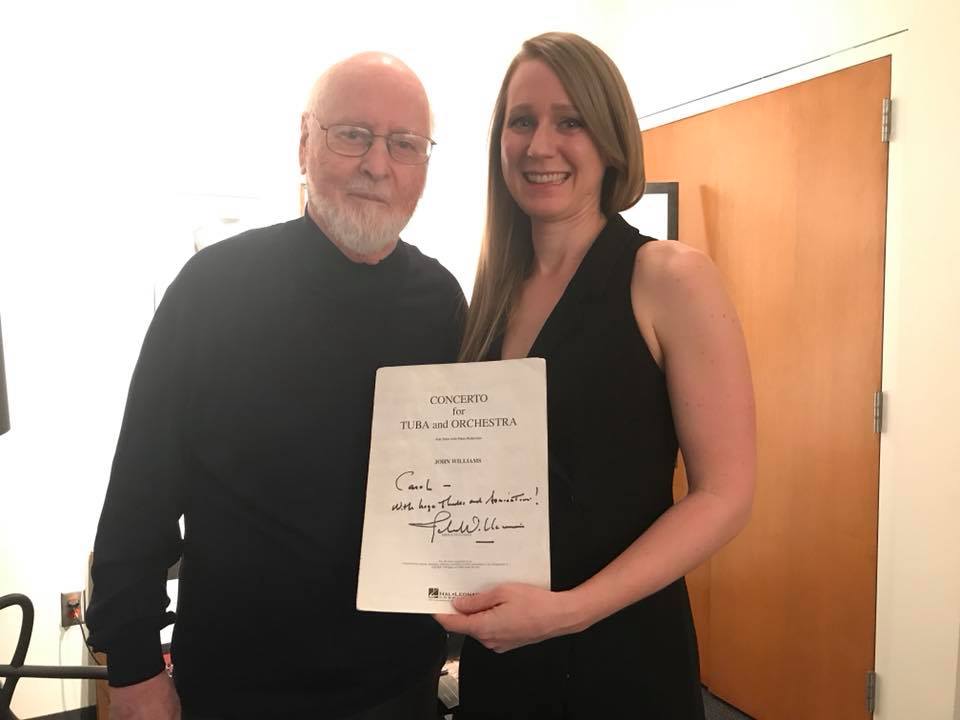
Photo from Carol Jantsch’s Facebook page, taken after a 2018 performance of Williams’ Tuba Concerto, with the composer in attendance -
Battle of the Barbers: Augustin Hadelich and Randall Goosby Play Samuel Barber’s Violin Concerto
It’s the battle of the Barbers!
Early last week, I posted about how I had inadvertently scheduled two concerts on the same day, both of them featuring the Samuel Barber Violin Concerto.
How did it happen? I impulsively acquired a seat to Friday afternoon’s Philadelphia Orchestra concert, practically as an afterthought, to fill-out the quota for a package deal for deeply-discounted tickets. What I’d failed to take into account was that I was already set to hear the concerto in Princeton on Friday evening, on a program presented by the New Jersey Symphony!
An embarrassment of riches, then, and a rare opportunity to juxtapose two interpretations of the same work, which turned out to be quite different from one another.
Classical music enthusiasts tend to toss around a lot of comparatives, and most of them incline toward the hyperbolic: This is the best recording. That performance was terrible! He was the greatest violinist of all time, and so forth. But really, is life always screwed to such a fever pitch? Is there no room for nuance?
I’ll offer my personal assessments of this weekend’s performances at the end of this post – and I can’t promise that they will be without overzealous comparatives – but first, a few words on my history with this particular concerto:
The first time I encountered the work was on a concert of the Philadelphia Orchestra, back in 1986. Elmar Oliveira was the soloist, and – can you imagine? – the concerto was on the same program as Prokofiev’s Symphony No. 6! Riccardo Muti, then the orchestra’s music director, conducted. What an evening! I hasten to add that Prokofiev was probably my favorite composer at the time, and I was devouring all of his music that I could.
Of course, I was still learning the repertoire, and as a young person, the frontier seemed wide-open. Whenever I encountered something I liked, I raced to the record store as soon as I had the funds to acquire it. I very quickly figured out that the most efficient way for me to accomplish this was to actually get a job as a record clerk – which I did, at a Sam Goody at 11th and Chestnut Streets, which at the time had the most extensive classical music section in the city. (This was before the arrival of Tower Records.)
Can you believe we had three people working the classical department? That’s what record stores were like in those days, when the technological development of the compact disc injected new life into the industry, with collectors eager to upgrade their libraries and push the limits of their audio equipment. It was there that I acquired Neeme Järvi’s Prokofiev cycle. Essentially, I wound up turning over most of my paycheck for the blister-packaged merchandise I had squirreled away in a cardboard cubby in the basement. I was still quite green, frankly, but I did have a greater-than-average knowledge of classical music, and as they say, in the kingdom of the blind, the man with one eye is king.
This may seem like another one of my flighty digressions, but I offer it as backdrop to the acquisition of my first recording of the Barber concerto. I was still buying used LPs, and some of the new soundtrack albums were still being released exclusively on vinyl, but by this point CDs had become an obsession. Isaac Stern’s classic recording of the Barber, with Bernstein and the New York Philharmonic, had yet to be reissued, and there really wasn’t very much competition on compact disc. The recording we had in stock, on the ProArte label, featured Joseph Silverstein as the soloist. He also conducted the rest of the selections, with the Utah Symphony, including Barber’s “The School for Scandal Overture” and the Second Essay for Orchestra. It actually turned out to be a very satisfying disc.
Oliveira finally recorded the concerto himself, with Leonard Slatkin and the Saint Louis Symphony Orchestra, his performance released on EMI in 1987. On the same disc was Howard Hanson’s “Romantic” Symphony. I remember my heart was beating so fast when I discovered this at the local mall. Now there are so many recordings of each.
For a time in the early ‘90s, I used a lugubrious passage from the slow movement of the concerto as a music bed on my answering machine. I was in my early 20s, licking my wounds from having been dumped by my college girlfriend. We were together for five years, basically, and it was not a clean break. Also, I had no idea what I wanted to do with my life. I’d taken a year to pound out some stories and send them to some magazines, while working at a Holiday Inn, delivering pizzas, etc.
Now I was caught in a series of dead-end retail jobs, mostly bookstores, with a bunch of other drifters, and it took me a few years to finally figure out that I could start my own. Of course, as soon as I moved on it and signed a lease on a store front, I was called to come in for the interview that landed me my first paid job as a classical music radio host. A Ross divided against himself cannot stand! Nevertheless, I continued the balancing act for the next 13 years, sleeping very little, I might add. Then I packed in the books (not that I’ve unloaded them all) and kept on with the radio.
But at the time I mention, in the early ‘90s, I was still wallowing in an impecunious quagmire, on my feet all day, working myself into exhaustion at a Barnes & Noble superstore, then coming home and blacking out on a fold-out sleeper sofa for an hour or so, before sitting down to a bowl of potato gruel and an evening of Wagner or Mahler on the old hi-fi.
It won’t surprise you to learn, I was often late on the rent. This is always stressful, but especially so, when your landlord lives in the same building. In this case, I was on the first floor, in an efficiency in the back of the building, with very little sunlight, but a tiny yard where I could enjoy my coffee in the morning and air out my clothes after a night downing Yuengling at a local dive bar.
Awkwardly, the fire escape was right behind the sofa bed, so that every morning I would see my landlord walk down the steps with his bicycle, before pedaling off to his university job. As he was a professor of English literature, I had hoped that maybe he could pass along some leads to some employment opportunities (this was in the days before the internet) – I was, after all, an English major – but he never knew of anything. Anyway, sometimes he would phone my machine. Once, he left a message, probably hoping for the rent, in which he remarked, “Samuel Barber is not half so ominous as you are.”
At work, I was always ordering books for myself, taking advantage of the employee discount. So another time, I was standing right next to one of my coworkers, whose task it was to call customers to notify them that their orders had come in. I wasn’t really paying attention, but after she hung up the phone, she muttered, “That guy’s machine sounds like a funeral parlor.” I took a look at the slip and busted out laughing. Of course that guy was me, my funereal manner enhanced by the Barber Violin Concerto.
Barber’s concerto, composed in 1939, is unapologetically lyrical, with long-limbed melodies and, in its first two movements, a yearning, even elegiac, quality. The final movement is an about-face, a grotesque moto perpetuo, during which the soloist is let off the leash for a thrilling romp around the park.
The first public performance was given by violinist Albert Spalding, with the Philadelphia Orchestra conducted by Eugene Ormandy at the Academy of Music at Broad and Locust Streets in 1941. I wonder if Barber, who died in 1981, could ever have anticipated just how much this concerto would take off. I doubt if there’s a major violinist in the world today who doesn’t have it in their repertoire.
But times were different in the 1940s. WPA-style composers were writing big, populist ballets and symphonies to boost morale during World War II, but all the while avant-gardists, many of whom embraced Arnold Schoenberg’s rejection of tonality, were engaged in subverting what they regarded as dangerously subjective, overly emotional (i.e. irrational) tendencies that had propelled civilization into two cataclysmic wars. In their place, they advocated a coolly rational, more objective music. Big, Romantic gestures were eyed with suspicion, if not disdain, and academics and public (the latter always appreciative of a good tune) parted ways.
Like Rachmaninoff, Barber was viewed as something of an anachronism. Unlike Rachmaninoff, he didn’t make the piano the center of his output. Nor did he possess the virtuosic technique as a performer to whip audiences into a frenzy. Anyway, Barber, though clearly capable of expressing emotion (as in his famous “Adagio for Strings”), preferred to do so with dignity and restraint. His preferred idiom was post-Brahmsian. There are flashes of anguish, but he never allows himself to wallow or teeter over into hysteria.
Perhaps this explains Augustin Hadelich’s interpretative decisions on Friday afternoon in Philadelphia. His take on the Violin Concerto was restrained to a fault – intimate, surely, but practically interior, for most of it nearly to the point to disengagement. There is something to be said for subtlety, and Barber himself would have been horrified ever to be caught blubbering. But there is a difference between drawing the listener in and leaving him or her out in the cold. Others may have reacted differently – there were cheers and the requisite standing ovation – but I didn’t find it particularly involving. As with “Hamnet,” I never would have survived without a cup of coffee. In the last movement, Hadelich proved – as if he needed to – that he was up to the work’s technical challenges, He’s a super violinist, who played a memorable Sibelius concerto when I last saw him in Philadelphia a few seasons ago – but I’m afraid it was too little, too late, and I came away feeling as if the whole thing had been underpowered.
I wonder too if trying too much to sculpt the music robbed it of some of its allure. On the second half of the concert, I felt Mahler’s Symphony No. 4, though one of his more intimate works, was also marred, a few passages aside, for the same reason – by babying it too much. Ironically, the work is infused with suggestions of childhood – quotations of folk song from the collection “Des Knaben Wunderhorn” and the final text relating a child’s vision of Heaven. (Once she settled in, soprano Joélle Harvey was radiant.) But there are also insinuating, sinister forces at play – dances of death, suggestions of funeral marches, and so forth. Except for those moments when, for instance, timpanist Don Liuzzi was allowed to rip, the performance turned out to be no more than up to the Philadelphia Orchestra’s usual fine standard, but in no way exceeding it.
It pains me to say so, since I am an admirer of the conductor, Dalia Stasevska. A few years ago, she conducted a Sibelius 5th Symphony that so far exceeded Esa-Pekka Salonen’s rendition when I heard him with the orchestra the following season, it wasn’t even in the same universe. Though Stasevska was born in Ukraine, both conductors are Finnish-bred. However, Stasevska does Salonen one better by being married to Sibelius’ great-grandson!
The whole experience was eclipsed by what I heard in Princeton on Friday evening, when Randall Goosby joined the New Jersey Symphony for a richly-satisfying performance of the Barber. I wonder if the individual venues might also have influenced my judgment. Hadelich played at somewhat of a remove in the cavernous Marian Anderson Hall at Philadelphia’s cathedral-like Kimmel Center for the Performing Arts. Goosby played in the much more intimate Richardson Auditorium at Princeton University, where the performers are practically in your lap. So Goosby’s instrument could be heard even in the work’s orchestral climaxes. But overall, my impression was that Hadelich was living in his head, while Goosby was letting us into his heart.
Of course, the conductor was the New Jersey Symphony’s Xian Zhang, whose podium manner makes Leonard Bernstein seem positively restrained by comparison. Zhang works hard, sometimes distractingly so, as she attempts to convey a sense of energy to her players, and I have to admit, it sometimes lends to the excitement of the performance. At others, it can be so over the top, you can’t help but smile. But is that such a bad thing? Especially when the second half of the program was Tchaikovsky’s Symphony No. 2, once commonly nicknamed in English-speaking countries the “Little Russian,” until world events precipitated a shift toward identifying it as the “Ukrainian.” Tchaikovsky lived and composed in Ukraine for part of the year, and the work is infused with Ukrainian folk song. The music is infectious, totally sidestepping the pathos of the later, more commonly-performed symphonies, with a march in place of the standard slow movement. The piece is downright balletic at times, and the climax is so manic that I couldn’t help but burst into laughter a few bars before the end.
This is the work George Plimpton wrote about after touring with the New York Philharmonic as a celebrity guest percussionist. Of course, Plimpton wasn’t a musician. That was his whole schtick – join the professionals, whether they be football players, boxers, or musicians, and then write about the experience. Plimpton had one job. He had to strike the gong in an exposed, pregnant moment, before a final mad crescendo to the double-bar line. He tells us that in his adrenaline rush, he smacked the thing so hard, he saw Bernstein’s eyes widen, and the shock wave travel out across the musicians into the audience to the back of the hall, and then the orchestra had to wait for the sound to decay so that they could start to play again.
Friday night’s gong-strike was not quite that egregious, but the performance itself was thrilling in the extreme, and altogether much more satisfying than anything I heard from the orchestra’s starrier rivals in Philadelphia that afternoon. I mean, come on. The concert opened with “Finlandia,” for crying out loud. If that doesn’t prime an audience, I don’t know what will.
So in the battle of the Barbers, the championship belt goes to Goosby. I still have faith in Hadelich, a marvelous violinist. Both artists are very much in their prime, and I look forward to, if not a rematch, then many happy musical experiences with them in the years ahead.
——–
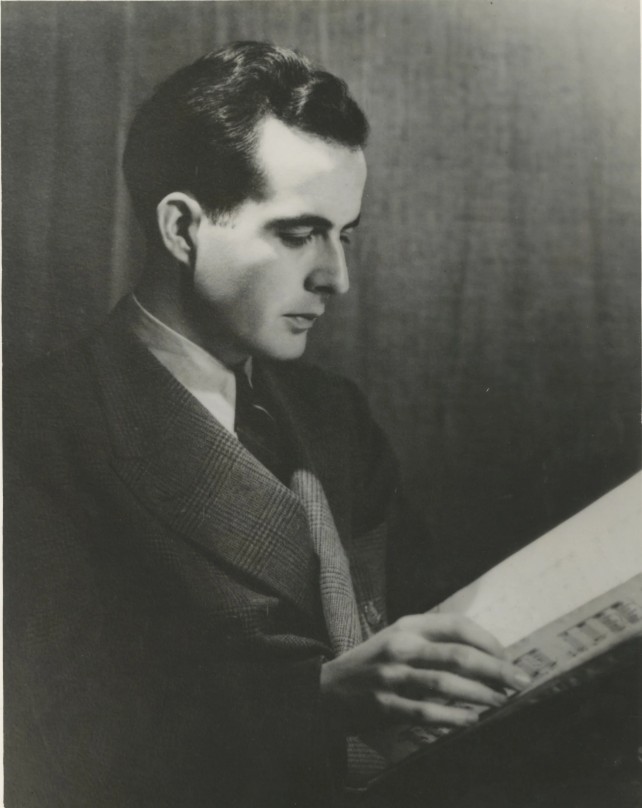
PHOTO: Samuel Barber in 1941
Tag Cloud
Aaron Copland (94) Beethoven (95) Composer (114) Film Music (148) Film Score (143) Film Scores (255) Halloween (97) John Williams (196) KWAX (232) Leonard Bernstein (105) Marlboro Music Festival (125) Movie Music (163) Mozart (91) Opera (215) Philadelphia Orchestra (90) Picture Perfect (174) Princeton Symphony Orchestra (110) Radio (90) Ross Amico (244) Roy's Tie-Dye Sci-Fi Corner (290) The Classical Network (101) The Lost Chord (269) Vaughan Williams (107) WPRB (397) WWFM (881)