Category: Daily Dispatch

  • Escape the Heat Arctic & Antarctic Music

    Escape the Heat Arctic & Antarctic Music

    It’s been quite a week, weather-wise, so we’re not about to leave anything to chance. Tomorrow morning on WPRB, we’ll be conjuring plenty of cool thoughts with musical journeys to the Arctic and Antarctic regions.

    We’ll hear Ralph Vaughan Williams’ “Sinfonia Antarctica,” of course, his Symphony No. 7, which grew out of his film score for “Scott of the Antarctic.” I will be interpolating readings from Scott’s journals by Sir John Gielgud, from another recording.

    We’ll also hear Nigel Westlake’s “Antarctica Suite,” written for guitarist John Williams. Then we’ll travel north to experience the struggle through darkness to light in George Lloyd’s “Arctic Symphony,” his Symphony No. 4.

    We’ll set foot in Lapland with “The White Reindeer” by Einar Englund. In addition, we’ll hear musical (and aseasonal) evocations of the aurora borealis, or northern lights, by Uuno Klami, Geirr Tveitt and Paul Moravec.

    Get ready to travel north and south, anywhere to beat the heat, tomorrow morning from 6 to 11 EDT on WPRB 103.3 FM and at wprb.com. I’ll be handing out the Eskimo pies, on Classic Ross Amico.

  • Cool Classical Music for Summer Heat

    Cool Classical Music for Summer Heat

    Enough already! With another “excessive heat warning” in effect this afternoon and heat index values expected to hit 106, let’s seek some musical relief, shall we, with works evocative of water, of winter, of cooler climes, and of simply kicking back and taking it easy. So far we’ve had refreshment from the likes of Jacques Ibert, Ottorino Respighi, Charles Tomlinson Griffes, Erich Wolfgang Korngold, Joan Tower and Peter Ilych Tchaikovsky. Tune in and chill out until 4:00 EDT, on WWFM – The Classical Network and at wwfm.org.

  • The Theremin’s Eerie Sound Celebrated

    The Theremin’s Eerie Sound Celebrated

    You all know the sound. That crazy, trilling electronic whistle that dips into a whoop. Or it starts in a trough and shoots up into the super stratosphere. It’s the sound of UFOs and mad science. It’s the sound of the theremin.

    The electronic instrument, invented by Léon Theremin in 1928, is played without physical contact. The proximity of the hands to two antennae determines volume and pitch.

    We’ll experience the instrument’s distinctive, extraterrestrial timbre, as we celebrate the birthday anniversary of Theremin today, by listening to performances by Clara Rockmore and to Bernard Herrmann’s suite from his influential film score for “The Day the Earth Stood Still” (which basically defined the sound of ‘50s science fiction).

    The instrument will be featured as part of a program that will also include birthday celebrations for eclectic Frenchman Jacques Ibert and Afro-English composer Samuel Coleridge-Taylor.

    Continuing with our ongoing salute to Brazil, to tie in with the Olympic Games in Rio, we’ll also hear Herrmann’s recording of Darius Milhaud’s “Saudades do Brasil.” The twelve dances that make up the suite are named for neighborhoods in Rio de Janeiro, where Milhaud lived for nearly two years as attaché to the French ambassador Paul Claudel.

    I hope you’ll join me today, from 4 to 7 p.m. EDT, when we’ll be mad for science and samba on WWFM – The Classical Network and at wwfm.org.


    More about Theremin and Rockmore here:

    http://www.huffingtonpost.com/network-awesome/from-russia-with-love-the_1_b_1384444.html

  • Howard Hanson’s Bold Island Inspiration

    Howard Hanson’s Bold Island Inspiration

    For many people, having to work through vacation can be a real drag; but for the creative artist, vacation can be a time to really get things done.

    For 40 years, Howard Hanson was the director of the Eastman School of Music. In that capacity he nurtured and championed innumerable American composers, giving literally thousands of premieres at the helm of the Eastman-Rochester Orchestra, an ensemble he founded. The lucky ones found their way onto records, issued on the Mercury label.

    Hanson, of course, was himself a composer. He was awarded the Pulitzer Prize for Music in 1944, for his Symphony No. 4 “Requiem,” written in memory of his father. But his best known music, undoubtedly, is his Symphony No. 2 “Romantic,” composed in 1930.

    The famous “Hanson sound” is one of heart-on-the-sleeve romanticism, characterized by glowingly nostalgic melodies, though he also had his severe side. After all, he was born in Wahoo, Nebraska, to Swedish immigrants, and a certain Nordic austerity can be detected, especially in his later works.

    This Sunday night on “The Lost Chord,” we’ll be listening to three pieces inspired by Hanson’s summer home on Bold Island, which is located in the North Atlantic, off the coast of Maine. The major work will be the Symphony No. 6, written in 1967 for the New York Philharmonic and dedicated to Leonard Bernstein.

    The piece is more tightly argued than Hanson’s earlier, more famous symphonies, structured in six brief movements, built on a recurring motif. At times, it can sound a bit like Sibelius, though Hanson very much remains his own man. Hanson being Hanson, he doesn’t really skimp on the lyricism, but he doesn’t exactly indulge it to the same extent he does in the earlier works. Still, predictably, the symphony was derided as old-fashioned by the genuinely austere musical establishment of the day.

    The Bold Island connection is through Hanson’s “Summer Seascape No. 2,” written a few years earlier, and clearly the blueprint for the symphony. In fact, the opening of the symphony is identical.

    The first “Summer Seascape” was the centerpiece of the “Bold Island Suite,” a separate work composed in 1961. The suite also contains movements with the descriptive titles “Birds of the Sea” and “God in Nature.”

    For Howard Hanson, summer in the North Atlantic was clearly a time to give his Nordic sensibility free rein. I hope you’ll join me for “August Hanson,” tonight at 10 EDT on WWFM – The Classical Network; or that you’ll listen to it later as a webcast at wwfm.org.


    PHOTO: Not-very-austere Puffins off the coast of Maine

  • Affetto Records Revives Classical Music

    Affetto Records Revives Classical Music

    “The philosophy of the label is very simple,” says John C. Baker, founder of Affetto Records. “We want to bring high-end musicians through a world of broadcast and CD distribution to people who may not have heard them before or know of them, with unique recordings of world premiere music – new arrangements, new compositions – and that’s basically what we have done in the last year.”

    Baker, a multi-Grammy nominated producer and recording engineer, established the Princeton-based Affetto in 2004 for the purpose of a jazz release. It was revived only last year to serve reputable classical musicians who were having difficulty finding labels willing to record them.

    “They were having trouble getting their recordings released,” he says. “It has become so much more difficult in this world of decreasing CD impact, although classical music is one of the only genres in which CD sales are still increasing, especially overseas. So I was encouraged, shall we say, to start my own label.”

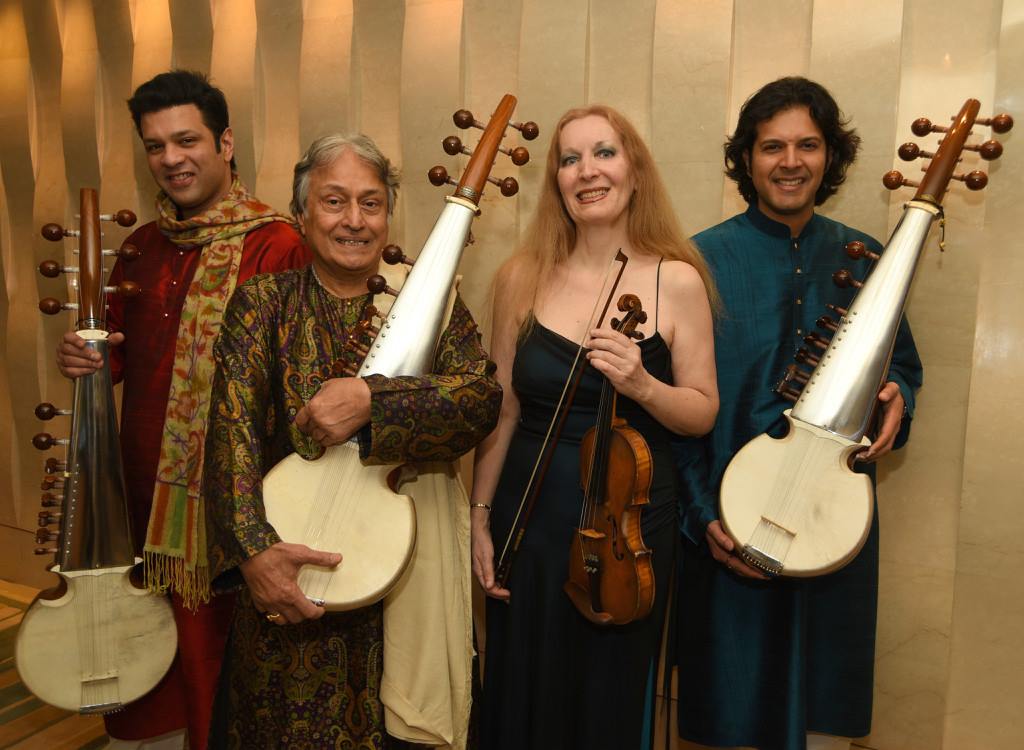
    One of those musicians was Elmira Darvarova, former concert master of the Metropolitan Opera Orchestra. Darvarova performs on Affetto’s most recent release, “Amalgam,” an unusual venture, which places her alongside Indian sarod master Amjad Ali Kahn, his two sons, Amaan and Ayaan Ali Khan, and tabla player Tanmoy Bose. The album was released overseas through an arrangement with Times Music, India’s largest record label and music publisher.

    “Amalgam” is only the most recent of a stimulating – and growing – catalog of recordings in Affetto’s stable, including first issues of music by Bach, Mendelssohn, Cyril Scott, and composers of American art song.

    Since 1992, Baker has recorded more than 200 albums, both self-released and for other labels. He engineers many of the live concerts heard on WWFM – The Classical Network and contributes to both NPR and PRI.

    Find out more about it in my article in today’s Trenton Times.

    http://www.nj.com/times-entertainment/index.ssf/2016/08/classical_music_princeton_prod.html

Tag Cloud

Aaron Copland (93) Beethoven (95) Composer (114) Film Music (139) Film Score (143) Film Scores (255) Halloween (94) John Williams (195) KWAX (229) Leonard Bernstein (103) Marlboro Music Festival (125) Movie Music (154) Mozart (89) Opera (210) Philadelphia Orchestra (89) Picture Perfect (174) Princeton Symphony Orchestra (108) Radio (88) Ross Amico (244) Roy's Tie-Dye Sci-Fi Corner (290) The Classical Network (101) The Lost Chord (268) Vaughan Williams (103) WPRB (396) WWFM (881)

DON’T MISS A BEAT

Receive a weekly digest every Sunday at noon by signing up here


RECENT POSTS