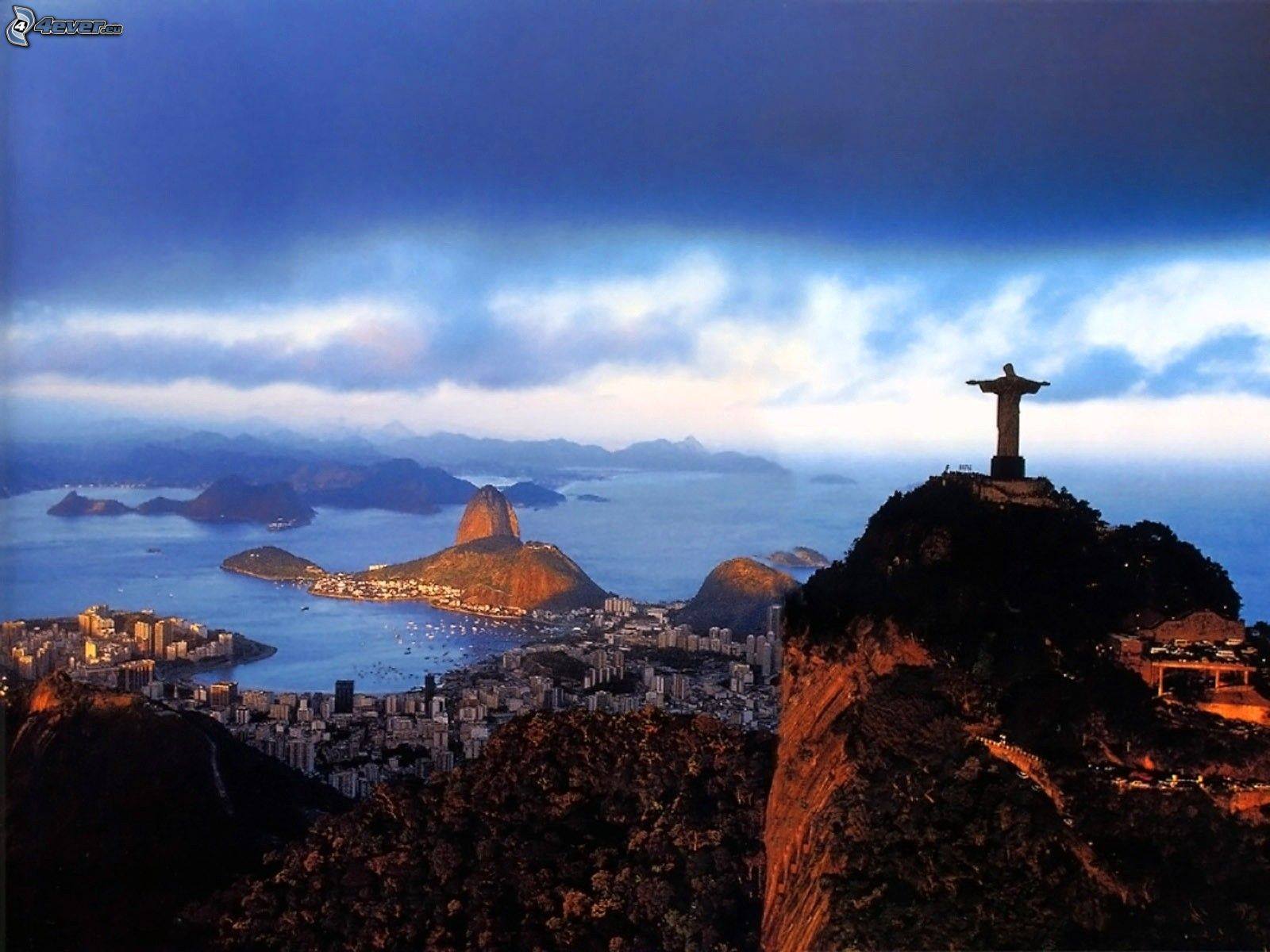
For those of you under the spell of the Summer Olympics in Rio, you’ll have some more opportunities to enjoy some Brazilian music this afternoon, including works by Camargo Guarnieri and Heitor Villa-Lobos; also a piece inspired by Brazil by David Gunn.
In addition, we’ll be celebrating the birthday anniversaries of French composers Cécile Chaminade and André Jolivet. I hope you’ll join me in some musical globetrotting this afternoon and early evening, from 4 to 7 EDT, on WWFM – The Classical Network and at wwfm.org.
The Olympic royalties continue to pile up for John Williams, thanks to NBC’s perpetual use of “Olympic Fanfare and Theme” (written for the 1984 Los Angeles Games), “Summon the Heroes” (written for the 1996 Atlanta Games), and his synthesis of Leo Arnaud’s “Bugler’s Dream” (the quintessential Olympic music) with his own ’84 opus. These are heard incessantly as bumpers, as coverage fades to commercial, or to underscore segues between events.
How much, exactly, does he make? According to an article in Variety, published in 2008, each prime time use could net between $500 and $2500.
Over the years, Williams has composed four original pieces for the games. In addition to his works for the ’84 and ’96 Olympics, he wrote “The Olympic Spirit” for the 1988 games in Seoul, South Korea, and “Call of the Champions” for the 2002 winter games in Salt Lake City.
Though Arnaud’s fanfare embodies the Olympic spirit like no other, it was not actually written with the Olympics in mind. “Bugler’s Dream” was written as part of a larger suite for conductor Felix Slatkin, who commissioned it for his 1958 album, “Charge!” In 1968, the fanfare was picked up by ABC for use in its coverage of the Winter Olympics from Grenoble. It became embedded in the public consciousness as THE music for the Olympics.
Like Williams, Arnaud worked in Hollywood for many years. A pupil of Maurice Ravel and Vincent d’Indy, he labored as an orchestrator on films ranging from “The Wizard of Oz” to “Ryan’s Daughter.”
In this article, Williams’ Olympic fanfares are ranked. It includes musical examples, so you can decide for yourself:
PHOTO: Williams, looking hale at 84, as he appeared at Tanglewood last week, between Boston Symphony Orchestra principal trumpeter Tom Rolfs and Philadelphia Orchestra principal guest conductor Stéphane Denève (photo by BSO principal trombonist Toby Oft)
This Sunday night on “The Lost Chord,” I indulge my inner English major with a program inspired by two plays that explore the relationship of power and corruption – Shakespeare’s “Macbeth” and Eugene O’Neill’s “The Emperor Jones.”
While the world’s eyes are on the Olympic Games in Brazil, our ears will be with the country’s most celebrated composer, Heitor Villa-Lobos, and a ballet which was originally performed on television in 1957. Somehow the score was never published. In fact, for decades it was even believed lost, until rediscovered by the conductor Jan Wagner (who is Venezuelan, despite his Teutonic name). Wagner will conduct the Odense Symphony Orc hestra, a Nordic band, in a surprisingly idiomatic performance.
Also on the program will be a half-remembered relic of American musical history, an aria from Louis Gruenberg’s opera, “The Emperor Jones,” sung by baritone Lawrence Tibbett, recorded in 1933.
“The Emperor Jones,” written in 1920, could be a sensitive subject in a more politically correct era. No doubt about it, O’Neill’s tragedy is a product of its time, with plenty of minstrel show dialect, and the uncomfortable use of the N-word.
Already in 1924, Sidney Gilpin, the actor who created Brutus Jones, hedged at playing the character in its first revival, unless O’Neill first changed what he perceived as some of the more offensive passages. O’Neill stood his ground, and Gilpin’s replacement, Paul Robeson, went on to international stardom.
It’s easy to write-off “The Emperor Jones” as an embarrassing relic. Yet there have been some high-profile stagings over the past few years which demonstrate that the play still has much to tell us.
Jones is a former railroad porter and convict, who kills a guard in his escape from prison, and through bluff and bravado establishes himself as emperor of a Caribbean island. He maintains his power through cruelty and exploitation. However, he overplays his hand, and the situation quickly erodes. As his subjects rise up against him, Jones retreats into the jungle and descends into primal fear, haunted by images of his victims.
The play not only parallels some of the themes of “Macbeth,” it also demonstrates the fragility of human reason; how easily under the influence of adrenaline, brought on by raw terror, man is undone by the animal impulses of fight or flight; the psychological impact of guilt; and an insight into tyranny which was remarkably prescient given that fascism would soon overtake Europe.
I don’t know why it never occurred to me before to juxtapose the two plays, but a quick Google search reveals that I am not the first, so there goes my dream of an honorary doctorate.
Also on the show will be selections from rarely-heard incidental music written for two productions of “Macbeth,” by William Walton (for John Gielgud) and Sir Arthur Sullivan (for Henry Irving), respectively.
Power corrupts, on “Power Plays,” this Sunday night at 10 EDT. Listen to it then, or catch it later as a webcast, at wwfm.org.
The José Limón Dance Company performs Heitor Villa-Lobos’ “The Emperor Jones”:
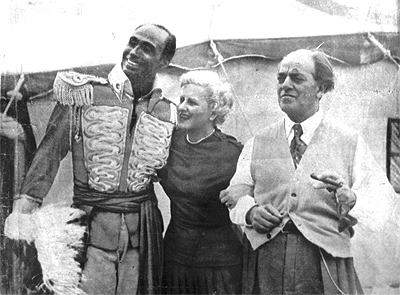
PHOTO: Choreographer José Limón as Emperor Jones, with Mindinha & Heitor Villa-Lobos
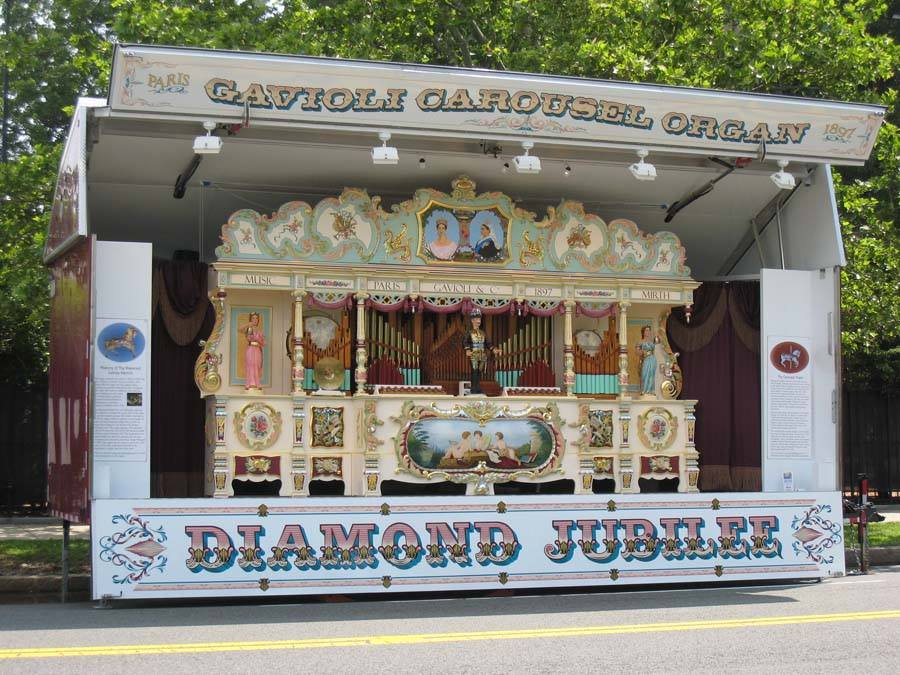
The atmosphere in Princeton this weekend might best be described as “carnivalesque,” as COAA – Carousel Organ Association of America and AMICA – Automatic Musical Instruments Collector’s Association bring their historic and wondrous collections to the community.
The organizations will combine for a “band organ rally” that will grace Princeton’s public spaces with ornate, century-old mechanical organs that may conjure memories for some of a bygone America from halcyon days.
The elaborate mechanical instruments will be on display in the streets, squares and parks of Princeton on Saturday and Sunday from 10 a.m. to 5 p.m. Information desks and exhibits will help provide context.
On Saturday at 10 a.m., at Nassau Presbyterian Church, across from Palmer Square, a one-hour multi-media presentation and orientation will be held to help acclimate the public to the music, the organizations, and their history.
The rally will include everything from crank, grind or monkey organs, to large, trailer-mounted models that approximate the sounds of marching bands or concert orchestras.
Music will range from vintage, classical and dancehall tunes to today’s greatest popular hits, which will be reinterpreted in very distinctive ways.
Find out more about the organizations and the mechanical instruments in my article in today’s Trenton Times.