Category: Daily Dispatch

  • Grazyna Bacewicz Polish Composer Spotlight

    Grazyna Bacewicz Polish Composer Spotlight

    “I believe this is the most brilliant woman composer who ever was.” So says conductor Mariusz Smolij about Grazyna Bacewicz.

    Smolij, known in the Greater Delaware Valley as Music Director of the Riverside Symphonia, based in Lambertville, NJ, joins me this week on “The Lost Chord,” for the second installment in a two-part series, to talk about his recording projects for the Naxos label. His recorded repertoire focuses on neglected music by Eastern European composers, from Hungary, from his native Poland, and, in the case of Ernest Bloch, from Jewish tradition.

    Bacewicz, who lived from 1909 to 1969, studied at the Warsaw Conservatory and then in Paris with Nadia Boulanger. She is a most interesting, Janus-like figure, her music embracing a kind of cosmopolitan neo-classicism, but not at the expense of her Polish heritage. She was an adept violinist and pianist, who survived a serious automobile accident that allowed her to concentrate wholly on composition for the last 15 years of her life. She remained energetic and prolific, also writing novels, short stories and memoirs. Though she is sometimes classified as a musical conservative, she retained her curiosity in regard to new developments in composition and was always on the lookout for ways to expand her horizons as an artist. She composed four symphonies, 12 concertos, chamber and instrumental works, opera and ballet, incidental music and film scores.

    Smolij, who has directed the Riverside Symphonia for over 20 years, is also music director of the Acadiana Symphony Orchestra and Conservatory of Music in Lafayette, LA, and formerly associated with the Houston Symphony Orchestra and the New Jersey Symphony Orchestra. He has taught conducting at the School of Music at Northwestern University and was a founding violinist of the internationally acclaimed Penderecki String Quartet.

    Only I would elect to highlight music by a great woman composer on Father’s Day. Consider it payback for the year I did an Odysseus show on Mother’s Day!

    I hope you’ll join me for “Topping the Poles” – Mariusz Smolij’s recordings of Grazyna Bacewicz, first lady of Polish music – this Sunday night at 10 EDT, with a repeat Wednesday evening at 6; or listen to it later as a webcast at wwfm.org.


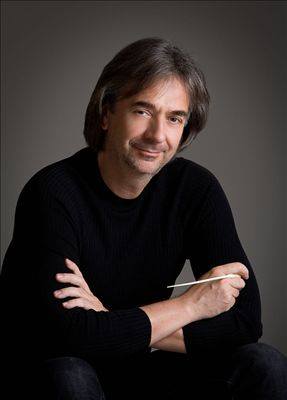
    PHOTOS: Mariusz Smolij (left) and Grazyna Bacewicz

  • Father’s Day Classical Music Tributes

    Father’s Day Classical Music Tributes

    For the nearly two decades that I hosted WWFM’s weekend mornings, I presented special shows on Father’s Day – as indeed I did on most holidays.

    Naturally, as the years went by, these became more and more elaborate, as a result of the cumulative material I was able to uncover. I played music written by composers from classical music dynasties, music performed by composers’ offspring, performer families playing music together, and music dedicated from father to son and vice versa, with the odd piece written specifically about fathers and family (Puccini’s “O mio babbino caro,” Richard Strauss’ “Sinfonia Domestica,” Percy Grainger’s “Father and Daughter,” Wolf-Ferrari’s “The School for Fathers,” Hugo Alfven’s “The Prodigal Son”). By the end of my run, it had gotten to the point where I could have programmed the entire day had they allowed me.

    I admit, I am just as happy at this point to have my Sunday mornings to myself, but I still can’t resist posting a few things for Father’s Day. I hope you enjoy them.


    Cellist Julian Lloyd Webber (brother of Andrew Lloyd Webber) plays music by his father, William Lloyd Webber:

    Eric Ewazen’s memorial to his father, the oboe concerto “Down a River of Time”:

    Howard Hanson’s Pulitzer Prize-winning Symphony No. 4, “Requiem,” dedicated to the memory of his father:

    Mov’t I https://www.youtube.com/watch?v=RWoq9Pgcjss
    Mov’t II https://www.youtube.com/watch?v=kigbLmK9ZJs
    Mov’t III https://www.youtube.com/watch?v=2TrA0WDZs-4
    Mov’t IV https://www.youtube.com/watch?v=kmb2P2Ec0Gs

    If you need to cut to the chase, just listen to the last movement. So beautiful.


    PHOTO: William Lloyd Webber (left), pater familias of the Lloyd Webber household

  • Composers and Koalas A Musical Encounter

    Composers and Koalas A Musical Encounter

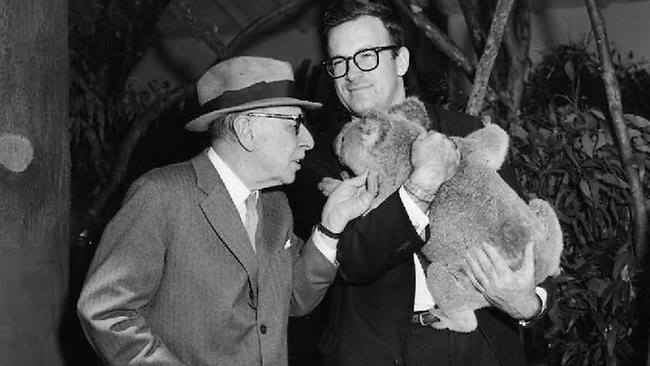
    Apropos of nothing – composers with koalas.


    PHOTOS: (Counter-clockwise from top) Igor Stravinsky, Sir William Walton and Leonard Bernstein

    Koala sings Mozart’s Requiem:

  • Peter Grimes at Princeton Festival

    Peter Grimes at Princeton Festival

    “Write what you know” is the frequently dispensed advice to young writers. It could just as easily apply to composers, especially if the composer happens to be Benjamin Britten.

    Britten was born in a Suffolk fishing port in 1913. The sights and sounds of the sea were in his blood. Powerful musical evocations of the sea pervade his opera, “Peter Grimes,” which was given its premiere in 1945.

    Additionally, the burden of adhering to his principles as a conscientious objector during the war and a lifelong struggle to remain to true to himself as a homosexual in an intolerant world likely informed his sympathetic portrayal of a tortured outsider hounded by an insular coastal community.

    Britten’s emotionally complex masterpiece is this year’s opera offering from The Princeton Festival. Performances will take place at McCarter Theatre Center’s Matthews Theatre on Saturday at 8 p.m., June 23 at 7:30 p.m., and June 26 at 3 p.m.

    Discounting the popular (though lighter-weight) collaborations of W.S. Gilbert & Sir Arthur Sullivan, “Peter Grimes” was the most successful opera to emerge from England in the 250 years since the death of Henry Purcell in 1695. “Grimes” is worlds away from “H.M.S. Pinafore.”

    Read more about the opera and the Princeton Festival’s exciting new production in my interview with stage director Steven LaCosse in today’s Trenton Times:

    http://www.nj.com/times-entertainment/index.ssf/2016/06/classical_music_peter_grimes_a.html


    Britten’s masterful “Four Sea Interludes” from “Peter Grimes”:

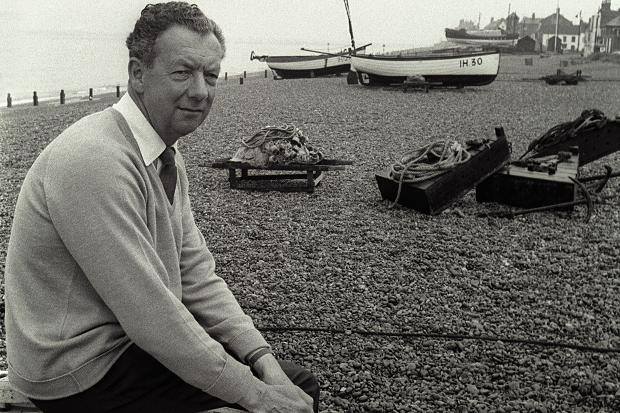
    PHOTO: Britten at Aldeburgh, the Suffolk coastal town where he founded his festival of music and the arts in 1948

  • Entitled Birds Fly High with Classic Film Scores

    Entitled Birds Fly High with Classic Film Scores

    This week on “Picture Perfect,” it’s an hour of entitled birds, with music from “The Maltese Falcon” (1941) by Adolph Deutsch, “To Kill a Mockingbird” (1962) by Elmer Bernstein, “Jonathan Livingston Seagull” (1973) by Lee Holdridge, and “The Sea Hawk” (1940) by Erich Wolfgang Korngold.

    With my computer gone fowl, it’s the flightiest show I could have hatched. Atticus Finch meets “The Albatross,” this Friday evening at 6 EDT, with a repeat Saturday morning at 6, on WWFM – The Classical Network; or listen to it later as a webcast at wwfm.org.

Tag Cloud

Aaron Copland (93) Beethoven (95) Composer (114) Film Music (139) Film Score (143) Film Scores (255) Halloween (94) John Williams (195) KWAX (229) Leonard Bernstein (103) Marlboro Music Festival (125) Movie Music (154) Mozart (89) Opera (210) Philadelphia Orchestra (89) Picture Perfect (174) Princeton Symphony Orchestra (108) Radio (88) Ross Amico (244) Roy's Tie-Dye Sci-Fi Corner (290) The Classical Network (101) The Lost Chord (268) Vaughan Williams (103) WPRB (396) WWFM (881)

DON’T MISS A BEAT

Receive a weekly digest every Sunday at noon by signing up here


RECENT POSTS