Category: Daily Dispatch

  • Confidence Games Charlatans in Film Music

    Confidence Games Charlatans in Film Music

    This week on “Picture Perfect,” it’s the equivalent of a cinematic shell game. We’ll have musical selections from films about confidence games, charlatans and hucksters.

    In “The Magician” (1958), also known as “The Face,” Igmar Bergman explores the idea of theatre as both confidence game and beautiful mystery. Max von Sydow stars as a traveling illusionist whose troupe of strolling entertainers, The Magnetic Healing Theatre, is put to test before being granted permission to perform at the royal court. The score, by Erik Nordgren, is sparse, made up of a dozen very short pieces for harp and two guitars, some movements for brass band, and in the main title, the addition of percussion.

    George C. Scott plays Mordecai Jones, a confidence man who defrauds the populace of the American South through various means, with a specialty in rigged punchboards, in “The Flim-Flam Man” (1967). The film, shot on location in Kentucky by director Irvin Kershner, features a gallery of colorful character actors, including Jack Albertson, Slim Pickens, Strother Martin and Harry Morgan. The happy-go-lucky score, by Jerry Goldsmith, makes use of harmonica, banjo, and freewheeling honky-tonk piano.

    Steven Spielberg’s “Catch Me If You Can” (2002) is based on the real-life exploits of the chameleonic Frank Abagnale, who, before his 19th birthday, managed to successfully pull a series of cons worth millions of dollars. Along the way, he posed convincingly as a lawyer, a doctor, and a pilot. Leonardo DiCaprio plays Abagnale, and Tom Hanks, the bank fraud agent who develops an unusual relationship with him, as the light-hearted cat-and-mouse thriller unfolds. John Williams wrote the intimate and jazzy score, a throw-back to the musical syntax of caper films of the 1960s, but also to the composer’s own jazz roots (when he still went by “Johnny Williams”).

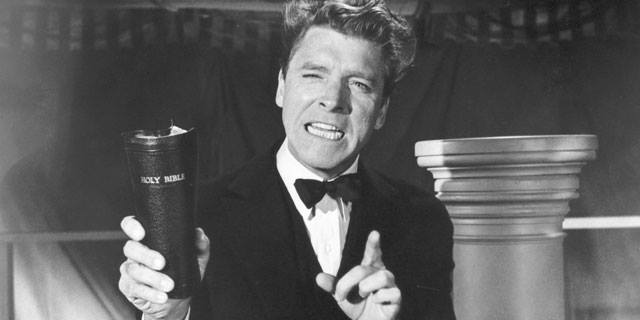
    Finally, we’ll hear music from that classic of religious hucksterism, “Elmer Gantry” (1960). Burt Lancaster plays the hard-drinking, fast-talking salesman-turned-revivalist, in one of the great movie performances. Lancaster was recognized with a much-deserved Academy Award for Best Actor. Shirley Jones, of “The Partridge Family” fame, won Best Supporting Actress for playing one of Gantry’s shady ladies. The film’s brilliant score was by none other than André Previn.

    Listen with “confidence” to WWFM – The Classical Network, this Friday evening at 6 EDT, with a repeat Saturday morning at 6; or enjoy the show later as a webcast at wwfm.org.
  • St John’s Eve Midsummer Magic on Classic Ross Amico

    St John’s Eve Midsummer Magic on Classic Ross Amico

    June 23. St. John’s Eve. By the time “the iron tongue of midnight hath told twelve,” bonfires will have been lit, love potions will have been sought, and the night will be alive with supernatural beings.

    Anyway, it’s a big deal in Europe, where it pervades the folklore of the British Isles, Scandinavia, France, Italy, Spain, Poland, Hungary, Russia and elsewhere. In Sweden, Midsummer is a national holiday.

    The influence is felt vicariously in the United States by way of the “Night on Bald Mountain” sequence in Disney’s “Fantasia,” Shakespeare’s “A Midsummer Night’s Dream,” and Igmar Bergman’s “Smiles of a Summer Night.”

    Among our featured highlights this morning will be a recording of “St. John’s Eve” by Gunnar de Frumerie. The allegorical ballet features appearances by John the Baptist, Salome, the Seven Deadly Sins, Angels, and the Devil, all tied up with Swedish Midsummer traditions.

    How now, spirit! Robin Goodfellow will squeeze the juice of love-in-idleness onto sleeping eyelids, from 6 to 11 EDT on WPRB 103.3 FM and at wprb.com. We’ll be singeing our tails leaping over bonfires, on Classic Ross Amico.


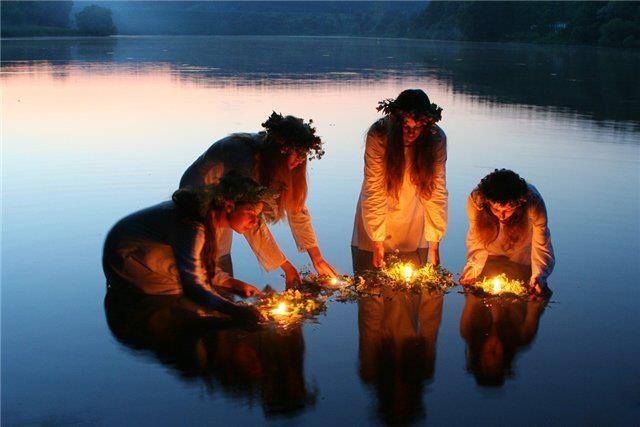
    PHOTO: Young women engage in a Ukrainian St. John’s Eve ritual

  • St. John’s Eve: Music & Midsummer Magic

    St. John’s Eve: Music & Midsummer Magic

    Bah! Chernobog cares nothing for your puny strawberry moon!

    This Thursday morning on WPRB, we leap over tepid news blurb observations about the solstice – and probably a few bonfires – to celebrate St. John’s Eve.

    Though the actual summer solstice may occur anytime between June 21 and June 25, June 24 is the Feast Day of St. John.

    St. John’s Eve is a time for the harvesting of St. John’s Wort, with its miraculous healing powers. It’s a time to seek the fern flower, which can bring good fortune, wealth, and the ability to understand animal speech. It’s a time for the lighting of bonfires against evil spirits, and even dragons, which roam the earth, as the sun again pursues a southerly course. And it’s a time when witches are believed to rendezvous with powerful forces, such as the demon Chernobog, who emerges from the Bald Mountain on St. John’s Eve at the climax of Disney’s “Fantasia” (though fair weather pagan Deems Taylor claims it’s Walpurgis Night).

    Not surprisingly, after a long, hard winter, the Scandinavian countries are crazy for Midsummer. Leaping over a bonfire is seen as a surety of prosperity and good luck. Not to light a bonfire is seen as offering up one’s own house for destruction by fire. The bigger the fire, the further at bay are kept evil spirits. The further the evil spirits, the better the guarantee of a good harvest.

    We’ll have music connected in one way or another with Midsummer rituals, including dances from “The Midsummer Marriage” by Sir Michael Tippett, the ballet “St. John’s Eve” by Gunnar de Frumerie, and Modest Mussorgsky’s “St. John’s Night,” an earlier, less-familiar incarnation of his popular musical picture “A Night on Bald Mountain,” as heard in his opera, “Sorochinsky Fair.”

    In addition, we’ll have Alfred Schnittke’s contrarian rondo, “(K)ein Sommernachtstraum.” The root of the title is German for “A Midsummer Night’s Dream,” but the postmodern inclusion of the “K” in parentheses modifies the meaning to “NOT a Midsummer Night’s Dream.” Indeed! Schnittke sets up the listener with a soothing notturno in the style of Mozart or Schubert, but very soon the atmosphere begins to shift.

    Also featured will be Rebecca Clarke’s “Midsummer Moon,” Aaron Copland’s “Midsummer Mood,” Hugo Alfven’s “Midsummer Vigil” (conducted by the composer), and Mario Castelnuovo-Tedesco’s “A Midsummer Night’s Dream,” with additional musical portraits of the denizens of Fairyland, Oberon, Titania and Puck.

    Since, after all, it is the Eve of St. John, there will also be performances by violinist Lara St. John’s polka band, Polkastra, from their wedding album, “I Do!”

    Start piling high the wood. We’ll touch things off tomorrow morning from 6 to 11 EDT on WPRB 103.3 FM and at wprb.com. Once again, we’re strapping on the goat leggings, on Classic Ross Amico.

  • Music Goosebumps Brain Science Smithsonian

    Music Goosebumps Brain Science Smithsonian

    I was alerted to this article in the Smithsonian by Roberta Batorsky. Leave it to the Smithsonian to report on the science of the aesthetic chill, or goosebumps.

    http://www.smithsonianmag.com/smart-news/researchers-look-what-happens-brain-when-music-causes-chills-180959481/?no-ist

    Check out Roberta’s blog, The Solipsist’s Soiree, always full of fresh links to interesting material.

    http://solipsistssoiree.blogspot.com/

  • Summer Solstice Lou Harrison’s Solstice

    Summer Solstice Lou Harrison’s Solstice

    The first day of summer. Only three months to go until autumn! That’s the good news. The bad news is the sun won’t set tonight until 8:30. That’s an awful lot of sun.

    Hey, man! It’s Lou Harrison’s “Solstice!”

    Solstice (1950) 26:57

    Part 1:

    1. Garden of the Sun 4:22
      https://www.youtube.com/watch?v=NOPcPia_jvc

    2. Entrance of the Moon Bull 3:51
      https://www.youtube.com/watch?v=f6j1vZz5-2M

    3. Battle 2:31
      https://www.youtube.com/watch?v=xMimlKMlrIw

    4. Earth’s Invitation 2:57
      https://www.youtube.com/watch?v=HDXh4ElaS5Q

    5. Vernal Dance 2:38
      https://www.youtube.com/watch?v=RYYSNGG4BXo

    Part 2:

    1. Saturnalia 1:47

    2. Rekindling of the Fire 2:59

    3. Turning of the Wheel 2:58

    4. Blaze of Day 2:54

    Leta Miller, flute; Yvonne Powers, oboe; Adam Gordon, trumpet; Nohema Fernández, celesta; Emily Wong George, tack piano; Stephen Tramontozzi, string bass; Peter Shelton, Lee Duckles, cellos; Dennis Russell Davies, conductor

Tag Cloud

Aaron Copland (93) Beethoven (95) Composer (114) Film Music (139) Film Score (143) Film Scores (255) Halloween (94) John Williams (195) KWAX (229) Leonard Bernstein (103) Marlboro Music Festival (125) Movie Music (154) Mozart (89) Opera (210) Philadelphia Orchestra (89) Picture Perfect (174) Princeton Symphony Orchestra (108) Radio (88) Ross Amico (244) Roy's Tie-Dye Sci-Fi Corner (290) The Classical Network (101) The Lost Chord (268) Vaughan Williams (103) WPRB (396) WWFM (881)

DON’T MISS A BEAT

Receive a weekly digest every Sunday at noon by signing up here


RECENT POSTS