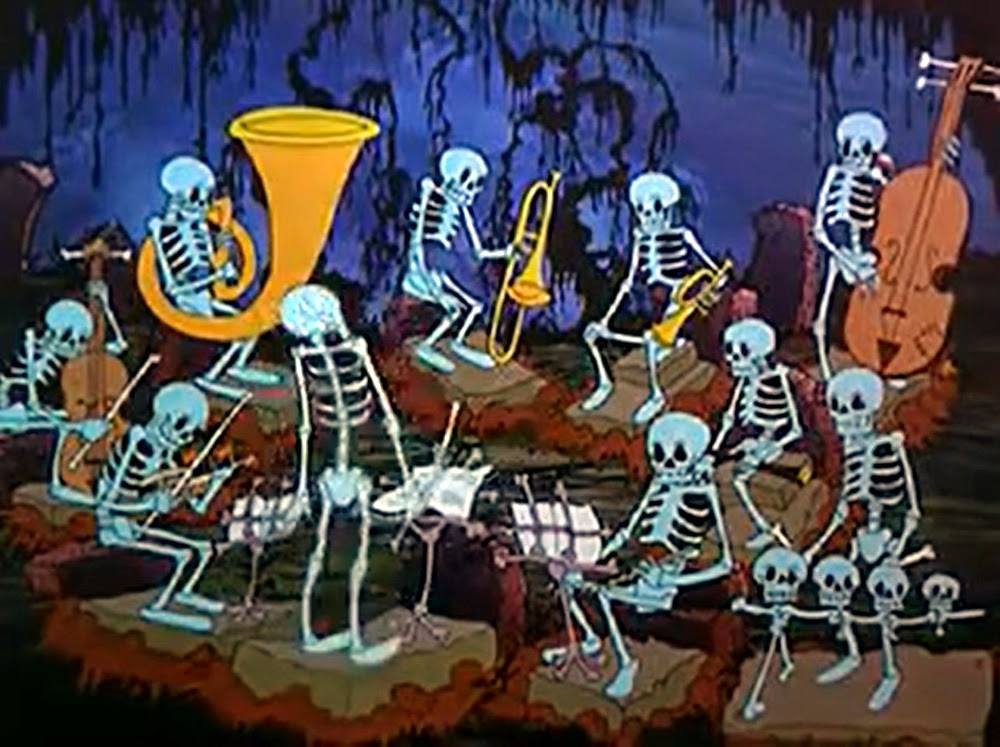
Human remains have been found under Cincinnati’s Music Hall, home of the Cincinnati Symphony. Apparently the building was constructed on a cemetery. Now this is the “Poltergeist” movie I want to see!
Tomorrow marks the final installment of our four-part salute to William Shakespeare on WPRB. Every Thursday morning in April, we have been honoring the Bard with music inspired by his writings, to mark the 400th anniversary of his shuffling off this mortal coil on April 23, 1616 (also the anniversary of his birth, though 52 years earlier).
We have five hours in which to hear any or all of the following: Frank Bridge’s “There is a willow grows aslant a brook,” Ernest Chausson’s “The Tempest,” Cecil Cole’s “Comedy of Errors Overture,” Gabriel Fauré’s “Shylock,” Gerald Finzi’s “Let us Garlands bring,” Florent Schmitt’s “Antony and Cleopatra,” Bedrich Smetana’s “Richard III,” and Johan Wagenaar’s “The Taming of the Shrew Overture,” among others.
‘Tis a consummation devoutly to be wished, tomorrow morning from 6 to 11 EDT, on WPRB 103.3 FM and at wprb.com. Conscience does make cowards of us all, on Classic Ross Amico.
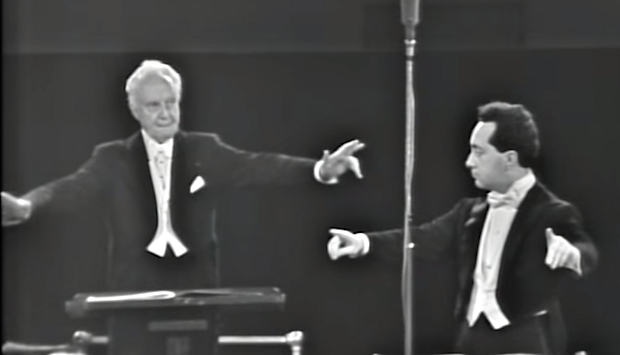
It was on this date in 1965 that Leopold Stokowski gave the world premiere of Charles Ives’ Symphony No. 4. The performance took place at Carnegie Hall with the American Symphony Orchestra and the Schola Cantorum of New York. At the time, the work’s complex, kaleidoscopic tempos and layered, shifting meters required multiple conductors, and Stokowski enlisted the aid of David Katz and a young Jose Serebrier (pictured).
The piece was composed between 1910 and the mid-1920s. Given the source, it’s hardly surprising that the music was decades ahead of its time. The first two movements had been performed by members of the New York Philharmonic under the direction of Eugene Goossens in 1927. This was the only occasion on which Ives would hear any of the music from the Fourth Symphony performed live by an orchestra. The composer died in 1954.
Bernard Herrmann conducted an arrangement of the lovely third movement, the simplest and most conservative of the four (why, then, the need for an arrangement?), in 1933. The music as Ives wrote it was not heard until the complete performance in 1965.
The composer’s biographer, Jan Swafford, describes the work as “Ives’ climactic masterpiece.”
Stokowski recorded the symphony a few days after the premiere and led a televised studio performance, which can be seen here:
Stokey kicks off twenty minutes of spoken introductory material (including commentary from producer John McClure) at the 4:30 mark. The symphony proper begins 25 minutes in.
When’s the last time you saw anything like this on television?
As I write this week’s article for the Trenton Times, somehow I feel a certain affinity with this photo of a great artist (Aaron Copland) posing in front of a toilet mural.
For anyone still suffering from PTSD as a result of having to read Shakespeare in school, you should consider giving him a second look. Not only are his nimble wordplay and poetic imagination mesmerizing, the number of phrases and idioms Shakespeare coined or popularized that are still in everyday use is astonishing.
There has been much posted about this over the past several days. This is one of my favorites: comedian Rob Brydon recites “Quoting Shakespeare.”
If you don’t know “The Trip,” the road comedy Brydon made with Steve Coogan, you owe it to yourself to check it out. It’s a mouthwatering blend of gourmet cuisine, banter, and dueling celebrity impressions.