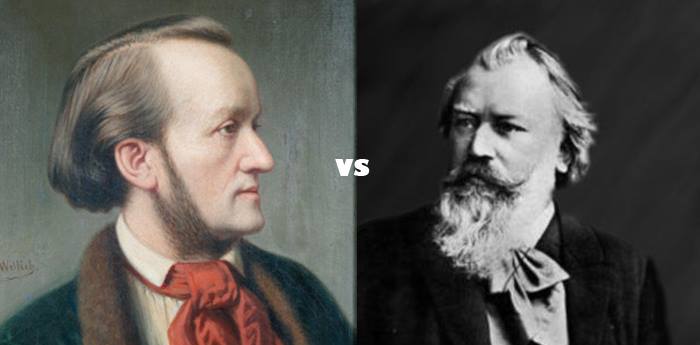
If Gabriel Fauré (1845-1924) and Jules Massenet (1842-1912) got in a knife fight, who would win? Discuss.
Happy birthday, gentlemen.

If Gabriel Fauré (1845-1924) and Jules Massenet (1842-1912) got in a knife fight, who would win? Discuss.
Happy birthday, gentlemen.

He’s Still the one.
Today is the birthday of William Grant Still (1895-1978), the so-called “Dean of Afro-American Composers.” Still emerged from unlikely circumstances (born in Woodville, Mississippi; raised in Little Rock, Arkansas) to become a major force in American music.
Having abandoned a career in medicine for studies at the Oberlin Conservatory of Music and the New England Conservatory in Boston (where he studied with George Whitefield Chadwick), Still was a “first” in many ways.
His was the first symphony written by a black composer to be performed by a major orchestra (the Eastman-Rochester). He was the first to be given the opportunity to conduct a major orchestra (the Los Angeles Philharmonic, at the Hollywood Bowl). His opera, “Troubled Island,” became the first to be produced by a major company (the New York City Opera). Another of his operas, “A Bayou Legend,” was the first to be performed on national television (as late as 1981).
Any of these would be significant in and of themselves, but it just so happens that Still was a damn fine composer. Perhaps the least likely pupil of Edgard Varèse, he incorporated jazz and blues elements into his concert music, which also frequently reflected the African and African-American experiences.
He cut his teeth writing arrangements for Paul Whiteman, W.C. Handy and Artie Shaw. According to Eubie Blake, one of Still’s improvisations in the pit band during Blake’s revue “Shuffle Along” became the basis for Gershwin’s hit tune “I Got Rhythm.” Still didn’t appear to be bitter about it, and in fact the two composers were on friendly terms and made it a point to attend performances of one another’s music.
Still quotes the melody in the third movement of his Symphony No. 1, otherwise known as the “Afro-American Symphony.” In fact, it had always been his intention to do so, before Gershwin popularized it. (Blake went on to say the swipe was probably inadvertent, but Still had definitely gotten there first.)
I’ve always been fond of the symphony, from the very first time I heard it. To me, it is every bit as much of a portrait of an artist as a young man as Virgil Thomson’s “Symphony on a Hymn Tune.” It’s a beautiful and wistful piece, built on lovely daydreams and uptempo, banjo-like riffs. This is the kind of music that Dvořák would have loved.
Here it is, in a pioneering recording by Karl Krueger and the Royal Philharmonic Orchestra, after all these years, still my favorite:
Mov’t I: https://www.youtube.com/watch?v=5s7o8UfKsV0
Mov’t II: https://www.youtube.com/watch?v=xSQUrW8eBhU
Mov’t III: https://www.youtube.com/watch?v=iEeaLvX82Lw
Mov’t IV: https://www.youtube.com/watch?v=Fu_qzX5K39g
And just to prove it was no accident, here’s the second movement of his Symphony No. 2, “Song of a New Race,” with Neeme Järvi and the Detroit Symphony:
https://www.youtube.com/watch?v=uaHe5hvWu6w
Now tell me Gershwin wouldn’t have killed to write that!
Happy birthday, William Grant Still.

Nothing says Mother’s Day like angry gods, shipwreck, cannibalism, gratuitous nudity, riotous drunkenness, a blinded Cyclops, and the wholesale slaughter of one’s rivals.
Okay, so maybe I wasn’t thinking when I did the programming for the latest installment of “The Lost Chord.” But dads should love this hour of high adventure and satisfied bloodlust, as we listen to musical evocations of Odysseus’ homeward journey.
Odysseus, of course, is one of the heroes of the Trojan War, waylaid time and again upon his return by Poseidon and the frailties of his own men. It takes him ten years to find his way back to Ithaca. When he gets there, he finds his wife beset by boorish suitors all vying for her hand and his throne.
What happens next pushes all the same buttons that are still pushed whenever Sylvester Stallone or Arnold Schwarzenegger apply the camouflage and begin strapping on their bandoliers and sheathing their big knives. In the process, there’s also some meaningful father-son bonding.
So maybe it would have been a more appropriate choice for Father’s Day. Hopefully there are some mothers out there who were also classics majors. I hope you’ll me for “Home Sweet Homer,” tonight at 10 ET, with a repeat Wednesday evening at 6. You can listen to it on Father’s Day as a webcast, if you want, at http://www.wwfm.org.

Perhaps as an alternative to waiting in line at the diner on Mother’s Day, you can cook breakfast for Mom at home and listen to “Haddon Hall.” Sir Arthur Sullivan’s rarely-heard light opera, given its premiere in 1892, will be the featured work on Sandy Steiglitz’s “Sunday Morning Opera.”
“Haddon Hall” is one of the works Sullivan composed without Gilbert, in the wake of the team’s temporary dissolution following “The Gondoliers.” Savoy Opera impresario Richard D’Oyly Carte, no doubt crestfallen at the G & S separation, introduced Sullivan to Sydney Grundy. The result was a mild satire that left audiences accustomed to Gilbert’s barbed observations vaguely dissatisfied.
The opera dramatizes the elopement of Dorothy Vernon of Haddon Hall in 1563, against her father’s wishes, with John Manners, son of Thomas Manners, 1st Earl of Rutland. The conflict may have been in part religious (the Vernons were Catholic, the Manners Protestant); it was most certainly financial (as the second son of an earl, Manners’ prospects were uncertain). If all this sounds a tad dry to American sensibilities, Grundy moves the action forward a century to about 1660, recasting it against the backdrop of unrest between Royalists and Roundheads. Isn’t that much more interesting?
There’s also a fuming Scottish stereotype in the person of “The McCrankie,” a particularly strict Puritan from the Isle of Rum, who sings to the accompaniment of bagpipes and drinks whisky from a flask, ha ha.
Anyway, the music should be nice. Purportedly, it bears the stamp of Sullivan’s only grand opera, “Ivanhoe,” which had been completed only the year before.
“Haddon Hall” enjoyed a vogue among amateur groups in the 1920s, but has since drifted into obscurity. The 2000 recording features Mary Timmons, Maxwell Smart (no shoe phone jokes, please), and Alan Borthwick. The performance is conducted by David Lyle.
“Sunday Morning Opera” can be heard on WPRB Princeton at 103.3 FM, beginning at 5:30 a.m. The main attraction begins at 7:00. After the opera, in the time remaining, Sandy will celebrate the birthday of Richard Tauber. You can listen online at http://www.wprb.com.
More about “Sunday Morning Opera” here: http://www.cs.princeton.edu/~san/schedule.html
PHOTO: When men were men, and women were women – if only we could tell them apart

Trenton’s prodigal son returns! I was so excited to be able to write about George Antheil again. Antheil, if you don’t know, was the greatest composer ever to emerge from New Jersey’s capital city.
The self-proclaimed “Bad Boy of Music” (the title of his autobiography), Antheil would practice the piano with such ferocity that he would have to pause periodically to soak his hands in two fish bowls. During his recitals, he would ostentatiously remove a pistol from a silk holster sewn into his jacket and place it atop the piano, to let the audience know up front that he would brook no nonsense.
Of course, he had good reason. His “Ballet Mécanique,” scored for player pianos, airplane propellers, siren and electric bells, inspired one of classical music’s great riots at its Paris premiere in 1926.
This weekend, the New Jersey Capital Philharmonic Orchestra will present a substantial suite from Antheil’s ballet, “Capital of the World,” on a concert which will also feature works on Spanish themes by Emmanuel Chabrier, Maurice Ravel and Manuel de Falla.
Based on the short story by Ernest Hemingway, “Capital of the World” tells of a young waiter who dreams of becoming a matador. Unfortunately, some spirited horseplay leads to tragic results.
Just don’t go into it expecting Antheil the enfant terrible. By the Second World War, his music had taken a turn toward the kind of populism embraced by many American composers of mid-century. Also, he had entered into a sideline of writing for film (“The Pride and the Passion,” also with a Spanish setting, was one of the projects he scored).
The ballet features a prominent part for flamenco dancer. Liliana Ruiz will be the soloist in tomorrow night’s performance. The concert will take place at the Trenton War Memorial, beginning at 8 p.m.
You can read more about it in my article in today’s Trenton Times:
http://www.nj.com/times-entertainment/index.ssf/2015/05/classical_music_nj_capital_phi_1.html
If you missed it, here’s a write-up of an Antheil walking-and-driving tour I took, back in 2013:
http://www.nj.com/times-entertainment/index.ssf/2013/08/early_life_in_trenton_left_mar.html
PHOTO: The Original Trenton Cracker
Aaron Copland (92) Beethoven (95) Composer (114) Film Music (119) Film Score (143) Film Scores (255) Halloween (94) John Williams (185) KWAX (229) Leonard Bernstein (99) Marlboro Music Festival (125) Movie Music (134) Opera (198) Philadelphia Orchestra (87) Picture Perfect (174) Princeton Symphony Orchestra (106) Radio (87) Ralph Vaughan Williams (85) Ross Amico (244) Roy's Tie-Dye Sci-Fi Corner (290) The Classical Network (101) The Lost Chord (268) Vaughan Williams (102) WPRB (396) WWFM (881)