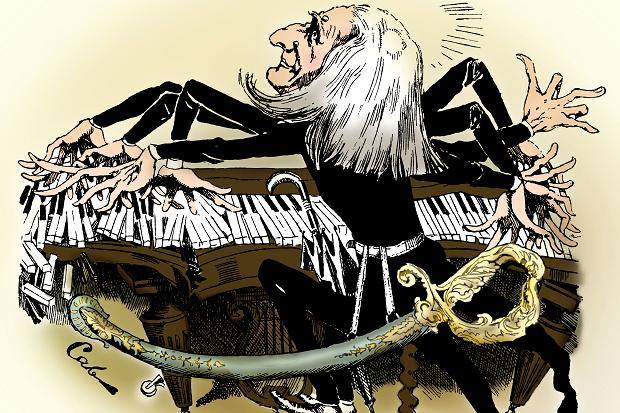
It’s hard to believe, I know, but I just have been too busy today to post anything. As an easy way out, my recent anecdotes about Liszt put me in mind of this classic — and brilliant — piece of shtick with Victor Borge. Enjoy.
Category: Daily Dispatch
-
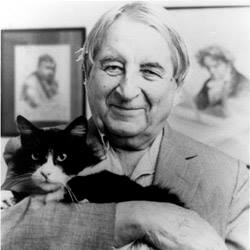
Slonimsky’s Savage Musical Takedowns
For the birthday of Nicolas Slonimsky (1894-1995), here a few favorites from his sidesplitting compendium of critical vitriol, “Lexicon of Musical Invective”:
“We recoil in horror before this rotting odor which rushes into our nostrils from the disharmonies of this putrefactive counterpoint. His imagination is so incurably sick and warped that anything like regularity in chord progressions and period structure simply do not exist for him. Bruckner composes like a drunkard!”
(Gustav Dompke, The German Times of Vienna, 1886)
“Heartless sterility, obliteration of all melody, all tonal charm, all music… This reveling in the destruction of all tonal essence, raging satanic fury in the orchestra, this demoniacal, lewd caterwauling, scandal-mongering, gun-toting music, with an orchestral accompaniment slapping you in the face… Hence, the secret fascination that makes it the darling of feeble-minded royalty…of the court monkeys covered with reptilian slime, and of the blasé hysterical female court parasites who need this galvanic stimulation by massive instrumental treatment to throw their pleasure-weary frog-legs into violent convulsion…the diabolical din of this pig-headed man, stuffed with brass and sawdust, inflated, in an insanely destructive self-aggrandizement, by Mephistopheles’ mephitic and most venomous hellish miasma, into Beelzebub’s Court Composer and General Director of Hell’s Music — Wagner!”
(J.L. Klein, “History of the Drama,” 1871)
And of course, who could forget:
“The violin is no longer played; it is pulled, torn, drubbed…. We see plainly the savage vulgar faces, we hear curses, we smell vodka.… Tchaikovsky’s Violin Concerto gives us for the first time the hideous notion that there can be music that stinks to the ear.”
(Eduard Hanslick, New Free Press, Vienna, 1881)
Tchaikovsky could recite every word of Hanslick’s sustained screed, from which this is but an excerpt, from memory.
The “Lexicon” is merely the tip of the Slonimsky iceberg. He conducted first performances of works by Ives and Varèse. His “Thesaurus of Scales and Melodic Patterns” influenced musicians from John Coltrane to Frank Zappa. His sly wit made him a favorite guest on radio and television programs, including “The Tonight Show.” It’s not surprising that he lived to be 101.
Happy birthday, Nicholas Slonimsky.
Slonimsky documentary on YouTube — narrated by Michael York!
-

Alexandre Dumas in Music on The Lost Chord
He is best known as the author of “The Three Musketeers” and “The Count of Monte Cristo.” However, Alexandre Dumas churned out historically-inspired prose on all manner of subjects, and he did so by the yard.
This Sunday night on “The Lost Chord,” we present an hour of music inspired by his works, including rarely-heard incidental music, written for a revival of the play, “Caligula,” by Gabriel Fauré; ballet music from an opera, “Ascanio,” taken from a novel featuring Benvenuto Cellini, by Camille Saint-Saëns; and a poetic monologue, “Joan of Arc at the Stake,” by Franz Liszt. We’ll also hear the suite for symphonic band, “The Three Musketeers,” by George Wiliam Hespe.
I hope you’ll join me for “The Lost Sword,” tonight at 10 ET, with a repeat Wednesday evening at 6; or that you’ll listen to it later as a webcast at http://www.wwfm.org.
-
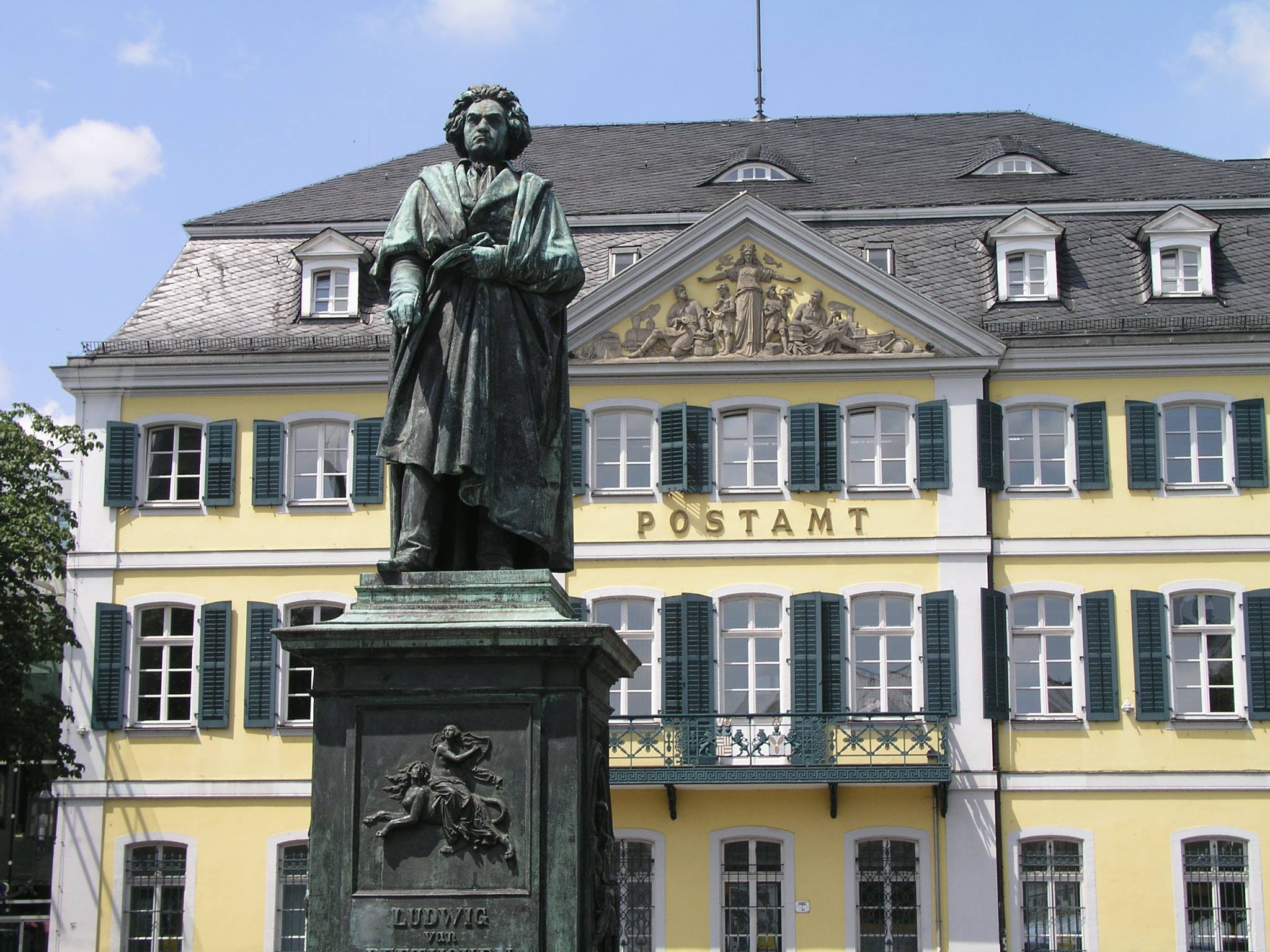
Liszt Saves Beethoven’s Monument
On this date in 1841, not for the first or last time, Franz Liszt came to the rescue. Liszt performed Beethoven’s “Emperor” Concerto in Paris, with Hector Berlioz conducting. The occasion was a fundraising project for a Beethoven monument to be erected in Bonn. Up to that time, it was not the custom to raise statues to cultural icons. Schiller finally got his only a few years earlier.
Then as now, virtually every musician revered Beethoven. Even so, some were reluctant to put forth the effort to make the monument a reality. Those who did were met with a tepid response.
Enter Liszt. When the project was in danger of floundering through lack of financial support, he personally donated over 10,000 francs. Until then, the total amount collected in France was barely 425 francs! More significantly, he returned from his early retirement from performing to put Europe on its collective ear with a series of concerts and recitals. Among these were a pair of duo piano programs with Frédéric Chopin.
Ca-Ching!
The monument would finally be unveiled on August 12, 1845, in honor of the 75th anniversary of the composer’s birth. Beethoven died in 1827, at the age of 56. On top of everything else, Liszt wrote a special work for the occasion, the “Festival Cantata for the Inauguration of the Beethoven Monument in Bonn.” The title pretty much says it all.
Robert Schumann, who had something of a cagey relationship with Liszt, actually dedicated his “Fantasie in C” to the cause AND to the pianist. Felix Mendelssohn contributed his “Variations sérieuses.”
The unveiling of the monument was to be the high point of a three-day Beethoven Festival. A month before the event, the planning committee realized that there was not a suitable venue in all of Bonn that would accommodate 3000 attendees. At Liszt’s urging, an architect was engaged and a new hall was built, Liszt picking up the tab himself. By the time construction began, it was less than two weeks before the festival, and builders had to work around the clock in order to complete the structure in time.
The unveiling took place in the morning, with Liszt again performing the “Emperor” concerto in the afternoon. He followed that up by conducting Beethoven’s Fifth Symphony. The next day, his “Festive Cantata” was featured as part of a four-hour concert.
You would think, after all he had poured into the occasion, the Bonn authorities would have kissed his feet. However, Lola Montez crashed a reception at the Hotel Der Stern, danced on a table, and insisted that she was Liszt’s personal guest. This embarrassed Liszt and created a bit of a scandal, so that the man who did the most to make both the Beethoven monument and festival realities was not invited back for the centenary celebrations.
This kind of thing happened to Liszt all the time. Is it any wonder that, also on this date, in 1865, Liszt took the cloth, Pope Pius IX conferring upon him the title of “Abbé?”
-

Comic Book Movie Music on Picture Perfect
Get out your Silly Putty! We’ll have plenty of vibrant colors for you to enjoy this week on “Picture Perfect,” when the focus will be on comic adventurers – as in heroes from the funnies.
We’ll hear music from “Prince Valiant” (1954), based on Hal Foster’s enduring Sunday strip about the exploits of a Viking prince at the court of King Arthur. The film stars Robert Wagner (in a page-boy haircut), Janet Leigh, James Mason, Sterling Haydn, and Victor McLaglen (as Val’s Viking pal Boltar). It also happens to feature one of Franz Waxman’s most rousing scores, clearly a prototype for the kind of music that later made John Williams a household name.
Then Billy Zane is “The Ghost Who Walks,” in a big screen version of Lee Falk’s “The Phantom” (1996). Like Batman, The Phantom harnesses personal tragedy – in this case, the murder of his father – to a thirst for justice. He is now part of an ancient lineage of Phantoms, who don the purple suit and fight crime from a cave in a remote African country, in part through the power of a magic ring. The memorable (though somewhat monothematic) score is by David Newman, one of the sons of legendary Hollywood composer Alfred Newman.
Warren Beatty helmed an amusing adaptation of Chester Gould’s “Dick Tracy” (1990), replete with primary color production design and meticulously applied make-up that transformed some of the most respected actors of the day (including Al Pacino, Dustin Hoffman and James Caan) into a live-action Rogue’s Gallery. Design and make-up were recognized with Academy Awards, as was Stephen Sondheim, for the original song “Sooner or Later (I Always Get My Man),” sung in the film by Madonna. We won’t hear Sondheim’s song, but we will hear some of Danny Elfman’s underscore, which harkens back to Hollywood’s Golden Age.
Finally, we turn from the American newspaper to the comic volumes of Belgian cartoonist Hergé, and his most famous creation, Tintin, a young journalist whose stories seem always to embroil him in globetrotting adventures. Developed for the screen by Steven Spielberg and Peter Jackson, “The Adventures of Tintin” (2011) was shot as 3-D motion capture animation.
After 50 years in the business, during which he wrote music for all manner of films, from across virtually every genre, John Williams finally got a crack at scoring an animated feature. The result was a double Academy Award nomination, as Williams had also written the music that year for Spielberg’s “War Horse.” Not bad for a 79 year-old composer.
Unfortunately, “Tintin” never gained the kind of traction with the public that the filmmakers had hoped for, otherwise the score would certainly be much better known, as it is cut from the same cloth – and is of the same high quality – as those for the “Star Wars,” Indiana Jones, and Harry Potter series.
I’ll see you in the funny pages this week, on “Picture Perfect” – music for the movies – this Friday evening at 6, with a repeat Saturday morning at 6; or listen to it later as a webcast, at http://www.wwfm.org.
Tag Cloud
Aaron Copland (93) Beethoven (95) Composer (114) Film Music (139) Film Score (143) Film Scores (255) Halloween (94) John Williams (195) KWAX (229) Leonard Bernstein (103) Marlboro Music Festival (125) Movie Music (154) Mozart (89) Opera (210) Philadelphia Orchestra (89) Picture Perfect (174) Princeton Symphony Orchestra (108) Radio (88) Ross Amico (244) Roy's Tie-Dye Sci-Fi Corner (290) The Classical Network (101) The Lost Chord (268) Vaughan Williams (103) WPRB (396) WWFM (881)