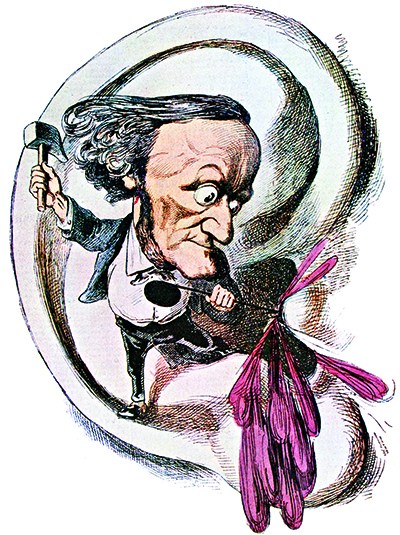
In 1876, the four operas – or music dramas (the composer’s preferred term) – of Wagner’s “Ring Cycle” were performed together for the first time, from August 13 through August 17, at the inaugural Bayreuth Festival, in the Festspielhaus (a theater of the composer’s design) in Bayreuth, Germany. The Bayreuth Festival has continued as a mecca for Wagnerites down to the present day.
To mark the 150th anniversary of the “Ring,” all three of my radio shows this weekend will tie in, in one way or another, with this most grandiose and influential undertaking.
First, today on “Picture Perfect,” we’ll have music from four films in which Erich Wolfgang Korngold served as ghostwriter for onscreen composers, providing a ballet for Errol Flynn’s in “Escape Me Never” (1946), a tone poem for Charles Boyer in “The Constant Nymph” (1943), and a cello concerto for Claude Rains in “Deception” (1946). More to the point, Korngold actually appears onscreen – hastily made-up when the actor hired for the purpose didn’t show – to play conductor Hans Richter in the Wagner biopic “Magic Fire,” for which he adapted selections from, yes, the Ring Cycle.
Then tomorrow morning, on “Sweetness and Light,” it will be the unlikeliest “light music” program, as we listen to piano transcriptions by Carl Tausig and Louis Brassin, the “Siegfried Idyll” (probably the sweetest thing Wagner ever wrote), humorist Anna Russell’s classic routine “The Ring of the Nibelungs (An Analysis),” and a cheeky work for piano four-hands by Gabriel Fauré & André Messager, in which they distill somber motifs from the cycle into a frivolous ballroom dance.
Finally, tomorrow afternoon/evening (depending on where you are), it will be an hour of historic recordings of “Die Walküre” – the second of the “Ring” operas (er, music dramas) – by Lawrence Tibbett, with Leopold Stokowski and the Philadelphia Orchestra, in 1934, and Lotte Lehmann and Lauritz Melchior, with Bruno Walter and the Vienna Philharmonic, in 1935. Also, we’ll hear Karl Muck conducting selections from Wagner’s “Parsifal” at the actual Festspielhaus, in 1927. The recording will feature actual bells of Wagner’s design, which were later melted down for munitions by the Nazis.
Hojotoho! Get out your party hats (helmets with horns and wings, of course), as we celebrate the 150th anniversary of the “Ring” this weekend, on KWAX Classical Oregon!
Stream the shows, wherever you are, at the times below:
PICTURE PERFECT, the movie music show – Friday at 8:00 PM EDT/5:00 PM PDT
SWEETNESS AND LIGHT, the light music program – Saturday at 11:00 AM EDT/8:00 AM PDT
THE LOST CHORD, unusual and neglected rep – Saturday at 7:00 PM EDT/4:00 PM PDT
Here’s the link!
https://kwax.uoregon.edu
Category: Daily Dispatch
-
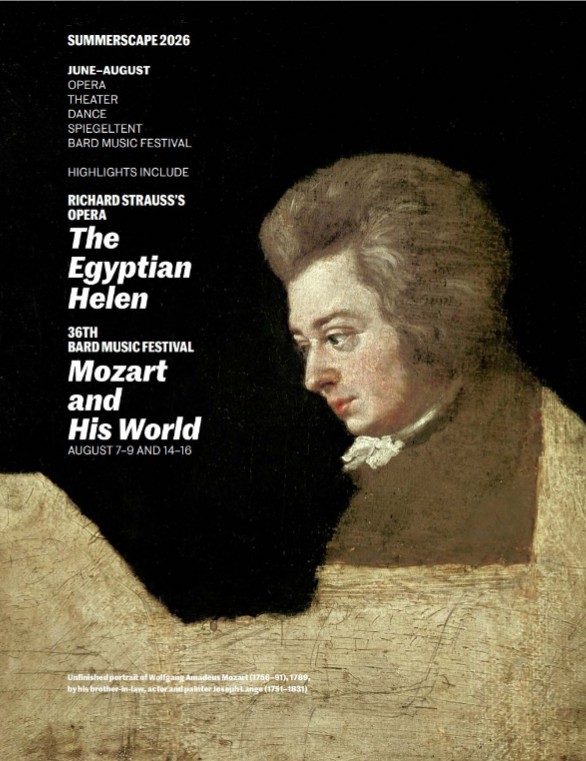
Livestreamed Content from the Bard Music Festival
With the Bard Music Festival (“Mozart and His World”) coming up this weekend at Bard College in Annandale-on-Hudson, NY, one thing I forgot to mention is that, if you’re unable to make the pilgrimage for whatever reason, concerts at Sosnoff Hall, in the campus’ Frank Gehry designed Fisher Center at Bard, will be available for livestreaming. This might be of particular interest to anyone hoping to attend opening night, as the concert appears to be sold out. (Of course, there’s always the possibly of lucking into standby tickets.)
“The Many Facets of Mozart” (Friday at 7 p.m. EDT) will feature an assortment of orchestral, vocal, and chamber performances, with old favorites such as the “Paris” Symphony, the Sinfonia concertante for violin and viola, and the Quintet for Piano and Winds (which the composer considered his best work), but also lesser-known pieces such as the Freemasonry influenced “Eine kleine deutsche Kantate” and the concert aria “Ch’io mi scordi di te?,” a very interesting work for soprano and orchestra with piano obbligato. The musical selections will be interleaved with commentary by conductor and co-artistic director Leon Botstein.
“Mozart and Prague” (Saturday at 7 p.m. EDT) will include the “Prague” Symphony, alongside works by the composer’s older Bohemian contemporaries Christoph Willibald Gluck and Josef Mysliveček. Simone Dinnerstein will be the soloist in Mozart Piano Concerto No. 18. As an added bonus, soprano Jana McIntyre, who I made such a fuss over when writing about her appearances at the Bard Berlioz festival, two years ago, and this summer’s production of Richard Strauss’ “The Egyptian Helen,” will sing the motet “Exsultate, jubilate” and an aria from Mysliveček’s opera “Il Bellerofonte.” It’s unclear to me whether the pre-concert talk, by Columbia University’s Elaine Sisman (at 6 p.m.), will be available as part of the livestream, but it has been the case when I’ve viewed some of these concerts in the past.
“Rivalries and Conspiracies (Sunday at 3 p.m. EDT) looks to be an especially fascinating program, illuminating the true nature of the relationship between Mozart and Antonio Salieri. Included will be a collaborative effort by the two composers, rediscovered as recently as 2015, “Per la ricuperate salute di Ofelia” (“For the recovered health of Ophelia”).
The second half of the concert will juxtapose selections from two operas – Mozart’s “Der Schauspieldirektor” (“The Impresario”) and Salieri’s “Prima la musica e poi le parole” (“First the music and then the words”) – which were first performed at opposite ends of an orangery AT THE SAME TIME, with the audience seated in the middle! The aim was so that the emperor, Joseph II, could determine which of the operas would delight the court more.
Both operas satirize the behind-the-scenes antics that occur during the creation of an opera. Between the meta-concept and its Ivesian realization, it all seems surprisingly modern. Also, the mad whim of a daffy ruler. I wonder if Hugo von Hofmannsthal had this in mind when he wrote the libretto for Richard Strauss’ “Ariadne auf Naxos?” In the Strauss opera, a wealthy patron (the richest man in Vienna) decides that the two works he commissioned, a drama and a comedy, should performed simultaneously, so that the entertainment will conclude in time for a fireworks display!
The Sunday program will also include a piano sonata by another Mozart rival, Muzio Clementi, whom Mozart once faced down in a piano duel. The match was deemed a tie, when the Emperor backed Mozart, but the Grand Duchess Maria Fyodorovna of Russia chose Clementi. Regardless, it was Mozart who had the last laugh, when he used a passage from Clementi’s sonata as the germ for his overture to “The Magic Flute.”
The pre-concert talk, at 2:00, will be delivered by McGill University’s Dorian Bandy.
Livestreams will also be offered from the Fisher Center during the festival’s second weekend (“Beauty, Charity and Reason” on Friday, August 14, at 7 p.m., “Family, Friends and Students” on Saturday, August 15, at 7 p.m., and a semi-staged performance of “The Abduction from the Seraglio” on Sunday, August 16, at 3:00 p.m. EDT).
Sorry, but in order to enjoy the morning and afternoon programs and panels across campus at Olin Hall, you’ll actually have to be in attendance!
“Mozart and His World” will take place at Bard College August 7-16. For more information, follow the link.
https://fishercenter.bard.edu/what-we-do/bard-music-festival/?gad_source=1&gad_campaignid=23614040550&gbraid=0AAAAACyZZJveNzj1-YYl9V6bTicb364wl&gclid=EAIaIQobChMI1_HItIyMlgMVTkP_AR0-tRbFEAAYASABEgK4afD_BwE -

Turtle Intermezzo in Mercer County, New Jersey
No doubt you follow this page because of our shared interest in classical music, classic movies, or classic books. Collectively, these form the core of my being.
However, I also happen to love animals. I mean, like crazy love. If they’re not dangerous to humans, I allow spiders to roam free, and I won’t kill a mosquito if I can help it. I don’t care if you’re a chipmunk or a skunk, you are welcome in my yard. I am thankful to abut a stretch of woodland and open space, so I get my share of raccoons, foxes, and deer.
For a number of years now, I’ve also volunteered at Mercer County Wildlife Center. They do great work there, and they work HARD, rehabilitating injured or immature raccoons, squirrels, opossums, groundhogs, rabbits, skunks, deer, snakes, waterfowl, raptors, in fact all manner of birds, bats, foxes, and a whole lot more – just about anything that would live locally in the wild (except for wolves, bobcats, and bears!). Among these are turtles, most of which are housed in what is known as the Shell Shack.
Well, the Shell Shack just got a lot cozier, as the center recently took in more than 150 box turtles, dumped on a river bank in Cranford, NJ. If you haven’t heard about it, google “Cranford turtles.”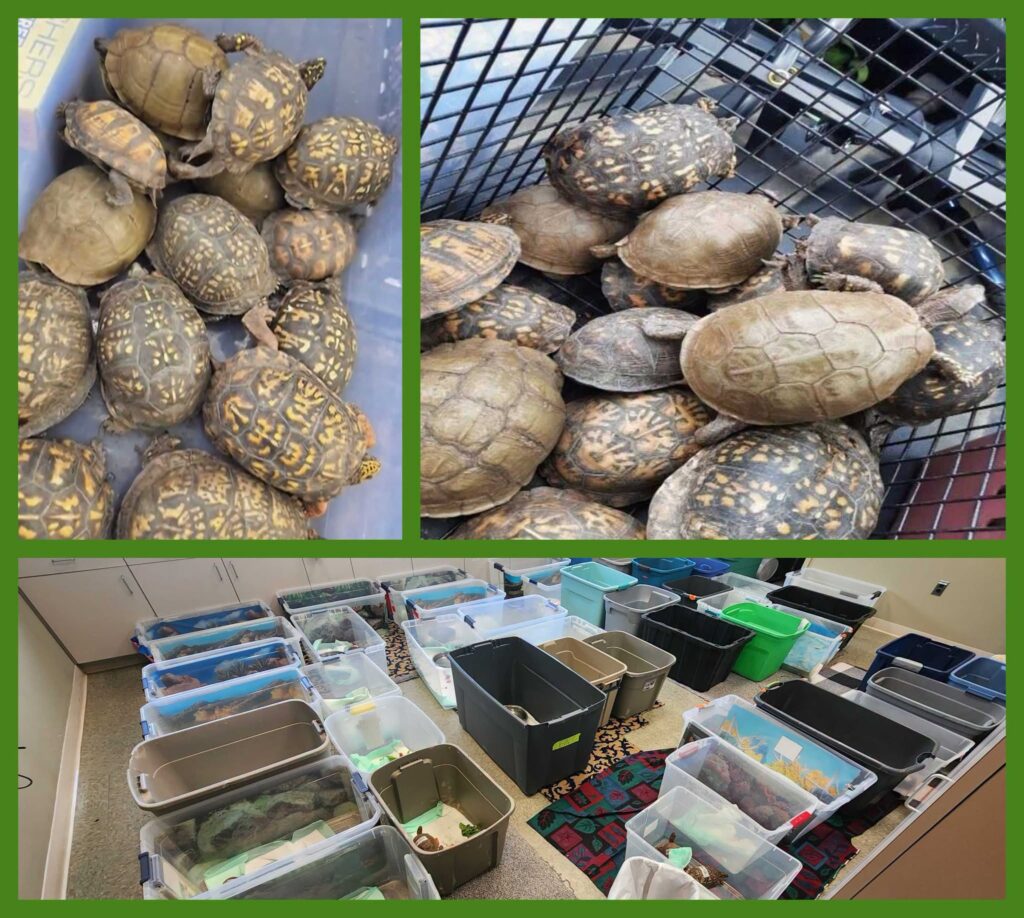
Nobody knows how or why they got there. While a fair number of them are Jersey box turtles, many are non-native to the state. International wildlife trafficking is a thing, a lucrative if unscrupulous business, and apparently there’s a huge market for American turtles in the Far East. Or it could have been an insane hoarder. Who knows? What’s evident is that somebody had to get rid of their collection.
Whatever their secret origin, Mercer County Wildlife, good folks that they are, agreed to take them in and have worked hard to accommodate the sudden influx. The count has swollen to 167 turtles!
I can’t convey strongly enough what an important resource this wildlife rehabilitation center is. It enlists roughly 85 volunteers – joined by student interns in the summers – largely, but not exclusively, for feeding and cleaning. (And how rewarding is it to syringe feed a baby squirrel?) The staff fields about 10,000 phone calls annually. The release rate of successfully rehabilitated animals stands at around 70 percent. That’s about 3,000 animals a year saved.
Otherwise healthy animals that cannot be returned to the wild on account of permanent injuries – for example, an eagle that can’t fly well enough to hunt, and an otherwise exuberant turtle who had been mishandled over a long period before being turned in (but now zips happily around a huge tank in the lobby) – are kept for educational outreach.
The Cranford box turtles are all set up now, but they still require maintenance and feeding, as do all of the other animal patients.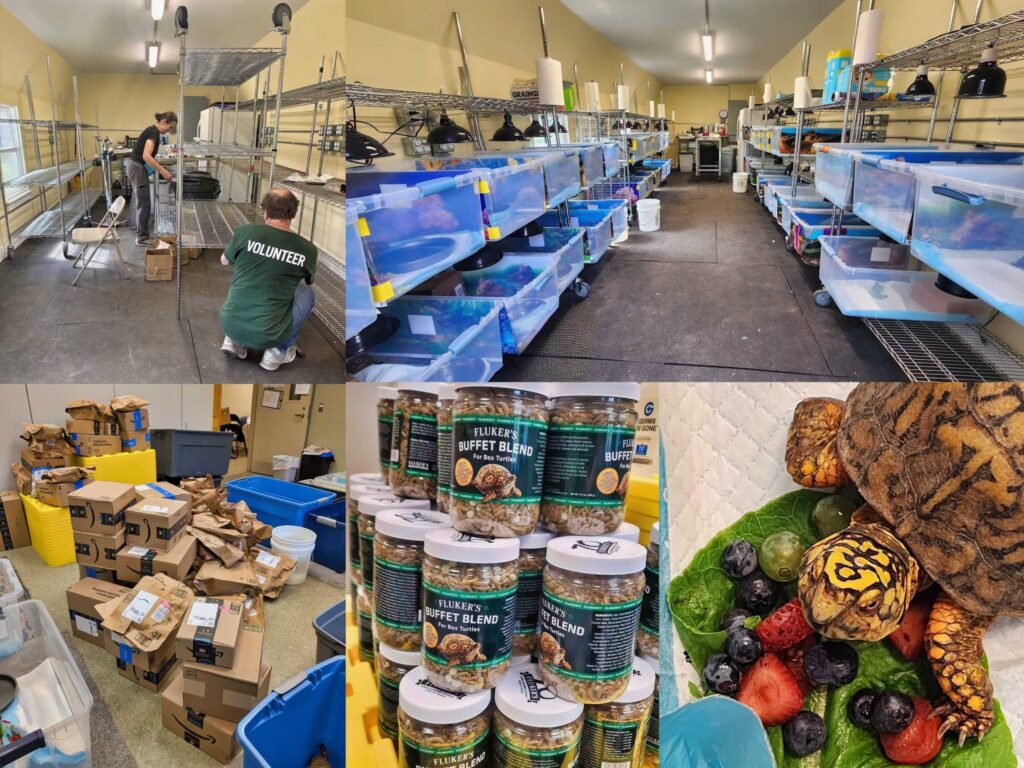
Please keep Mercer County Wildlife Center in mind when you plan your charitable giving. A donation in any amount would be welcome, much appreciated, and put to very good use. Thanks for anything you do to help and protect our wildlife!
Donate here: https://www.wildlifecenterfriends.org/donate
Click the tab at the top of the page at the link for turtle updates and photos!
-
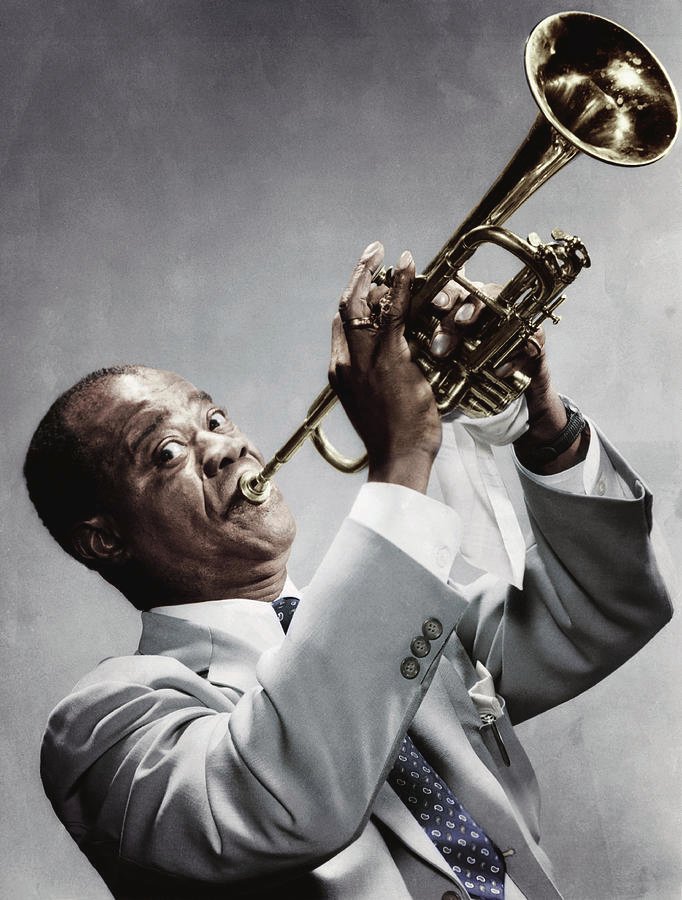
Three August Americans
A great day for American music.
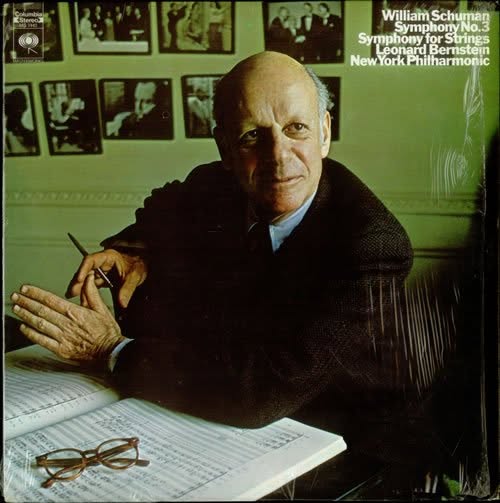
Seminal jazz artist and pop cultural icon Louis Armstrong was born on this date in 1901. Armstrong’s birth certificate didn’t come to light until years after his death, so he always celebrated his birthday on July 4. Can’t get much more American than that.William Schuman, president of the Julliard School (1945-61) and Lincoln Center (1961-69), and first recipient of the Pulitzer Prize for Music for his cantata “A Free Song” in 1943, was born on this date in 1910. In his day, he was regarded as one of our great American symphonists. His Symphony No. 3 (1941) was especially well-regarded.
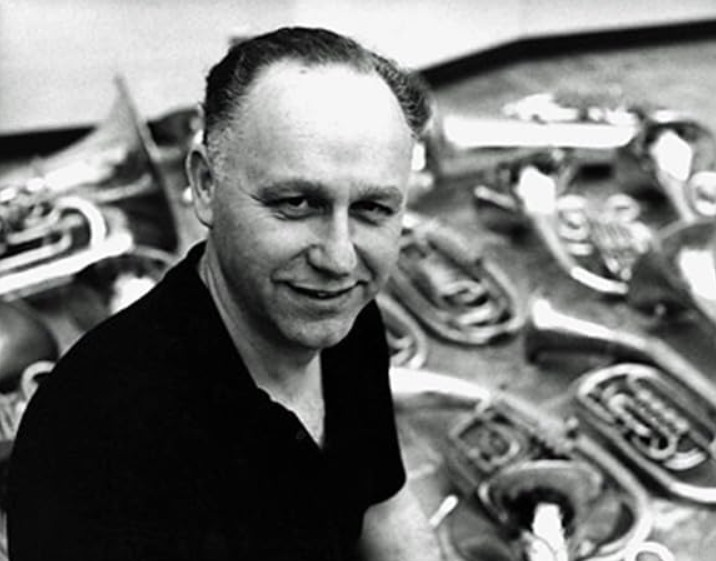
Film composer David Raksin, who got his start working with Chaplin on “Modern Times,” but best-remembered for his music for the noir classic “Laura,” was born in Philadelphia on this date in 1912. Due to his longevity – Raksin lived to see 92 – he became an invaluable fount of information about old Hollywood.
Pretty great country, that could produce that array of talent. Happy birthday, gentlemen. Thanks for all the music.
———-
Armstrong live in 1933
With Velma Middleton, “All That Meat and No Potatoes”
William Schuman on “What’s My Line?”
Schuman, Symphony No. 3
Raksin talks about working with Chaplin on “Modern Times”
Raksin plays “Laura” -
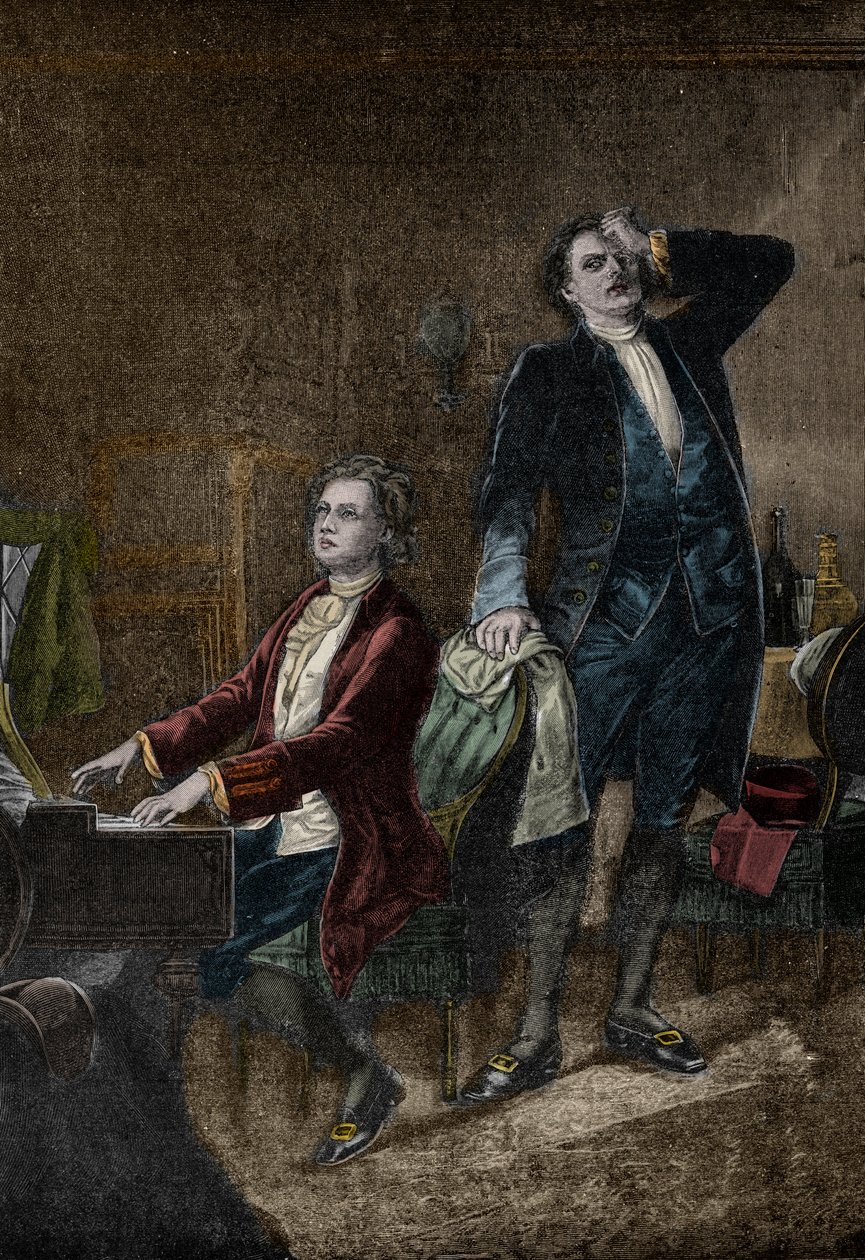
Mozart and Salieri at the Bard Music Festival
On this date in 1778, the world’s most famous opera house, Milan’s Teatro alla Scala (La Scala for short), was opened with “L’Europa Riconosciuta,” or “Europa Revealed,” a work composed especially for the occasion by Antonio Salieri. What better opportunity to remind you that this year’s Bard Music Festival, “Mozart and His World,” will commence this weekend at Bard College in Annandale-on-Hudson, NY?
Playwright Peter Shaffer and his forebears (notably Pushkin) would have us believe that a rivalry between the two composers drove a jealous Salieri to scheme “the monster” into an early grave. But the actual relationship between the two was much more nuanced, with Salieri promoting Mozart’s works and even instructing one of his children (as well as Beethoven, Hummel, Czerny, Schubert, and Liszt). Mozart and Salieri even collaborated on a work, rediscovered in 2015, “Per la ricuperate salute di Ofelia” (“For the recovered health of Ophelia”), which will be heard at the festival.
In the theater and at the movies (and now television), there is no obligation for artists to adhere to historical fact in pursuit of their own dramatic ends. But I’m confident the scholars at Bard are not going to let the enduring Salieri legend slip past without comment.
Bard missed a trick in not reviving Salieri’s La Scala opera. Instead, the festival will conclude with the Mozart opera most performed during his lifetime – not “Figaro,” “Don Giovanni,” “Cosi,” or “The Magic Flute,” but “The Abduction from the Seraglio.”
Even so, while the focus is always on the music, the Bard experience is so much more. The programming – a careful juxtaposition of works and composers – is further illuminated by biographical, historical, and musicological context.
This year, there are a few more familiar selections than has been the custom (the subject is, after all, Mozart), but there are more than enough detours to maintain interest. And all the concerts are organized around a particular theme. It’s possible for one to go to Bard either for the deep dive, attending preconcert talks and panels and chatting up the resident scholars, or for the simple diversion and enjoyment of musicmaking at a very high level in two venues, on a pleasant, green campus situated in the Hudson Valley against the backdrop of the Catskills.
Some of Mozart’s well-known works will be presented to establish context, but there will be plenty of music I guarantee you will have never heard and composers you will only know perhaps from reading about them in music histories.
As more detailed information has become available, I am delighted to find that Princeton’s Scott Burnham will be among the visiting scholars, Byron Adams will deliver the pre-concert talk for this Saturday afternoon’s concert, “Fathers and Sons” (featuring music of Mozart’s dad, Leopold, and some by the Bach boys), and pianist Simone Dinnerstein will perform two Mozart concertos on Saturday night (alongside works by Christoph Willibald Gluck and Josef Myslivecek).
Salieri wouldn’t be the only one envious to attend.
“Mozart and His World” will be held at Bard College August 7-16. Here’s the complete schedule at a glance.
https://fishercenter.bard.edu/what-we-do/bard-music-festival/
———-
IMAGE: Illustration for Pushkin’s “Mozart and Salieri,” 1830
Tag Cloud
Aaron Copland (94) Beethoven (95) Composer (114) Film Music (149) Film Score (143) Film Scores (255) Halloween (97) John Williams (197) KWAX (232) Leonard Bernstein (105) Marlboro Music Festival (125) Movie Music (164) Mozart (91) Opera (215) Philadelphia Orchestra (90) Picture Perfect (174) Princeton Symphony Orchestra (110) Radio (90) Ross Amico (244) Roy's Tie-Dye Sci-Fi Corner (290) The Classical Network (101) The Lost Chord (269) Vaughan Williams (107) WPRB (397) WWFM (881)