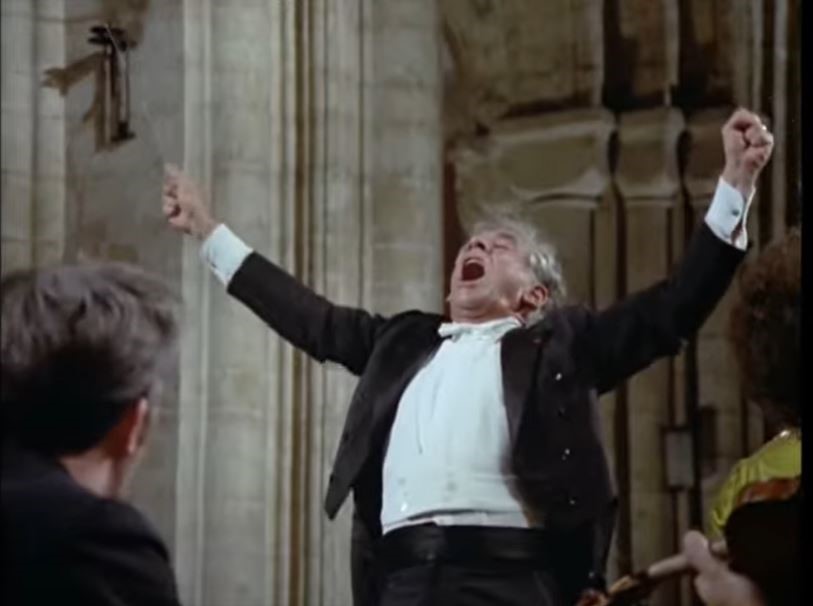
The finale of Gustav Mahler’s spinetingling “Resurrection” Symphony, conducted by Leonard Bernstein. Of course, the piece is so much more powerful – ecstatic and exhausting – when you take the full, 90-minute pilgrimage, but even excerpted, as here, it still puts my hair on end. Eat your heart out, Bradley Cooper. And happy birthday, Gustav Mahler!
The whole thing, probably riddled with YouTube ads:
At the age of 10, Buffalo-born Leonard Pennario moved with his family to Los Angeles. L.A. would remain his base of operations for the rest of his career. He made his first recordings for Capitol Records in 1950 (over 40 albums were pressed). By 1959, he was the best-selling American pianist.
This week on “The Lost Chord,” we’ll anticipate the centenary of Pennario’s birth (on July 9) with highlights from his Capitol catalogue, remastered for a 4-CD set on the MSR label. Tune in to enjoy his superlative interpretations of Prokofiev’s “Visions fugitives,” Ravel’s “La valse,” and the rarely-heard Piano Sonata by Miklós Rózsa.
I’d love to tell you more – about Pennario’s remarkable development and early triumphs, his professional relationships with top-tier musicians and personal ones with Hollywood glitterati, his ambivalent reception by the critics and his excellence at bridge – but it’s a holiday weekend, so I hope you’ll understand if I leave a little something for the show!
I hope you’ll join me for “Go West, Young Man” – Leonard Pennario in Los Angeles – on “The Lost Chord,” now in syndication on KWAX, the radio station of the University of Oregon!
Clip and save the start times for all three of my recorded shows:
PICTURE PERFECT, the movie music show – Friday at 8:00 PM EDT/5:00 PM PDT
SWEETNESS AND LIGHT, the light music program – ALL NEW! – Saturday at 11:00 AM EDT/8:00 AM PDT
THE LOST CHORD, unusual and neglected rep – Saturday at 7:00 PM EDT/4:00 PM PDT
No more blather and bleeding chunks from the local classical music station. Enjoying complete works, such as Leonard Bernstein’s “Serenade after Plato’s Symposium,” Richard Strauss’ “Also sprach Zarathustra,” and Frederic Chopin’s Piano Concerto No. 1, introduced by mellifluous fellow Trenton-Princeton radio exile Peter Van de Graaff on KWAX this morning, courtesy of digital radio. A whole world of classical music radio broadcasts now at my fingertips, enjoyable without the intermediation of a smart phone or laptop. A liberating windfall from my recent birthday! My light music program, “Sweetness and Light,” begins at 11:00 EDT/8:00 PDT. Enjoy an hour of beach music at kwax.uoregon.edu.
It’s the Fourth of July weekend, and the beaches are open!
I hope you’ll join me this morning on “Sweetness and Light” for some serene inspirations evocative of surf and sand.
For the locals (I am, after all, based in Princeton), I’ll have two works that are Jersey shore specific, including the “Cape May Suite” by Rick Sowash (who lives in Cincinnati; so there!) and “The Atlantic City Pageant” by John Philip Sousa – named for the famous beauty pageant and given its first performance on Atlantic City’s Steel Pier.
We’ll also hear from Virgil Thomson, Émile Waldteufel, Ronald Binge, Clive Richardson, Ralph Vaughan Williams, and Morton Gould.
Oh yeah, and I almost forgot John Williams, who wryly puts “Tourists on the Menu” in a promenade from the proto-summer blockbuster “Jaws.”
No teeth in any of the music, however, on “Sweetness and Light.” Meet me at the seaside this Saturday morning at 11:00 EDT/8:00 PDT, exclusively on KWAX, the radio station of the University of Oregon!
The great cellist János Starker would have been 100 years-old today. Hard to make out what this commercial might actually be for, since he’s living quite large, enjoying some music (on vinyl), a cigarette, and what looks like a glass of scotch – interestingly at odds with his ascetic sartorial and decorative choices. Spoiler: the ad is for a stereo system.
That looks like a portrait of composer Zoltán Kodály on the wall. By coincidence, Kodály’s educational system of solfège hand signs plays an important part in Steven Spielberg’s “Close Encounters of the Third Kind,” which I only just posted about this morning. Starker knew Kodály, who was on the faculty while he was a student at the Franz Liszt Academy of Music in Budapest.
Starker survived internment in a Nazi concentration camp (he was Jewish) to become one of the world’s most celebrated cellists. He served as principal with the Dallas Symphony Orchestra, at New York’s Metropolitan Opera, and with the Chicago Symphony, and left his mark as an outstanding soloist and chamber musician. In all, he made over 150 recordings.
For over 50 years, he was on the faculty of Indiana University Jacobs School of Music. He died in 2013 at the age of 88. Not bad, considering he smoked 60 cigarettes a day and consumed copious amounts of scotch.
It’s doubtful American television would have aired a 90-second ad like this, even back in 1982.
Starker plays the third movement of Kodály’s Sonata for Solo Cello
Starker first played the sonata for the composer in 1939, at the age of 15. He did so again, shortly before Kodály’s death in 1967. Kodály told Starker, “If you correct the ritard in the third movement, it will be the Bible performance.” The cellist recorded the work four times, in 1948, 1950, 1956, and 1970.
François Truffaut lectures on Kodály hand signs in this scene from “Close Encounters of the Third Kind.”