Category: Daily Dispatch

  • Rachmaninoff’s Birthday Dog Prelude & His Regrets

    Rachmaninoff’s Birthday Dog Prelude & His Regrets

    According to the “Old Style” calendar, Sergei Rachmaninoff was born in Russia on March 20, 1873 – which translates to April 1 on the Gregorian calendar. However, it would appear that Rachmaninoff himself preferred to celebrate on April 2, as supported by this application for U.S. citizenship archived at the Library of Congress.

    https://www.danperforms.com/wp-content/uploads/2021/05/Rachmaninoff-Birth-Certificate.jpg

    Today is an excellent excuse, therefore, to share this clip of some dude playing the Prelude in C-sharp minor with the assistance of his dog – which I can’t stop watching!

    https://www.youtube.com/shorts/FdUbPrxU7g4

    Rachmaninoff, a lifelong dog-lover, no doubt would have approved.

    Unfortunately, the composer came to loathe this particular piece, the second of five “Morceaux de fantaisie,” Op. 3. Russian publishers at the time did not pay royalties, so he basically sold it outright, at the age of 19, for 40 rubles.

    Much to his chagrin, “The Prelude” was an instant hit. Opportunistic publishers in the West issued it under many titles, and of course he never saw a penny.

    Yet he was expected to include it in every recital.

    Whenever it came time for him to play his encores, invariably audiences would cry “C-sharp!” If he refused, they hissed. The composer confided, “Many, many times I wish I had never written it.”

    The piece is so sober and portentous, how could it not have been parodied often?

    You asked for it, you got it: happy belated birthday, Sergei Rachmaninoff!


    Mickey Mouse, “The Opry House”

    Harpo Marx, “A Day at the Races”

    Igudesman & Joo

  • Hamlisch’s Historic Oscar Triumph

    Hamlisch’s Historic Oscar Triumph

    50 years ago today, Marvin Hamlisch made history at the 46th Academy Awards, when he became the first person ever to win in three music categories at the same Oscars ceremony. Hamlisch was honored with the awards for Best Original Score and Best Original Song (with Alan and Marilyn Bergman) for “The Way We Were,” and also in the rather cumbersomely-named category “Best Scoring: Original Song Score and Adaptation or Scoring: Adaptation,” for “The Sting.”

    Hamlisch’s use of ragtime as the basis for his music for “The Sting” contributed enormously to the Scott Joplin revival of the 1970s. Suddenly everyone was pecking out “The Entertainer” on their pianos. Nevermind the fact that the prevalence of Joplin’s music in the film was anachronistic for a caper set during the 1930s; the music perfectly complemented the bright and breezy hijinks of Paul Newman and Robert Redford.

    Hamlisch was only the second artist, after Richard Rodgers, to win all five of the major awards: Emmy (4), Grammy (4), Oscar (3), Tony (1), and, most unusually for a musical, the Pulitzer Prize for “A Chorus Line.”

    Hamlisch thanked Joplin in his “Sting” acceptance speech. Later, when the nominees for Best Original Score were read, Cher made a repeated hash of Hamlisch’s name, until corrected by Henry Mancini. But Hamlisch had the last laugh, when he in turn acknowledged her as “Sheer.”

    The presenters for the song-and-adaptation Oscar were Donald O’Connor and Debbie Reynolds. John Huston introduced Mancini and Cher. As a nice bonus, John Williams was also honored with two more nominations, pre-“Jaws.” Williams won his first Oscar, for adapting the music for “Fiddler on the Roof,” in 1972.

    The ‘70s were a very good decade for Joplin, who died in 1917 at the age of 48. In 1970, Joshua Rifkin’s first LP of Joplin piano rags became a classical bestseller for Nonesuch Records. The same year, the composer was inducted into the Songwriter’s Hall of Fame. In 1973, Gunther Schuller revived period orchestrations of Joplin’s works for another recording, “The Red Back Book,” which won a Grammy.

    Joplin’s opera, “Treemonisha,” was finally given its first complete staging in 1972. And in 1976, Joplin received a citation from the Pulitzer Prize committee “for his contributions to American music.” Of course, by then, he had already been dead for 59 years.

    More than anything, it was the use of his rags on the soundtrack for “The Sting,” and the resulting Top-40 status of “The Entertainer” (which reached number 3 on the Billboard charts), that brought Joplin roaring back into the popular consciousness.

    Intriguingly, after Hamlisch’s death in 2012, it was revealed that he had been poised to succeed Peter Nero as music director of the Philly Pops, leaving us in the Philadelphia area to muse on what might have been.

    More than just a singular sensation, Marvin Hamlisch was the one.

  • Rachmaninoff Busoni Dogs Composers Birthdays

    Rachmaninoff Busoni Dogs Composers Birthdays

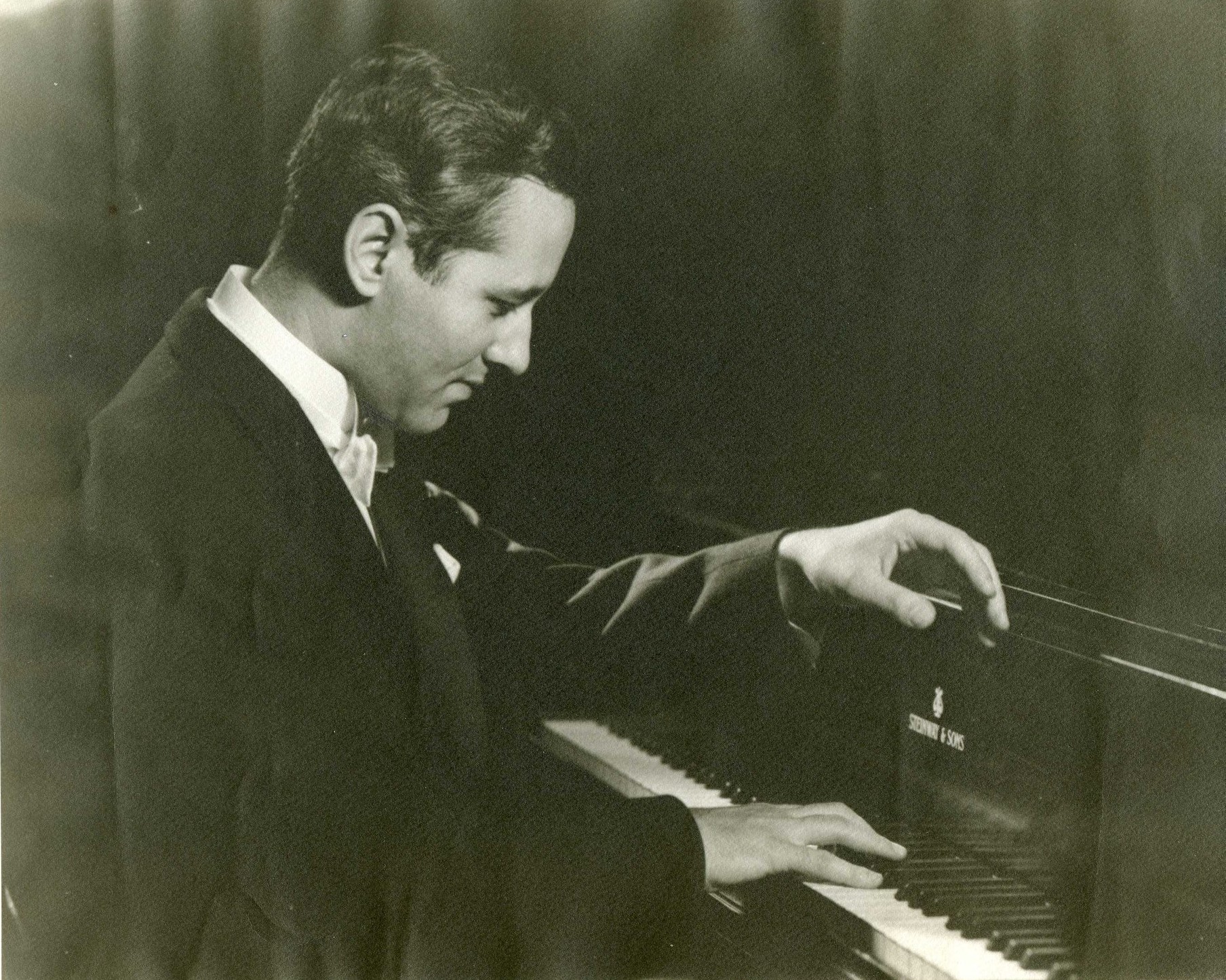
    On their birthdays, two formidable composer-pianists with their dogs: Sergei Rachmaninoff and Levko (left) and Ferruccio Busoni and Giotto. Uploading additional photos to the comments section now.

  • Rachmaninoff’s April Fool’s Humor & Busoni’s Epic

    Rachmaninoff’s April Fool’s Humor & Busoni’s Epic

    Happy April Fool’s birthday to laugh-riot Sergei Rachmaninoff.

    Depending on where you look, Igor Stravinsky described his dour compatriot as either “six-foot-two of Russian gloom” or “a six-and-a-half-foot scowl.” Perhaps both. It’s true, you won’t find very many photos of Rachmaninoff smiling. But just to prove he was not entirely without a sense of humor, I share with you the following anecdote:

    Rachmaninoff was a favorite recital partner of violinist Fritz Kreisler. Once, in the middle of a concert in New York, Kreisler suffered a memory lapse. As he continued to noodle on his violin, feigning nonchalance while attempting to grope his way out of the labyrinth, he subtly inched closer to his pianist.

    “Where are we?” he whispered.

    To which Rachmaninoff replied, “Carnegie Hall.”

    On this day devoted to fun and frivolity, the two friends are reunited in spirit in Rachmaninoff’s transcription of Kreisler’s “Liebesfreud,” or “Love’s Joy.”

    Also, a shout-out to inadvertent prankster Ferruccio Busoni, another great pianist born on this date. Actually, his parents named him Ferruccio Dante Michelangelo Benvenuto Busoni. So clearly he had a sense of destiny. Or at any rate, he had a lot to prove! Perhaps that’s what spurred him to write what could very well be the most grandiose piano concerto of all time.

    Busoni’s concerto swings for the fences, with an epic, 70-minute running time, large orchestration, demanding solo part, and men’s chorus in the finale (which doesn’t start singing until an hour in).

    The text, from Adam Oehlenschläger’s verse-drama “Aladdin,” begins:

    “Deep and quiet, the pillars of rock begin to sound:
    Lift up your hearts to the power eternal,
    Feel Allah’s presence, behold all his works!”

    In the score, Busoni instructs that the chorus should be “invisible.” Somehow, this was mistranslated, resulting in a widespread belief that he actually wanted the singers to perform nude. Whether or not it’s ever been presented that way (in the interest of authenticity) is anyone’s guess.

    Oddly, the concerto isn’t designed as a showcase for a fire-eating virtuoso. Beyond it being something of an endurance test for the soloist, there aren’t really any flashy cadenzas or too many opportunities to hot dog. The work is more like a gargantuan piano fever dream.

    I particularly like the movement “All’Italiana,” evocative of Italian folk music and popular song. It always makes me think of Chico Marx.

    To give you a sense of perspective, Rachmaninoff’s ever-popular Piano Concerto No. 2, at less than half the length, was first performed three years earlier, in 1901. The work would later be used on the soundtrack to “Brief Encounter.” There is nothing brief about Busoni’s concerto.

    The pianist here is Marc-André Hamelin, who used to come into my bookshop looking for arcane sheet music, back in the day. Just a few years before this video, as a matter of fact. About a decade later, I saw him perform Busoni’s concerto at Carnegie Hall.

    The Chico Marx business begins about 46 minutes in. The movement gets zanier and zanier.

    Here Eileen Joyce plays Rachmaninoff’s Piano Concerto No. 2 in “Brief Encounter,” with Celia Johnson and a young Trevor Howard:

    Happy birthday, Busoni and Rachmaninoff!

  • Haydn’s Easter Symphony No 30 Alleluia

    Haydn’s Easter Symphony No 30 Alleluia

    In the name of all that’s holy – not only is it Easter; it’s also Haydn’s birthday!

    Having done Easter morning radio broadcasts for 19 years – some of them lasting up to six hours – I became quite adept at pulling together varied and, I like to think, interesting, wholly enjoyable Easter programs.

    One of the staples of these broadcasts was always Haydn’s Symphony No. 30, composed in 1765. The work was nicknamed “Alleluia,” for a Gregorian Holy Week plainsong chant quoted in its first movement.

    Now that the kids are done with their egg hunts, it’s high time for a little Haydn seek.

    Enjoy the symphony, happy Easter, and happy birthday, Franz Joseph Haydn!

Tag Cloud

Aaron Copland (93) Beethoven (95) Composer (114) Film Music (124) Film Score (143) Film Scores (255) Halloween (94) John Williams (188) KWAX (229) Leonard Bernstein (101) Marlboro Music Festival (125) Movie Music (139) Opera (202) Philadelphia Orchestra (89) Picture Perfect (174) Princeton Symphony Orchestra (106) Radio (87) Ralph Vaughan Williams (85) Ross Amico (244) Roy's Tie-Dye Sci-Fi Corner (290) The Classical Network (101) The Lost Chord (268) Vaughan Williams (103) WPRB (396) WWFM (881)

DON’T MISS A BEAT

Receive a weekly digest every Sunday at noon by signing up here


RECENT POSTS