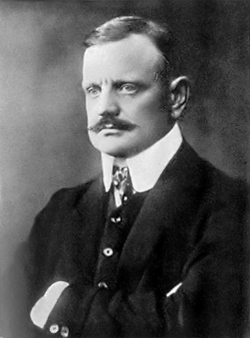
Josef Suk (1874-1935) was the one-time pupil and eventual son-in-law of Antonin Dvořák. In fact, his early works very much reflect Dvořák’s influence, sunny, romantic music full of nationalistic touches.
However, a double tragedy occurred in Suk’s 30th year. In 1905, he lost both his father-in-law and his beloved wife – Dvořák’s elder daughter – Otilie. The events directly inspired Suk’s “Asrael Symphony,” named for the Angel of Death. Not surprisingly, morbidity colors much of his mature output.
Today marks the 150th anniversary of Suk’s birth. Here are some samples of Suk, pre- and post-happiness.
Serenade for Strings (1892)
“Asrael Symphony” (1905-06)
And a personal favorite, “Pohádka,” or “Fairy Tale” (1897-98). Suk arranged the suite from incidental music he composed for a play called “Radúz and Mahulena,” in which true love conquers all. The work took on special significance for the composer, since it was the period in which he was secretly in love with his teacher’s daughter and feared the day of reckoning, when all would be revealed. He needn’t have worried, of course. Dvořák was delighted. Alas, Suk’s happiness was to be short-lived.
It’s always interesting to go back and look at a piece of speculative fiction. Even the widely-lauded “2001: A Space Odyssey” (1968) carried the Pan-Am corporation ten years past the company’s expiration. It’s not the only thing it got wrong, of course. The belated sequel, “2010: The Year We Make Contact” (1984), doubles-down on the Pan-Am attachment (the company was still in existence at the time of the film’s making); but what’s more resonant in these movies is not what they got wrong, but rather what they got right.
Hindsight will be 20/10 on the next Roy’s Tie-Dye Sci-Fi Corner, as we kick off the new year with a conversation about Arthur C. Clarke’s vision of a redemptive future.
“2010” connects best when it addresses what, for better or worse, never changes – human nature. If anything, its message of peace and the necessity of cooperation between the world’s nations is more timely than ever. Also, it makes us care more about its characters than Stanley Kubrick ever did in the comparatively aloof original.
Where the sequel is conspicuously less successful is in addressing the great, unknowable mysteries of the beyond. Peter Hyams is no Kubrick, nor does he attempt to emulate his style, but he puts together a surprisingly competent follow-up, with a knock-out cast, including Roy Scheider, Helen Mirren, John Lithgow, and the always fine Bob Balaban, in the days before Jeff Goldblum gobbled up all the quirky scientist roles.
The special effects are spectacular, of course – by 1984, they had it down – but they could never be as special as in 1968, when technicians had to invent everything from the ground up. Much as space travel was portrayed as commonplace in “2001,” believable depictions of planets and space ships, by 1984, had become a matter of course. It pains me now to look back and be reminded of how good we still had it at the movies, before everything really did become mundane with the rise of CGI.
Some of “2010” is a little too literalist for my taste, but fans of the original will have fun with the meticulously reconstructed sets and the return of Keir Dullea, the Discovery, and Hal-9000 – the latter given an unexpected twist in its character arc.
Roy and I will be joined by filmmaker Jeffrey Morris (who, if I understand correctly, had some experience with Hyams), for a reassessment of perhaps three-quarters of an underrated movie. “2010” is sci-fi for adults, so it’s good that Jeffrey will be on hand to keep us on point. But there will be plenty of “Contact” sport in the comments section, I’m sure, when we livestream on Facebook, YouTube, etc., this Friday evening at 7:00 EST!
“2001” franchise-creator Arthur C. Clarke predicts our modern world with, in some respects, remarkable accuracy in this astonishing video. Still waiting for the blessing/curse of his replicator, though, even as I detest his vision of animal “servitude.”
“The only thing we can be sure of about the future is that it will be absolutely fantastic.”
Unexpectedly, I got to spend a few hours with a very good friend on New Year’s Eve, a high point of the holiday – perhaps THE high point. He’s been in the act of overhauling his living room, taking up the carpet, replacing the furniture, and, his greatest source of pride, enhancing his entertainment center.
So we listened to Korngold’s Symphony in F-sharp (yes, folks, that is how I like to celebrate New Year’s Eve) and “Straussiana,” and, since he’s also a ‘70s prog rock guy (when we were teenagers, I remember, I would sometimes see him at school wearing a Yes t-shirt), we fell into a discussion about unexpected quotations of classical music in ‘70s popular song.
That’s when he put on “Beach Baby.” “Beach Baby,” written by John Carter and his wife, Gillian Shakespeare, became the only substantial hit for the band The First Class in 1974. It clearly emulates the carefree endless summer sound of The Beach Boys, in ironic contrast to the lyrics which suggest it’s all now a faded memory, at least as far as the love relationship is concerned.
So I’m sitting there, my thoughts drifting to Wawa Hoagie Fest jingles, when all of a sudden what should appear in the firmament but the noble “swan theme” that climaxes Jean Sibelius’ Symphony No. 5! Talk about out of left field.
Sibelius, Finland’s national composer, wrote the 5th on a commission from the Finnish government to celebrate his 50th birthday. That’s how big a deal Sibelius was and is in Finland. The last movement builds to a climax of impressive grandeur, a sublime apotheosis in the form of an ennobling “swan theme” (identified as such, as Sibelius specifies in his journal that it was the sight of swans in flight over a lake near his home that inspired it). The 5th Symphony is among the noblest in the entire literature, and I have long regarded it as my favorite symphony.
And here it was, hilariously, seemingly out of nowhere, in “Beach Baby.”
Somehow its use got back to the Sibelius estate, as a lawsuit was filed against the songwriters for copyright infringement. The case was settled out of court, with the estate receiving half of the song’s proceeds.
But I guess it was worth it, as it became the band’s biggest hit. In fact, it was the band’s only hit. Although they went on to release two studio albums and a number of singles, The First Class was unable to replicate the success of “Beach Baby.” Maybe if they had gone on to appropriate the big tune from Sibelius’ Symphony No. 2…
Interestingly, Trenton composer George Antheil, who never seemed to have a problem with aping the styles of his contemporaries, also “borrowed” a passage from Sibelius’ 5th. I’ve never seen anything to the effect that he received a cease-and-desist because of it. Then again, it’s not quite so blatant unless you really know Sibelius’ symphony. For some reason, he poaches not the “swan theme,” but rather a scurrying passage in the strings introduced at the opening of the last movement (preceding the big tune). Did George really get away with it? He WAS the Bad Boy of Music.
All in all, a New Year’s Eve well spent.
Once you know “Beach Baby,” it’s easy to detect a suggestion of the Sibelius tune at the opening, but the blatant crib appears around three minutes in.
In this recording of Antheil’s Symphony No. 3, his Sibelius crib appears for the first time, in the second movement, around 17 minutes in. Here, I cued it up for you.
Finally, the last movement of Sibelius’ Symphony No. 5, in all its glory
They say that imitation is the sincerest form of flattery. The Sibelius estate says, see you in court!
In eulogizing composer Ron Nelson and hornist Hermann Baumann earlier today, I failed to notice Alice Parker has also died. Parker, the eminent choral composer, director, and teacher, wrote more than 500 arrangements and original compositions. With her music in the repertoire of churches and choral societies everywhere, she was one of the most frequently performed and heard of contemporary composers, with weekly auditors in the thousands.
A native New Englander, Parker largely ignored contemporary trends in composition, instead often drawing inspiration from folk music and hymn tunes. As a composer for voice, she was also attracted to poetry. Her musical output was enormous. Among her original works were 11 song-cycles, 11 works for chorus and orchestra, 33 cantatas, 47 choral suites, and more than 40 hymns. She also composed four operas and authored at least five books.
Parker saw music as a unifying force. Her final work, “On the Common Ground,” completed in 2020, was an appeal to a country deeply divided by politics and values.
“Beauty awakens the sense, in us, of our vulnerability as human beings,” she commented in 2017. “It’s why you feel like crying when you see a gorgeous sunset, or hear a Bach solo cello suite, or a gorgeous melody, or a little kid singing.”
“When we sing something perfectly lovely together… and it really clicks, you have this marvelous feeling of brotherhood in the room,” she stated elsewhere. “We are all human beings. We are all feeling this emotion together at the same time. And this is uniting us. We are not separate.”
Parker died on Christmas Eve. She was 98 years-old.
I borrowed some of this information from an appreciation in today’s Washington Post.
On January 2, I breathe a sigh of relief, as things are poised to settle down. Glancing over my shoulder at the past two or three weeks, I really don’t know how I made it through the holidays. I’m aware that there’s real suffering in the world, and by comparison I am very lucky, and I should just suck it up, but for me sustained frenzy is not the true meaning of Christmas! I need some quiet. So I’ll keep the tree up a while longer and build in some time for reflection and maybe listen to some of the music I never got around to enjoying during the month of December.
Sadly, two prominent musicians will not have that luxury, as neither made it through the holidays for real.
I suppose, like many, I first encountered Ron Nelson’s music in Howard Hanson’s classic Mercury recording of his “Savannah River Holiday.”
His sarabande “For Katherine in April” is also quite lovely.
Those who played in wind bands may have broader familiarity with his work, because of pieces like “Rocky Point Holiday.”
Leonard Slatkin once described him as “the quintessential American composer,” noting his “ability to move between conservative and newer styles with ease. The fact that he’s a little hard to categorize is what makes him so interesting.”
I was just thinking about Nelson the other day, believe it or not, probably because of his birthday (which fell on December 14). I can’t imagine I was thinking of him on Christmas Eve, the day of his passing.
Nelson was 94 years-old.
We also lost legendary hornist Hermann Baumann. I know it’s terrible to say, but I confess I assumed Baumann died long ago. I remember an on-air announcement on Philadelphia’s WFLN that he had suffered a paralyzing stroke – and WFLN has been off the air since 1997!
But apparently he recovered sufficiently to resume performing and teaching. Good for him. I have no idea whether or not he was able to attain his former excellence. An often disorienting effect of recordings is that we are exposed to the same performances again and again, as if the artists are preserved in amber. So it’s especially shocking when the illusion is shattered and suddenly we realize how much they have aged or even passed away. For those of us still spinning records from decades ago, these artists exist forever in their prime.
Baumann’s recordings have given me much pleasure over the years. I find it interesting that he began his career as a singer and a jazz drummer, before switching to the French horn at the age of 17. He certainly made up for lost time, as he landed principal positions with several German orchestras over a period of about 12 years.
He began his solo career in 1964 – a bold move, as how many horn concertos are there, next to those written for the piano and the violin? But Baumann was also a prolific chamber music artist. In addition, he was a pioneer in performance of music from the Baroque and Classical eras on the natural horn, a valveless instrument.
Baumann died on December 29. He was 89 years-old.
The holidays are a time we should be counting our blessings. R.I.P., gentlemen, and thanks for all the music.
Baumann, seemingly of able body, talking about singing and the French horn
Playing Bach on the natural horn
A selection from Beethoven’s Sextet for 2 Horns and String Quartet