Category: Daily Dispatch

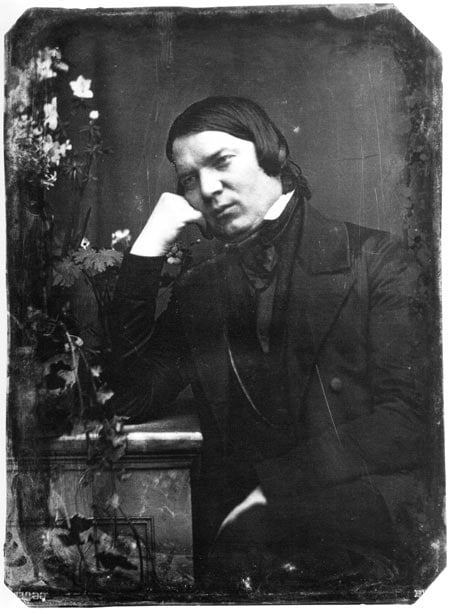
  • Robert Schumann Tormented Genius

    Robert Schumann Tormented Genius

    A would-be concert pianist, he’s said to have destroyed his hand through the use of a finger-strengthening device of his own design.

    He took his underage sweetheart’s father – who also happened to be his teacher – to court, to sue for the right to marry, ultimately winning that right the day before she came of age.

    He went mad from syphilis, hurled himself into the Rhine, and spent his final months in an asylum.

    His name was Robert Schumann, and he was one of the most romantic of Romantic composers.

    It’s hardly surprising that such an overheated personality would write such emotionally turbulent music. Whether tender (as per “Kinderszenen,” his reminiscences of childhood) or troubled (the “Nachtstücke,” a premonition of his brother’s death), Schumann was the ne plus ultra of tormented genius.

    Happy birthday, Florestan! Or should that be Eusebius?


    “Kinderszenen” (“Scenes from Childhood”), performed by Clara Haskil

    “Nachtstücke” (“Night Pieces”), performed by Emil Gilels

    “Fantasie in C major,” performed by Valdimir Horowitz

    The “Fantasie” was completed in 1839, during Schumann’s enforced separation from Clara Wieck, his future wife. He wrote to her: “The first movement is the most passionate I have ever composed; it is a profound lament on your account.”

    In the end, he dedicated the work to Franz Liszt. Liszt returned the favor by dedicating his Piano Sonata in B minor to Schumann in 1854. By that time, Liszt had long been persona non grata to the Schumanns. Clara, in particular, loathed him and his music.

    She confided in her diary: “Liszt sent Robert today a sonata dedicated to him and several other things with a friendly letter to me. But the things are dreadful! [Johannes] Brahms played them for me, but they made me utterly wretched … This is nothing but sheer racket – not a single healthy idea, everything confused, no longer a clear harmonic sequence to be detected there! And now I still have to thank him – it’s really awful.”

    In any case, Robert, at 44, was already in the asylum.

  • Albinoni’s Adagio Mystery: Fact or Fiction?

    Albinoni’s Adagio Mystery: Fact or Fiction?

    I’ve told this story so many times, I thought surely I had shared it here before. Maybe I have. But it’s not turning up in a search of my old posts, so please forgive me if I’m repeating myself.

    Today is the 350th anniversary of the birth of Tomaso Albinoni.

    Albinoni is one of those Italian Baroque composers (Venetian, to be exact) who wrote so much agreeable, fairly interchangeable music. Perfect for morning or afternoon drivetime. For the most part, his works are short – ten minutes at average, as an educated guess. Those in a major key are bright, those in a minor key don’t dig too deeply. Oboe concertos. Concertos for strings. Thanks to Albinoni, the term “concerto a cinque” is heard fairly commonly on classical music radio stations.

    In his lifetime, his works were viewed as being on a par with those of Arcangelo Corelli and Vivaldi. Bach also found his music of interest, basing at least two of his fugues on Albinoni themes and using the composer’s basslines for instructional purposes. It is this matter of the bassline that has secured Albinoni’s immortality in the hearts of music-lovers everywhere.

    During World War II, a significant portion of Albinoni’s output was lost in the bombing of Dresden. (Which makes me wonder, how much did this guy actually write, anyway?) Then in 1958, seemingly out of nowhere, a musicologist by the name of Remo Giazotto (1910-1998) published a previously-unknown “Adagio in G minor.” This he claimed to have reconstructed from surviving fragments – a bassline and the wisp of a violin melody – from an Albinoni manuscript that had been housed in the Dresden State Library.

    Sad and soulful, perhaps even desolate – wholly of a piece, in fact, with the tale of its recovery from the ruins of a city that had been leveled in a three-day Allied attack – it has become Albinoni’s most-frequently performed work. It’s been used in countless movies and television shows – “Gallipoli” comes to mind – and it is included in just about any collection of greatest hits of the Baroque.

    The thing is, did Albinoni really write it?

    Curiously, for whatever reason, Giazotto never produced the actual manuscript from which he claimed to have reassembled the work. This has led to a widespread belief that the piece is not by Albinoni at all, but Giazotto’s own creation. But if that’s indeed the case, why not own it? It’s beautiful music, man!

    Perhaps he was afraid of being laughed out of academia. “Respectable” music at this point in time was teetering into the avant-garde. At the very least, it wasn’t tonal.

    Interestingly, following Giazotto’s death, one of his assistants, Muska Mangano, did find the “Albinoni” fragments among his papers. In the upper right-hand corner of the page, there was a stamp corroborating that the source material had indeed once been stored in Dresden. However, the fragments had been transcribed in a modern hand. It’s assumed that this was the source from which Giazotto worked.

    The original Albinoni manuscript has yet to be recovered. Clearly, there is still a fair amount of mystery surrounding the true provenance of this timeless, haunting classic.

    So once more, an assessment of Albinoni manages to focus very little on the merits of his own achievements! Nothing about the cantatas. Nothing about the operas, which nobody knows.

    Still, if people are still talking about him 270 years after his death, he must have done something right.

    Happy birthday, Tomaso Albinoni!


    The Albinoni Adagio

    A whole mess of Albinoni “concerti a cinque” performed by I Musici

    An aria from one of his operas

    Trailer for Peter Weir’s “Gallipoli”

  • George Szell Autocrat Genius Cleveland Orchestra

    George Szell Autocrat Genius Cleveland Orchestra

    All’s Szell that ends well.

    A notorious autocrat from an era when autocrats were tolerated, respected, and even revered on the podium, George Szell was a formidable perfectionist, even to the extent of lecturing the Severance Hall custodians on the proper way to mop a floor and what kind of toilet paper they should be supplying in the restrooms.

    When he took over as music director in Cleveland in 1946, straight off, he fired 12 of the orchestra’s 97 players and signed the rest to short-term contracts. His aim was to rebuild the ensemble into a force to be reckoned with. “A new leaf will be turned over with a bang,” he declared. By the time of his death in 1970, 40 percent of his musicians were seeing psychiatrists.

    Dietrich Fischer-Dieskau noted “his compulsive need to always have an opinion different from others and his considerable paranoia when it came to the orchestra’s ill-will.” Just because you’re paranoid doesn’t mean they don’t hope you fall down the stairs and break your neck.

    He may have been a bit of a martinet and a world-class S.O.B., but Szell’s goal was a lofty one. He whipped Cleveland into one of the country’s top orchestras – which is to say, one of the best in the world. If he expected much of his musicians, he himself never phoned-in a performance. He was always hyper-prepared, and in rehearsals, nothing escaped his notice. It was not unusual for him to take everything apart and rebuild it from the ground up, even at the expense of his musician’s nerves. Sometimes it backfired, and the orchestra was so wrung out, it had nothing left for the actual performance.

    While the uncanny precision of Szell’s Clevelanders was often praised, many of their performances were criticized for a perceived lack of warmth. Certainly, there is enough documentary evidence to prove that on occasion Szell could indeed catch fire and inspire his players. He is much kinder in filmed rehearsals than his reputation would suggest.

    He may have been a little tightly wound, but you can’t quibble with the results. Thank your lucky stars you didn’t have to work for him, but boy, he certainly could conduct!

    Happy birthday, George Szell.


    Szell’s benchmark modern orchestra Haydn:

    While on tour with the Cleveland Orchestra in Tokyo, and with only two months to live (he was terminally ill with cancer), Szell conducted what may very well be the most thrilling performance of Sibelius’ Symphony No. 2 I have ever heard, certainly on a par with the classic Barbirolli account with the Royal Philharmonic Orchestra:

    Szell as a Mozart pianist:

    One of Szell’s own, early compositions, “Variations on an Original Theme”:

    Szell speaks!

    Szell on “The Bell Telephone Hour” on NBC. These days, you won’t even find something like this on PBS.

    Szell rehearses Beethoven

    Szell conducts Beethoven and Bruckner in Vienna

    https://www.youtube.com/watch?v=vuXODojyfME

  • Forgotten Pulitzer Music: Beyond the Familiar

    Forgotten Pulitzer Music: Beyond the Familiar

    Beyond Aaron Copland’s “Appalachian Spring” and Charles Ives’ Symphony No. 3, how many Pulitzer Prize winners are actually known to the average concertgoer? Sure, the operas of Gian Carlo Menotti and Robert Ward get revived from time to time, and Jennifer Higdon has been exceptionally fortunate for a composer in her prime. But most Pulitzer winners tend to languish in relative obscurity.

    This Sunday night on “The Lost Chord,” in advance of Friday’s announcement of this year’s winners and nominees, we’ll take another look back on Pulitzer history and sample three honored works.

    The very earliest recipient in the music category, in 1943, was William Schuman’s “A Free Song.” Schuman sets a text drawn from Walt Whitman’s “Drum Taps,” verse which grew out of the poet’s Civil War experiences, but also spoke with vigor and optimism to a country once again caught in the throes of conflict. The work was recorded for the first time only in 2011.

    Also on the program will be music by William Bolcom. Bolcom, who only just turned 83, is a composer at home in all genres. His cabaret recitals with his wife, Joan Morris, have always been great favorites; his rag, “Graceful Ghost,” receives heavy air time around Halloween; and his magnum opus, “Songs of Innocence and of Experience,” is a kaleidoscopic, two-and-a-half-hour journey enlivened by bluegrass, country, soul, folk, vaudeville, rock, reggae, and classical influences. We’ll hear selections from Bolcom’s “12 New Etudes for Piano,” the Pulitzer-winner from 1988, performed by the unflappable Marc-André Hamelin.

    Finally, we’ll turn to Caroline Shaw and her extraordinary “Partita for 8 Voices,” which was awarded the Pulitzer in 2013. Shaw, the youngest recipient of the prize for music, was only 30 years-old at the time and a doctoral candidate at Princeton University. Her “Partita” navigates a dizzying array of genres and techniques. The piece will be presented in a flabbergastingly virtuosic performance by the a cappella ensemble Roomful of Teeth, of which Shaw is a founding member.

    I hope you’ll join me for an hour of prized Pulitzer music. That’s “Further Pulitzer Surprises,” this Sunday night at 10:00 EDT, on WWFM – The Classical Network and wwfm.org.


    PHOTO: Caroline Shaw (front left) with Roomful of Teeth

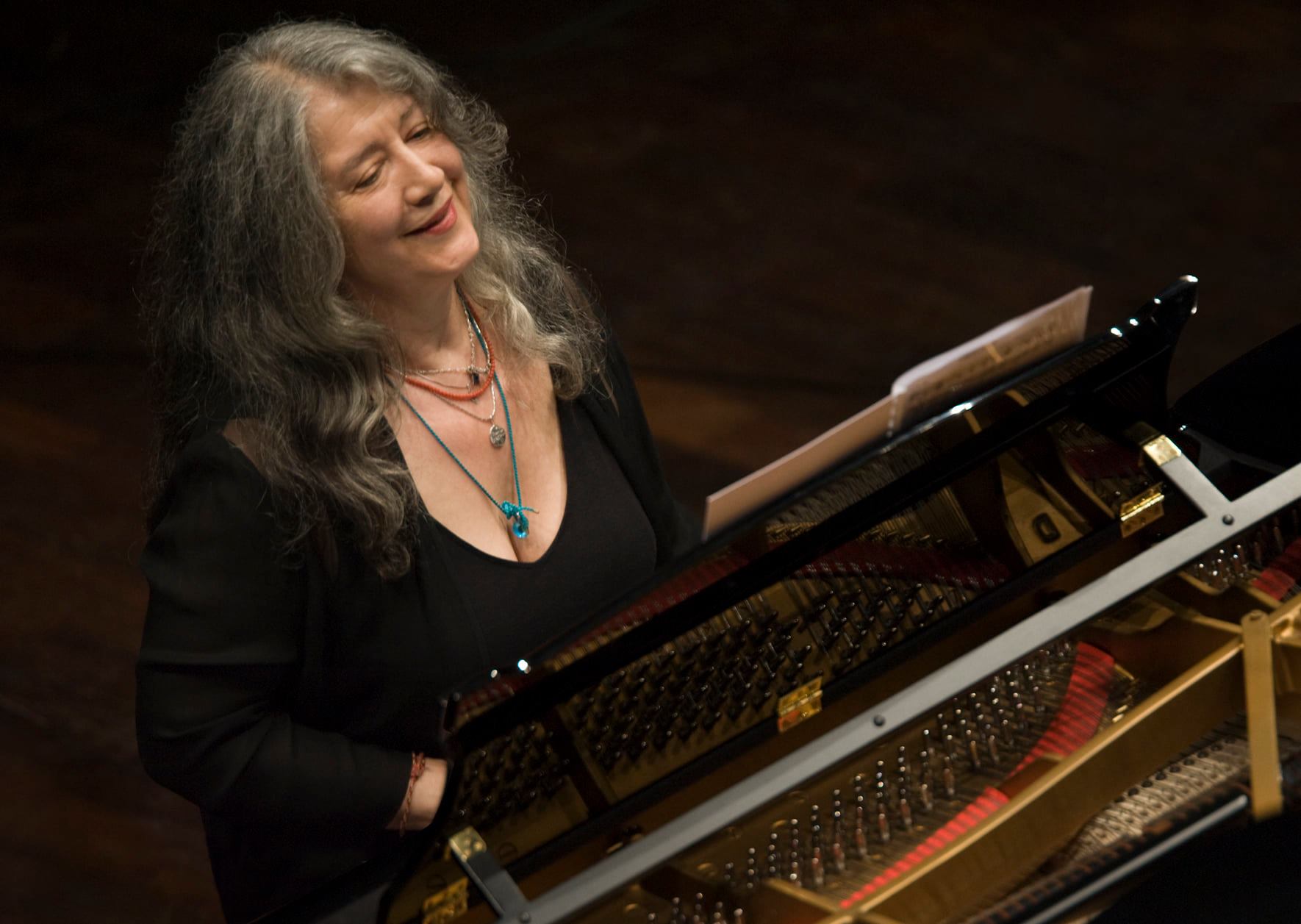
  • Martha Argerich Still Unstoppable at 80

    Martha Argerich Still Unstoppable at 80

    Martha Argerich, the super-virtuoso, who nonetheless plays with lyricism and feeling, is 80 years-old today. Conquering depression, conquering nerves, conquering failed marriages, conquering cancer, Argerich is unstoppable. At 80, she still has lava in her veins.

    Argerich at 25, playing Liszt’s Hungarian Rhapsody No. 6

    Argerich at 77, playing Prokofiev’s Piano Concerto No. 3, a work she’s stated, matter-of-factly, is easy for her

    Argerich rehearsing Ravel with her ex-husband, Charles Dutoit

    Argerich demonstrating how to smoke while playing the piano

    Smoking hot Martha Argerich. Happy birthday to one of our great pianists, and many happy returns!

Tag Cloud

Aaron Copland (94) Beethoven (95) Composer (114) Film Music (152) Film Score (143) Film Scores (255) Halloween (104) John Williams (198) KWAX (233) Leonard Bernstein (105) Marlboro Music Festival (125) Movie Music (167) Mozart (91) Opera (219) Philadelphia Orchestra (91) Picture Perfect (174) Princeton Symphony Orchestra (110) Radio (90) Ross Amico (244) Roy's Tie-Dye Sci-Fi Corner (290) The Classical Network (101) The Lost Chord (269) Vaughan Williams (107) WPRB (397) WWFM (881)

DON’T MISS A BEAT

Receive a weekly digest every Sunday at noon by signing up here


RECENT POSTS