Category: Daily Dispatch

  • Handel vs. Bononcini: Opera Rivals in London

    Handel vs. Bononcini: Opera Rivals in London

    It took a German composer to kick off the Italian opera craze in England.

    George Frideric Handel, fresh off an Italian sojourn, exploded onto the London music scene with “Rinaldo” in 1711. In fact, despite some stiff competition from rival companies, Handel would dominate Italian opera there for several decades.

    One of his chief competitors was the Italian composer, cellist, and singer Giovanni Bononcini. In fact, it was their rivalry, and the rabid partisan allegiance of their respective followers, that spawned the epigram “Tweelde-dum and Tweedle-dee.” The phrase was coined nearly 150 years before Lewis Carroll’s usage, by John Byrom in 1725.

    Some say, compar’d to Bononcini
    That Mynheer Handel’s but a Ninny
    Others aver, that he to Handel
    Is scarcely fit to hold a Candle
    Strange all this Difference should be
    ‘Twixt Tweedle-dum and Tweedle-dee!

    It was on this date 300 years ago that Handel and Bononcini were pitted against one another in a back-to-back musical contest, when directors of the Royal Academy of Music arranged for the two composers to set adjacent acts of the same opera. The music for the first act of “Muzio Scevola” would be written by house composer Filippo Amadei, for the second by Bononcini, and for the third by Handel.

    You might think that Handel, in clean-up position, had the natural advantage, but Bononcini had already written two complete operas based on the libretto himself, in 1695 and 1710. Furthermore, he had been composing operas for the Academy for just as long as Handel had been its music director. There were plenty who preferred Bononcini’s lighter touch and straightforward melodies. Underlying all, there was also an interesting political component, as Handel was favored by the Whig party, and Bononcini by the Tories.

    Neither composer’s victory was a foregone conclusion. But on the night of the opera’s premiere, March 23, 1721, the audience overwhelmingly favored Handel.

    In the end, Bononcini left London in disgrace in 1732, when it was discovered that he had passed off a madrigal by Antonio Lotti as his own work – unusual blowback in an era when composers frequently stole from one another with impunity.

    Adding insult to injury, Handel took the libretto for Bononcini’s “Xerse” and set it to music himself, as “Serse” or “Xerxes.” Granted, it was received as one of Handel’s rare failures (Londoners were taken off guard by its comedic elements). Nevertheless, it yielded one of his best-known melodies, the aria “Ombra mai fu,” widely circulated in countless instrumental arrangements as “Handel’s Largo.”


    “Ombra mai fu”

    Handel’s Largo

    “Lascia ch’io pianga” from Handel’s “Rinaldo”

    “Muzio Scevola”

    Baroque opera… ‘tis a silly place (if occasionally sublime).


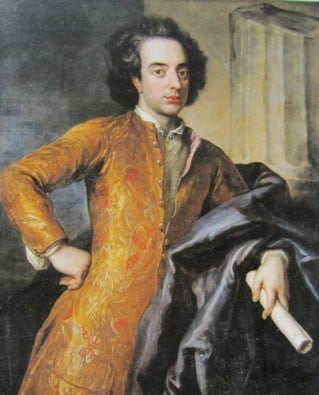
    Dueling portraits of Bononcini and Handel. Is it any wonder that Handel was favored by the “Whigs?”
  • Coffee and Clear Decisions

    Coffee and Clear Decisions

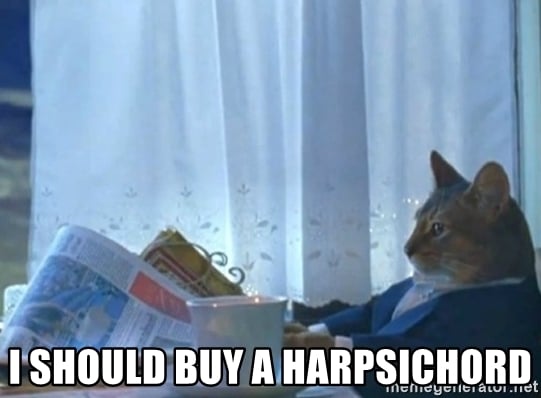
    In making decisions, it’s best to be sure it’s not the coffee talking.

  • Kápralová and Smyth: Forgotten Female Composers

    Kápralová and Smyth: Forgotten Female Composers

    This Sunday night on “The Lost Chord,” the focus will be on outstanding works by two extraordinary female composers.

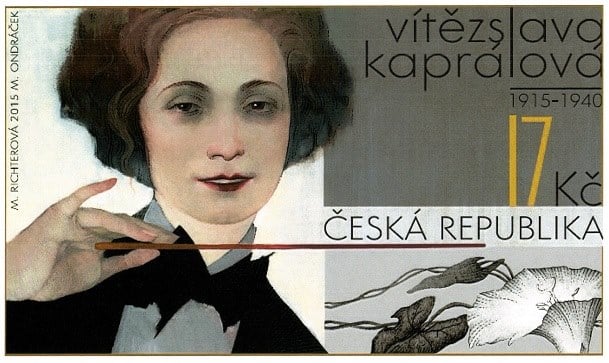
    Vitězslava Kápralová (1915-1940) was one of the great hopes of Czech music, a figure who undoubtedly would be much better known had she not died of tuberculosis at the age of 25. As it stands, her reputation is only beginning to emerge from the shadow of her teacher and lover, Bohuslav Martinu.

    Kápralová’s String Quartet was written while she was yet a student at the Prague Conservatory, where her teachers included Vitězslav Novák and Václav Talich. (She studied with Martinu later in Paris.) The work was completed in 1936, when Kápralová was about 21 years-old.

    More about Kápralová here, in this article written to mark her centenary in 2015:

    https://www.telegraph.co.uk/culture/music/classicalmusic/11365848/The-tragedy-of-Europes-great-forgotten-female-composer.html?fbclid=IwAR1EgKzOjglhAKe-58wHwivhYjI1LtTCPzgr0efhV0xuf0898oeeZYbJHU0

    Ethel Smyth (later DAME Ethel Smyth, 1858-1944) was one of the most vocal advocates of the women’s suffrage movement in England. She overcame early opposition to a career in music on the part of her father to receive the praise of George Bernard Shaw, who called her Mass “magnificent.”

    However, her works were often better-appreciated abroad. Her operas, in particular, were embraced in Germany. One of them, “Der Wald,” was the only opera by a woman composer mounted by New York’s Metropolitan opera for over a century!

    Smyth served time in prison for putting out the windows of politicians who opposed a woman’s right to vote. She also wrote for the cause “The March of the Women.” When Sir Thomas Beecham went to visit her in jail, he witnessed her conducting through the bars of her window with a toothbrush as her associates gathered for exercise in the courtyard.

    Smyth’s “Serenade in D” – a symphony in all but name – was her first orchestral score, composed in 1890, when she was about 32 years-old. In my opinion, it’s better than just about anything composed by her contemporary, Sir Hubert Parry, and much more compelling than the symphonies of Sir Charles Villiers Stanford.

    More about Smyth here, in this piece put together in connection with a revival of her opera, “The Wreckers,” by the great Leon Botstein:

    https://www.npr.org/sections/deceptivecadence/2015/07/23/410033088/one-feisty-victorian-womans-opera-revived?fbclid=IwAR2GIlgZ3p6rwkh8dFa-2H7X27tQPRRKFK_TLnuxWI67kayucG8tuXkOj5I

    I hope you’ll join me for music by these two extraordinary women – “A Woman’s Place is in the Concert Hall” – this Sunday night at 10:00 EDT, on WWFM – The Classical Network and wwfm.org.


    Vitězslava Kápralová honored on a postage stamp; Ethel Smyth taken into custody

  • Bach 500 Goal Achieved! Thanks WWFM

    Bach 500 Goal Achieved! Thanks WWFM

    We made it! 500 donations achieved! We’ve crossed the finish line of this year’s Bach 500! Thank you for your generous support of WWFM – The Classical Network and wwfm.org. Lots more Bach on the way, free of fundraising interruptions.

    Enjoy the music on this lovely spring day, and get on to the important business of Sunday brunch, a winning combination of Bach and pancakes!

  • WWFM Bach 500 Finale Donate & Enjoy Bach All Day

    WWFM Bach 500 Finale Donate & Enjoy Bach All Day

    It’s the final morning for the WWFM Bach 500! Make a donation now, and this afternoon enjoy an all-Bach “Sounds Choral” at 2 pm and an all-Bach “Sunday Opera,” featuring three of his cantatas (since Bach wrote no opera), and more, at 3 pm EDT.

    Of course, you’re getting all-Bach this morning, as well, but the fundraising will stop as soon as we cross the finish line of 500 contributions in any amount.

    Consulting the membership thermometer on the station’s homepage, I see we’ve got just over 50 donations to go. If you haven’t contributed in a while, and you enjoy the service, and you can afford to so, please commit to whatever you can. Even $20 pushes us that much closer to the goal.

    Again, we are looking for numbers of participants in this one, not dollar amounts. Once we reach 500 contributions, fundraising ends, and then we’re on to just Bach’s music.

    Looking forward to that victory lap soon! Have a cup of coffee, then enjoy the “Coffee Cantata.” Your contribution keeps us in beans. Call now at 1-888-232-1212, or join us online at wwfm.org.

    Thank you for your support of WWFM – The Classical Network, and happy birthday, Bach!

    https://wwwfm.secureallegiance.com/wwfm/WebModule/Donate.aspx?P=DEFAULT&PAGETYPE=PLG&CHECK=vOU2bz5JCWmgCDbf53nm9ezWDeZ%2beA1M

Tag Cloud

Aaron Copland (93) Beethoven (95) Composer (114) Film Music (136) Film Score (143) Film Scores (255) Halloween (94) John Williams (195) KWAX (229) Leonard Bernstein (103) Marlboro Music Festival (125) Movie Music (151) Mozart (88) Opera (208) Philadelphia Orchestra (89) Picture Perfect (174) Princeton Symphony Orchestra (108) Radio (88) Ross Amico (244) Roy's Tie-Dye Sci-Fi Corner (290) The Classical Network (101) The Lost Chord (268) Vaughan Williams (103) WPRB (396) WWFM (881)

DON’T MISS A BEAT

Receive a weekly digest every Sunday at noon by signing up here


RECENT POSTS