Category: Daily Dispatch

  • Ten Commandments Movie Music for Passover

    Ten Commandments Movie Music for Passover

    This week on “Picture Perfect,” just in time for Passover, I put my Covid-beard to the test, with a presentation of selections from Cecil B. DeMille’s “The Ten Commandments.”

    From a 6-CD set on the Intrada label – the collector’s equivalent of stone tablets handed down from Mount Sinai – we’ll hear lovingly remastered highlights from the 1960 Dot and 1966 United Artists soundtrack re-recordings, the Pillar of Fire and parting of the Red Sea sequence from the original score, as heard in the film, and rare demos, prepared for Mr. DeMille by the composer, Elmer Bernstein, who announces his themes as he plays them, from the piano.

    We arrive at Mount Nebo before sunset!

    So let it be written, so let it be done!

    Join me for the definitive “The Ten Commandments,” on “Picture Perfect,” music for the movies, this Saturday evening at 6:00 EDT, on WWFM – The Classical Network and wwfm.org.

  • 2001 A Space Odyssey & Star Trek Director Chat

    Here’s our epic bull session about “2001: A Space Odyssey” – nearly as long as the movie itself (though not quite). It probably would have been a little shorter had we not gotten sidetracked by a shared obsession with childhood model-building. But, much like “2001” itself, the journey is the destination.

    It was great to reunite with my cousin, and Roy’s lifelong friend, Joe Metz, now living in Utah, whose favorite film “2001” is.

    Speaking of epic conversations, Roy’s special guest tomorrow night will be director and writer Ralph Senensky. Senensky will talk about his extensive body of work for television, amassed over the span of a quarter century. Of particular interest to sci-fi fans will be his anecdotes about having directed six classic “Star Trek” episodes.

    Tune in for a chat with this “Enterprising” director. The next Roy’s Tie-Dye Sci-Fi Corner will be livestreamed on Facebook, this Sunday evening at 7:00 EDT!

    https://www.facebook.com/roystiedyescificorner

  • Arturo Toscanini Legend Intensity and Legacy

    Arturo Toscanini Legend Intensity and Legacy

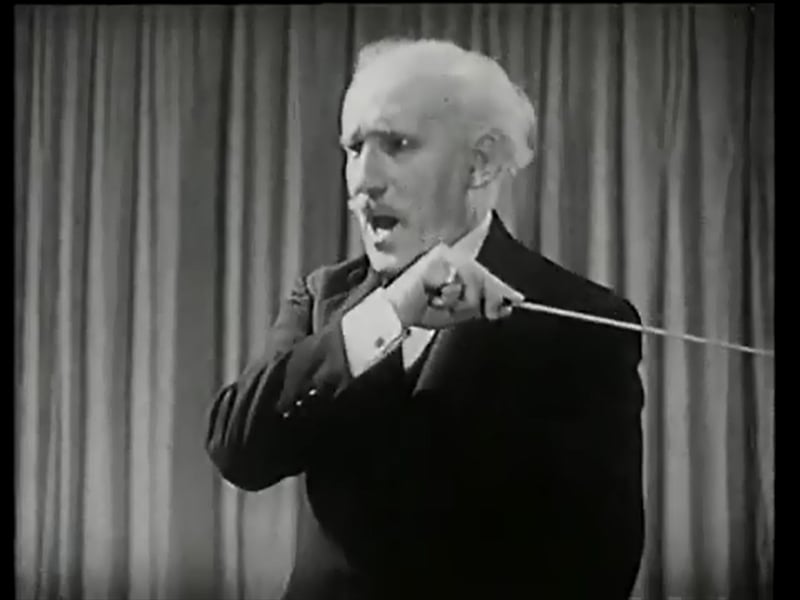
    Arturo Toscanini was one of the most celebrated conductors of the 20th century. His intensity, perfectionism, and alleged fidelity to the score have been enshrined in legend. And when the legend becomes fact, I print the legend.

    Toscanini served as music director of La Scala, Milan, the Metropolitan Opera, the New York Philharmonic, and the NBC Symphony Orchestra. He conducted first performances of Puccini’s “La bohème,” Leoncavallo’s “Pagliacci,” Respighi’s “Feste Romane,” and Barber’s “Adagio for Strings.” As a cellist, he played in the world premiere of Verdi’s “Otello.”

    From 1937 to 1954, he reached millions of Americans via his weekly broadcast concerts on NBC radio. These originated at Rockefeller Center’s Studio 8-H, now the home of “Saturday Night Live.”

    Toscanini was vehemently anti-fascist. He despised Hitler, and vowed never to conduct in Germany as long as “the Führer” remained in power. In Italy, he was beaten up by brownshirts and had his passport confiscated for refusing to conduct “Giovinezza,” the fascist anthem. He also worked closely with violinist Bronislaw Huberman in support of the Palestine Orchestra, made up of Jewish exiles from fascist Europe. He once confided to a friend, “If I were capable of killing a man, I would kill Mussolini.”

    Il Duce really caught a break when Toscanini emigrated to America. It sounds to me as if the Maestro could have been borderline more than once. Ironically, for someone who hated dictators, he sure could dish out an autocratic tirade.

    Happy birthday, Arturo Toscanini.


    Conducting Verdi, “La Forza del Destino Overture” (on film, 1944)

    Beethoven, Symphony No. 3, “Eroica” (at Carnegie Hall, 1939)

    https://www.youtube.com/watch?v=uYfgjL9dBkU

    Respighi, “Feste Romane” (“Roman Festivals,” 1949)

    Toscanini snaps his baton and calls his double bassists “ball breakers.”

    https://www.youtube.com/watch?v=i-1KtSOwLXE

  • 2001 A Space Odyssey Revisited

    2001 A Space Odyssey Revisited

    Despite anything you may have heard from Heywood Floyd, there is no outbreak at Clavius Base.

    I’m moving to Clavius.

    On the next Roy’s Tie Dye Sci Fi Corner, we’ll be joined by my cousin, and Roy’s lifelong friend, Joseph R. Metz, for a discussion of one of Joe’s favorite films, “2001: A Space Odyssey” (1968).

    Stanley Kubrick’s masterpiece is visual, cerebral entertainment of a kind that defies description. It is that rare film that lives up to the overused adage “seeing is believing.” Boundary-pushing special effects, an unconventional story arc, and a ruminative structure that, like the mysterious Monolith that propels mankind’s development, takes a very long view – it’s a vision so ambitious that it could only be conveyed in Cinemascope.

    It’s not every film that can make a cultural superstar out of György Ligeti. Ligeti, in retrospect, perhaps the most significant figure of the 1960s musical avant-garde, takes his place in the interplanetary pantheon alongside Johann and Richard Strauss.

    Amazingly, Kubrick gets just about everything right, except for the year – presumably selected because it signifies a new century, but also no doubt predicated on the assumption that the space program would continue to develop at full 1960s steam. And for the “product placement.” Every corporation cited in the film has long since gone out of business! And what’s the deal with those red Djinn chairs? But to the best of our knowledge, from our current perspective, and without a time machine, “2001” is about as credible as it gets.

    I understand the deliberate pace and “show-don’t-tell” narrative may not be to everyone’s taste, and that Kubrick’s approach would probably seem as alien as any extraterrestrial intelligence to someone coming to the film for the first time from the punched-up digital age of sensory overstimulation. But returning to it now, after many years, I have to say “2001,” for me anyway, has only gotten better, and somehow faster. It is so refreshing to rediscover a film that is so… cinematic.

    Put your narrative expectations aside, take a chill pill, or drop some acid (as some did, back in the day), and marvel at the slow burn that is “2001: A Space Odyssey.” We’ll be riding a bicycle-built-for-two with HAL-9000 (with a sidecar for Joe), on the next Roy’s Tie-Dye Sci-Fi Corner. All our bones will be but stepping stones to a rendezvous with the moons to Jupiter. Leave your tapir meat in the comments section, as we livestream on Facebook, this Friday evening at 7:00 EDT!

    https://www.facebook.com/roystiedyescificorner

  • John Antes Moravian Composer

    John Antes Moravian Composer

    At a time when ants, for some inexplicable reason, begin to make their way indoors (isn’t it just getting nice outside?), I suppose it’s only appropriate that we acknowledge the anniversary of the birth of John Antes.* The Moravian composer was born in Frederick, Montgomery County, PA, on this date in 1740.

    Antes is credited with being one the first American composers to write chamber music. He was also the creator of the earliest surviving bowed string instrument made in America by someone actually born in the colonies. Antes’ violin, made in 1759, is housed in the Museum of the Moravian Historical Society in Nazareth, PA. A viola, made by Antes in 1764 (again believed to be the earliest surviving of American origin), is housed in the Lititz Moravian Congregation Collection in Lancaster County. Antes created at least seven such instruments.

    In 1752, Antes attended school in Bethlehem, PA. In 1760, he was admitted into the Single Brethren’s choir there. From Bethlehem, he travelled to Herrnhut, Germany, the international center of the Moravians, to prepare for a career as a missionary. In the meantime, he also took up watchmaking. He was ordained a minister in 1769, and then set out for Egypt. There, he served as a missionary to the Coptic Church in Grand Cairo. After a largely uneventful decade, he was captured and bastinadoed by followers of Osman Bey.

    During his convalescence, he occupied himself with the composition of three string trios. He also sent a copy of six quartets to Benjamin Franklin, whom he had known in America. The quartets are now lost (nice job, Ben), but the trios survive.

    Apparently, Antes also delved into making keyboard instruments (he completed a few for friends), but then the church elders reined him in. An Antes cello was discovered in somebody’s attic in 2018.

    https://apnews.com/article/e88096710de44cde9c4db7fae41b1760

    Video comparison of the three surviving Antes instruments:

    https://www.youtube.com/watch?v=-WhWs-3u-EI

    Selections from the String Trio No. 2 in D minor:

    Here’s a shout-out to all my peeps in the Lehigh Valley.


    *Pronounced “Anties.”

Tag Cloud

Aaron Copland (93) Beethoven (95) Composer (114) Film Music (136) Film Score (143) Film Scores (255) Halloween (94) John Williams (195) KWAX (229) Leonard Bernstein (103) Marlboro Music Festival (125) Movie Music (151) Mozart (88) Opera (208) Philadelphia Orchestra (89) Picture Perfect (174) Princeton Symphony Orchestra (108) Radio (88) Ross Amico (244) Roy's Tie-Dye Sci-Fi Corner (290) The Classical Network (101) The Lost Chord (268) Vaughan Williams (103) WPRB (396) WWFM (881)

DON’T MISS A BEAT

Receive a weekly digest every Sunday at noon by signing up here


RECENT POSTS