
An oldie but a goodie. Beware the Ides of March.
Category: Daily Dispatch
-

Irish Music This Sunday on The Lost Chord
This Sunday night on “The Lost Chord,” we anticipate St. Patrick’s Day, with two contrasting works with ties to the Emerald Isle.
John Kinsella was born in Dublin in 1932. He combined composition with a career in music administration until 1988, when he left his position as Head of Music at RTE, Ireland’s national broadcasting organization.
As a composer, he was influenced by contemporary trends in the European avant-garde, until 1977. Then, following the completion of his String Quartet No. 3, he wrote nothing for a period of 18 months. He emerged from this self-imposed silence a renewed artist, crafting wholly tonal works of great beauty and integrity. Since then, he has completed eleven symphonies, a second violin concerto, a cello concerto, a fourth string quartet, and various other works.
Kinsella’s Symphony No. 3 was composed in 1989-1990. The work falls into two substantial movements, framed by a brief Prologue and Epilogue, and separated by an Intermezzo, all of which return to material stated in the symphony’s opening bars. The movements are performed without break.
Although it is not a programmatic work, the composer dedicated the symphony, with gratitude, to his parents. He intended the piece as a personal expression of certain aspects of the joy of life. Hence, the subtitle, “Joie de vivre.”
More overtly folk-inflected is “Laments and Dances from the Irish,” after melodies by Irish harper Turlough O’Carolan (1670-1738). Philadelphia-born composer Arnold Black was afflicted with cerebral palsy from birth, resulting in limited mobility on his right side. Yet he managed to become a master of the violin. So successful was he on his instrument that following graduation from the Juilliard School, he was hired as assistant concertmaster of the Baltimore Symphony, and ultimately concertmaster of the National Symphony Orchestra in Washington, DC.
Black’s “Laments and Dances” was commissioned by the Newman and Oltman Guitar Duo. Michael Newman and Laura Oltman reside along the Delaware River in Warren County, NJ. Together or between them, they have taught or been guitarists-in-residence at the Mannes College of Music in New York City, Princeton University, The College of New Jersey, and Lafayette College in Easton, PA. They are also directors of the Raritan River Music Festival, held in historic venues in Central Jersey throughout the month of May. The duo is joined in this recording by the Turtle Island String Quartet.
Pour yourself a pint of stout and find your bliss. We laugh and weep along with the Irish, on “Airs from Erin,” this Sunday night at 10:00 EDT, on WWFM – The Classical Network and wwfm.org.
-
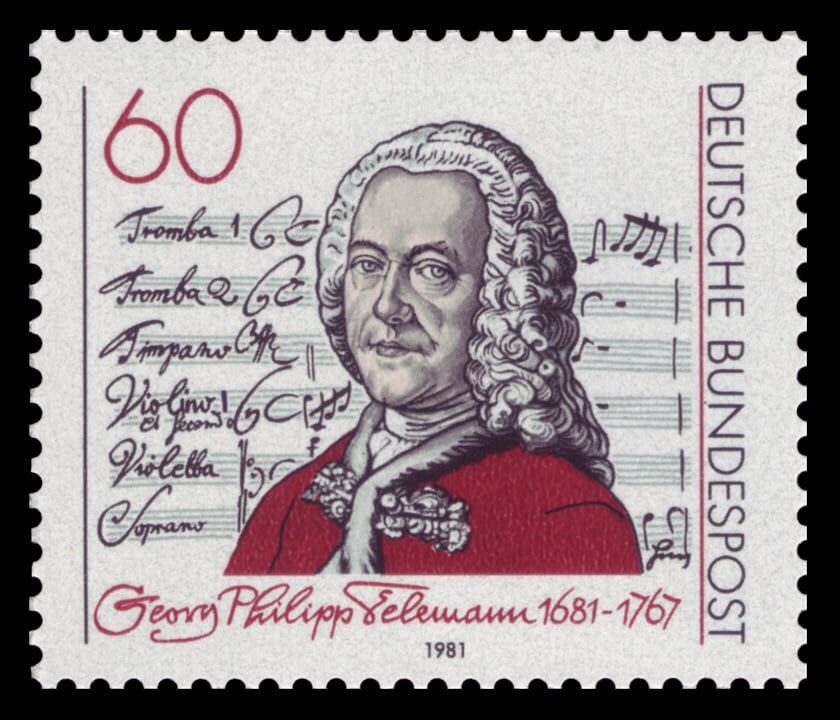
Telemann The Overshadowed Baroque Master
Poor Telemann. He was a casualty of having done his job too well.
He wrote more music than Bach and Handel combined – over 3000 works – making him one of the most prolific composers of all time. Yet nothing in his oeuvre has captured the public imagination quite like the “Brandenburg Concertos” or the “Water Music.”
Of course, he wrote “Water Music” too.
On the other hand, he was recognized in his own lifetime. He was an innovator, assimilating Italian and French influences into his own style, and his contemporaries bought and studied his scores. He was offered the cantorate of the Thomaskirche in Leipzig, ahead of Bach. He counted Bach among his friends, as well as Handel. Bach even requested that he be the godfather of his son, Carl Philipp Emanuel.
Telemann lived an unusually long life (86 years), though it was not without its miseries. His first wife died young. His second ran up gambling debts in amounts larger than his annual income. Ultimately, his friends had to bail him out. As he grew older, he suffered further indignities, including failing eyesight.
Celebrated in his own day, by the 19th century he was dismissed as a “polygraph,” someone who had simply composed too much. In a sense, he was a victim of his own success.
Today, he inspires renewed enthusiasm among early music specialists, who have done much to restore his reputation. At the very least, he deserves a little recognition on his birthday.
Happy Birthday, Georg Philipp Telemann!
One of my favorite Telemann moments, the “Air à l’Italien” from the Suite in A Minor for Flute and Orchestra:
Always been partial to this one, too:
While we’re on the topic of Baroque masters, allow me to offer a gentle remind that we are now only a week away from Bach’s birthday. WWFM The Classical Network is looking to generate enough donations to cancel fundraising on March 21, so that we can all celebrate with just Bach’s music. To make it happen, we need 500 listeners to step up and contribute IN ANY AMOUNT. Once the 500 donations are reached, the focus will shift exclusively to the music.
Already the tally is at the halfway point. Contribute now, and become one of the “Bach 500.” Thank you for doing your part in making this campaign a success and in ensuring a home for great music from the Baroque and beyond, on WWFM – The Classical Network and wwfm.org!
-
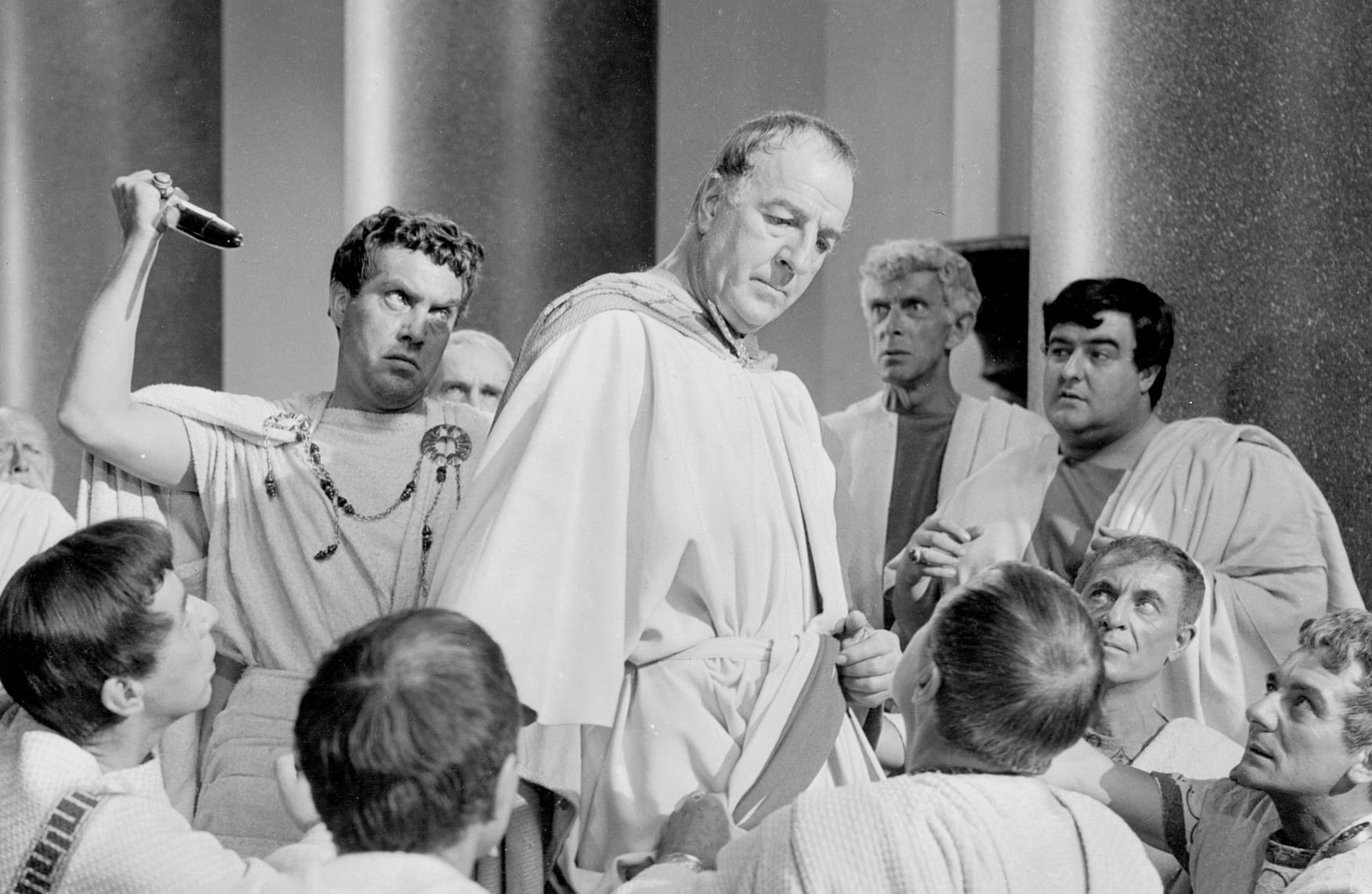
Ides of March Rome on Film
Beware the Ides of March!
March 15th is a day that has lived in infamy and superstition, ever since the murder of Julius Caesar in 44 B.C. After declaring himself Dictator for Life, Caesar was set upon by members of the Roman Senate and stabbed 23 times.
This week on “Picture Perfect,” toga is the dressing of choice for a Caesar salad of films set in Ancient Rome.
We’ll begin with Joseph L. Mankiewicz’s adaptation of Shakespeare’s “Julius Caesar” (1953). A two-time double Oscar winner, Mankiewicz – who won back-to-back Academy Awards for writing and directing “A Letter to Three Wives” in 1949 and “All About Eve” in 1950 – wrote and directed this big screen version of the Bard’s historical drama, which was produced by John Houseman, and features an all-star cast, including Marlon Brando as Mark Antony, James Mason as Brutus, John Gielgud as Cassius, and Louis Calhern as Caesar.
The music is by MGM’s go-to composer for spectacles of this sort, Miklós Rózsa, who had earlier provided the score for “Quo Vadis,” and would go on to win his third Academy Award for “Ben-Hur.”
Ten years later, Mankiewicz would return to Rome, at least in part, for “Cleopatra” (1963), though it was a decision he would come to rue. For budgetary and interpersonal reasons, “Cleopatra” became a nightmarish experience for practically everyone involved. Although a box office success – the year’s highest grossing release – the film achieved the dubious distinction of becoming the most expensive ever made. Its massive cost overruns and production woes nearly bankrupted 20th Century Fox.
“Cleopatra” stars Elizabeth Taylor and Richard Burton, whose scandalous, extra-marital romance caught fire during the making of the film. Despite the behind-the-scenes drama, both film and score were nominated for Academy Awards, as was Rex Harrison for Best Actor, in the role of Julius Caesar.
Alex North, who had written the highly-regarded music for “Spartacus” three years earlier, follows up on his success with another one of his finest scores.
By contrast, the Pax Romana was an era of relative peace and stability. It spanned two centuries, from the reign of Augustus Caesar to the death of Marcus Aurelius. The movies would have us believe that Marcus was the victim of foul play, murdered by his son Commodus. Hollywood never did let history get in the way of a good story!
Joaquin Phoenix plays Commodus in “Gladiator” (2000), something of a missed opportunity, with a dream cast, including Russell Crowe, Richard Harris, Derek Jacobi, and Oliver Reed. Alas, it gave most of its over-qualified supporting players very little to do.
More damningly, the visual storytelling was marred by the over-use of shaky handheld cameras and an over-reliance on computer generated imagery, supplanting the traditional – though likely prohibitive – lavish sets and cast-of-thousands. Even so, the film was honored with five Academy Awards, including that for Best Picture.
One of those Oscars went to Hans Zimmer for his score, though the music is not without controversy. As is often the case with this composer, Zimmer was heavily assisted by a lot of under-credited hands, who appear in fine print in the soundtrack’s CD booklet. Also, one of the battle scenes adheres so closely to “Mars, the Bringer of War” that Zimmer was actually sued by the Holst Foundation. That said, the score was tremendously popular, and the soundtrack remains one of the best-selling of all time.
One of my biggest beefs with “Gladiator” is that, although never acknowledged as a remake, it essentially lifts most of its plot from “The Fall of the Roman Empire” (1964). Anthony Mann directed the old school sword-and-sandal epic, which stars Sophia Loren, Stephen Boyd, Alec Guinness, and James Mason. On this occasion, Christopher Plummer plays mad Commodus.
The grandiose score is by Dimitri Tiomkin, who conducted a 110 piece orchestra, made up of (as advertised) “England’s finest musicians.” Only Tiomkin, a pupil of Alexander Glazunov, would include balalaikas in a score about Ancient Rome.
Watch your back! Rome wasn’t built in a day. It falls in an hour this week, on “Picture Perfect,” music for the movies, this Saturday evening at 6:00 EST, on WWFM – The Classical Network and wwfm.org.

Tag Cloud
Aaron Copland (93) Beethoven (95) Composer (114) Film Music (136) Film Score (143) Film Scores (255) Halloween (94) John Williams (195) KWAX (229) Leonard Bernstein (103) Marlboro Music Festival (125) Movie Music (151) Mozart (88) Opera (208) Philadelphia Orchestra (89) Picture Perfect (174) Princeton Symphony Orchestra (108) Radio (88) Ross Amico (244) Roy's Tie-Dye Sci-Fi Corner (290) The Classical Network (101) The Lost Chord (268) Vaughan Williams (103) WPRB (396) WWFM (881)