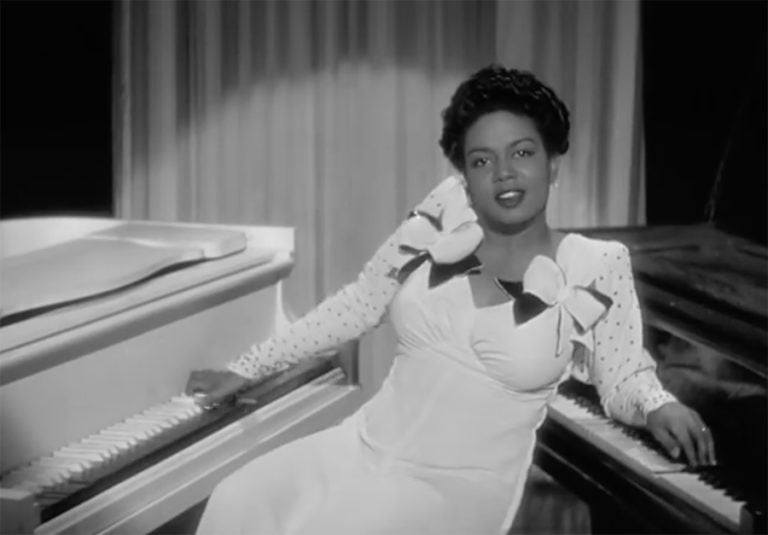
In 1950, Juilliard-trained pianist Hazel Scott became the first Black American to host her own television show. A born performer, she excelled in jazz, blues, boogie-woogie, ballads, Broadway, and classical music. It was by “swinging the classics” that she first achieved fame.
Unusual for any performer in Hollywood, she had complete control over her image and music. She always spoke up, and she never backed down. When she criticized the House Un-American Activities Committee, doors began to close. Happily, she was able to reinvent herself with a glorious third act in Paris.
You’ll find lots of great footage in this fascinating 20-minute documentary:
Scott swings Liszt:
Scott stops the show, playing black and white grand pianos, in “The Heat’s On” (1943):
After suffering through “The Assassination Bureau,” Roy made the command decision to nix it. It turns out there’s no science fiction in it.
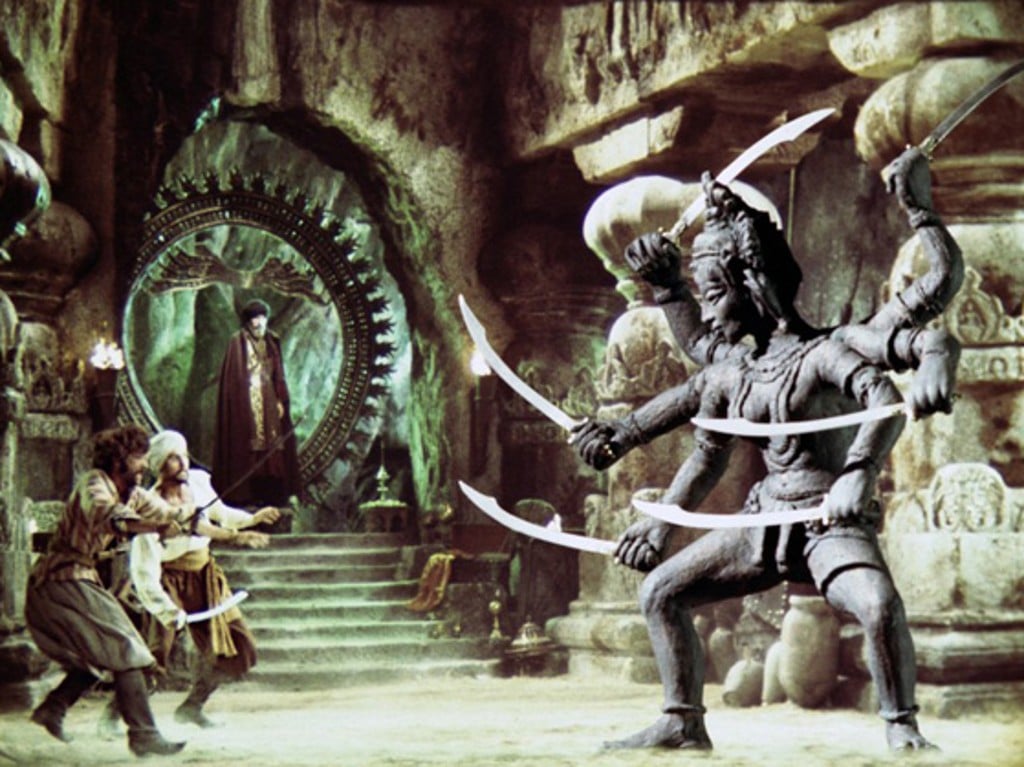
Therefore, our John Phillip Law festival continues with “The Golden Voyage of Sinbad” (1973). Legendary stop-motion artist Ray Harryhausen breathes life into the Dynamation homunculi, dueling Kali statue, centaur-cyclops, golden griffin, and perhaps myth’s most impassive Siren. That’s some serious Sinbad science! Law, you’ll recall, played Pygar the angel in last Friday’s film topic, “Barbarella.”
Miklós Rózsa’s portentous score still echoes in my ears, even as a well-oiled Caroline Munro lingers in my memory. Tom Baker, on the very eve of “Doctor Who” celebrity, plays the villainous necromancer Koura. In the days before anyone ever heard of cultural appropriation, a blue-eyed Sinbad swashbuckles his way through a mish-mash of mythologies.
Join us, as we too shall sin bad, on the next Roy’s Tie-Dye Sci-Fi Corner. Your destiny is written in the comments section, as we livestream on Facebook, this Friday evening at 7:00 EST!
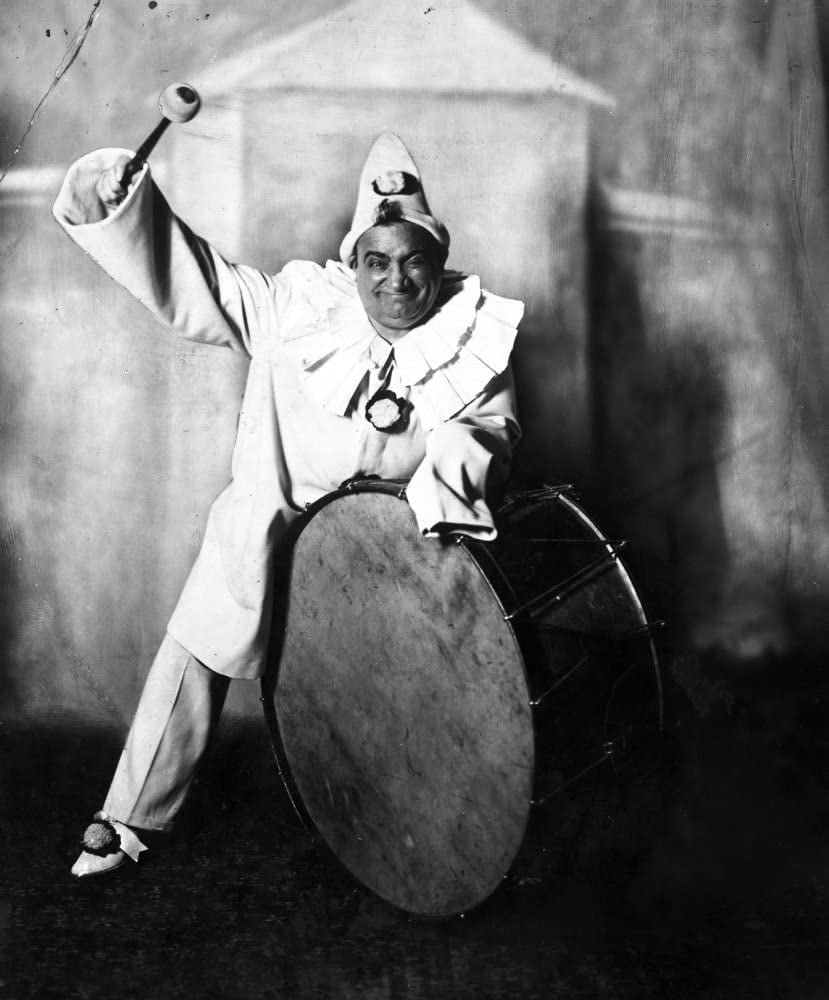
Before Michael Jackson, before The Beatles, before Elvis, there was the first global superstar of the gramophone – Enrico Caruso. The first million-selling recording was Caruso’s “Vesti la giubba,” from Leoncavallo’s “Pagliacci.” You know it, even if you think you don’t.
Caruso recorded it three times, in 1902, 1904, and 1907. Here are all three versions, the first two with piano, and the last with orchestra.
Leoncavallo, as can be imagined, was over the moon. In 1904, he dedicated his “Mattinata” to Caruso. It was the first song ever written expressly for the Gramophone Company (now EMI). It’s been popular with tenors ever since.
Here’s Caruso’s recording, with the composer at the keyboard.
Caruso may have had the sales, but Leoncavallo definitely had the mustache.
This year is significant in that it also marks the centenary of the tenor’s death, on August 2, 1921. It’s believed that an injury suffered on stage precipitated his untimely demise at the age of 48.
Let’s face it, Caruso was never a model of health. His appetite was prodigious. He liked his food, he liked his cigarettes, and he liked his work. In all, he appeared at the Old Met 863 times, and he toured extensively. He also left 247 records.
When he died, thousands turned out for his funeral in Naples. For the better part of a decade, his remains were displayed in a glass sarcophagus, until his wife had him sealed up in an ornate tomb.
More about the King of Tenors in August. For now, happy birthday to the Great Caruso.
Richard Strauss’ final opera, “Capriccio,” is an extended, though lighthearted debate on the relative merits of words and music. In the case of Arrigo Boito, the two never really came into conflict.
As one of the great librettists, Boito provided the texts for Verdi’s late masterpieces, “Otello” and “Falstaff.” He also worked up a revision of “Simon Boccanegra” and – under the anagram Tobia Gorrio – provided the libretto for Ponchielli’s “La Gioconda.”
But Boito himself was also a composer of merit, if not a prolific one. Although he destroyed his first opera, “Ero e Leandro,” and his last, “Nerone,” was left incomplete at the time of his death (to be finished by Arturo Toscanini and Vincenzo Tommasini), he totally nailed it with “Mefistofele.”
There may be those who look down their noses at Boito’s take on Goethe’s “Faust,” yet the work stubbornly clings to the outskirts of the standard repertoire. Audiences love it. For me it is much more entertaining than anything in Verdi (I know, them’s fightin’ words) and I personally find the melodic invention much richer than that in the more popular version by master melodist Charles Gounod.
Sure, as narrative it’s a little clunky – it’s as if Boito presents the story as a series of tableaux that are just kind of stitched together – and the most hair-raising set piece, the prologue in Heaven, comes right at the beginning. How could it not be all downhill from there? But the composer has the good sense to bring it all back at the end.
What the opera really demands is a strong personality at its core, someone who, through his magnetic stage presence and sheer force of will, can haul the circus train of wonders, boxcar after boxcar, before our astonished ears and eyes.
Feodor Chaliapin, by all accounts, was just such a force. He gained wide notoriety in the title role, for his earthy interpretation and his insistence on playing it half-naked.
In the recent past, Samuel Ramey owned the piece. He too preferred to show a fair amount of skin (though less than Chaliapin) – but really, couldn’t that be said for just about any of Ramey’s roles?
Here are some scenes from the stunning – and fun – Robert Carsen production from San Francisco Opera in 1989. The first 26 minutes would knock your socks off. Unfortunately, the full video is not currently posted on YouTube.
Son lo spirito che nega sempre tutto (I am the spirit that denies):
Ecco il mondo (Behold the world):
The finale, with Mephisto drinking Johnny Walker Red and tossing cards into a hat:
Shakespeare may be for all time. But Thomas Bowdler is for today.
Bowdler, the self-appointed moral guardian who anticipated the Victorian age – a time when it was understood that legs should always be referred to as “limbs” when in the presence of a lady – saw to it that all of the indelicate bits were excised or altered in the Bard’s plays, when he came to edit “The Family Shakespeare” in 1807. Distressingly, the book was a tremendous success that went through at least 11 printings.
No more in “Othello” did an old black ram tup a white ewe. Nor did they make the beast with two backs. Heavens!
All references to sex, violent death, blasphemy, and vulgarity were delicately paraphrased or removed. Bowdler’s crusade to rewrite history was undertaken in the interest of family values.
In the 20th century, there was a sharp backlash, and Bowdler became a figure of fun. That’s the best lesson he could impart. The Oxford English Dictionary defines “Bowdlerise” (in American English spelled with a “z”) as “To expurgate a book or writing, by omitting or modifying words or passages considered indelicate or offensive; to castrate.”
His name has become synonymous with misguided censorship. Libraries and booklovers heap scorn on Bowdler’s memory by celebrating “Bowdler’s Day” every year on July 11, the anniversary of his birth.
But lest we grow smug, it’s helpful to consider that victories without vigilance risk being overturned. There is an alarming tendency in human nature to view uncomfortable remnants of the past as things to be buried or discarded, as if it were some sort of moral victory to do so. But it doesn’t change history. If anything, it betrays an imperfect understanding of history.
Unencumbered by nuance, sweeping gestures undeniably feel good. They are simple. They bring immediate gratification. But they can also be messy.
There is less flash, less exhilaration in arriving at understanding through context. That requires education and consideration. It is a quieter, more thoughtful path, and it calls for cool heads. It will never electrify a mob like the golden calf of revolution.
Bowdler died on this date in 1825. Now, if only his spirit could be laid to rest.
On a more affirmative note, it seems this tug of war has always been with us!
Ironically, I had to post a link to a secondary source, reprinting the article, since Australian legislation has restricted the sharing of domestic news links to Facebook!