Category: Daily Dispatch

  • Shore Leave Chaos Sci-Fi Show Tonight

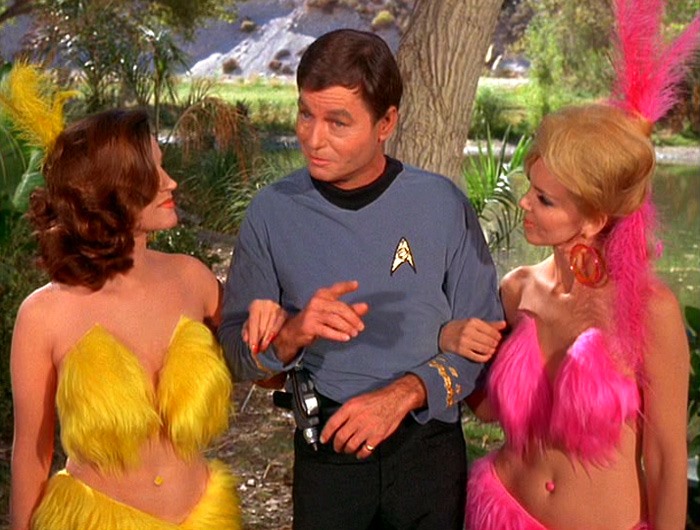
    On Friday night, Roy and I beamed down to a congenial planet in the Omicron Delta system for a little rest and relaxation. Unbenownst to us, it was actually a fantasy planet, so all our desires were made reality. Naturally, that meant there was much fighting, killing, and chorus girls in synthetic feathers. That’s what we get for going on “Shore Leave.”

    You can share our “amusement” by watching the video below. Then be sure to join us tonight, as our special guest will be composer Gerald Fried, who wrote the music for five classic “Star Trek” episodes (including “Shore Leave” and “Amok Time,” with its iconic fight music); also Stanley Kubrick’s “The Killing” and “Paths of Glory,” the Academy Award-nominated “Birds Do It, Bees Do It,” and the Emmy Award-winning “Roots.”

    We’re very excited to have him. Postpone your pon farr kal-if-fee, and join us for the next Roy’s Tie-Dye Sci-Fi Corner, this Sunday night at 7:00 EST!

    https://www.facebook.com/roystiedyescificorner/

  • Soviet Cinema’s Musical Masterpieces

    Soviet Cinema’s Musical Masterpieces

    This week on “Picture Perfect,” peek behind the Curtain for music by notable composers for Soviet cinema.

    Alfred Schnittke, a name usually associated with the avant-garde, actually composed over 60 film scores. One of these was for “Agony” (1974), about Rasputin, his influence over the Tsar, and the conspiracy to murder him.

    Georgy Sviridov, a pupil of Shostakovich, wrote the music for “Time, Forward!” (1962), based on the novel of Valentin Kataev. Set in the 1930s, the film describes a day of construction work at the Magnitogorsk Iron and Steel Works. Some of the music was used during the opening ceremonies of the 2014 Winter Olympics in Sochi.

    Dmitri Shostakovich, of course, is celebrated for his symphonies and string quartets, which are regarded as some of the most important of the 20th century. He also happened to write some 30 film scores, beginning all the way back in the silent era. Far and away his greatest hit composed for film, at least in the West, is the Romance from “The Gadfly” (1955), based on the novel of Ethel Lillian Voynich. The music gained broader exposure as the theme to “Reilly, Ace of Spies.”

    Sergei Eisenstein’s “Alexander Nevsky” (1938) invariably turns up on lists of the greatest films ever made. Nevsky, the 13th century Russian prince, military leader, and saint, thwarts the attempted invasion of Novgorod by Teutonic Knights of the Holy Roman Empire.

    Sergei Prokofiev arranged his masterful score into a concert piece, a cantata. However, these days, orchestras seem to be performing it more and more often as it was originally heard, with the film. The synthesis of music and visuals for the climactic Battle on the Ice is one of its indelible highlights.

    Say “da” to classic music for Soviet cinema, on “Picture Perfect,” music for the movies, this Saturday evening at 6:00 EST, on WWFM – The Classical Network and wwfm.org.

  • Star Trek Shore Leave Party This Friday

    Star Trek Shore Leave Party This Friday

    Kirk scraps with an old Starfleet rival, McCoy picks up a couple of chorus girls, and Spock turns on the sass, in “Shore Leave,” a lighthearted episode from the first season of “Star Trek.”

    The music is by Academy Award-nominated, Emmy Award-winning composer Gerald Fried. Fried will be our special guest this Sunday evening.

    For tonight, forget your troubles on a planet where every desire is made reality. Of course, I’m stuck on Earth, so I’ll have to do the show anyway. Sound off in the comments section, during Roy’s Tie-Dye Sci-Fi Corner, as we live-stream on Facebook, this Friday evening at 7:00 EST.

    https://www.facebook.com/roystiedyescificorner/

  • Robert Moran’s Music Returns!

    Robert Moran’s Music Returns!

    Robert Moran has made “Composers Datebook”… again! The program is being aired today, on classical music stations all across the country (including WWFM – The Classical Network and wwfm.org, at 5:01 p.m. EST). If you can’t find it, or you just can’t wait, it’s also been posted here:

    https://www.yourclassical.org/programs/composers-datebook/episodes/2021/01/08

    While you’re at it, be sure to follow the link to Moran’s “Lunchbag Opera.”

    This seems like a good time to mention that Bob has not one, but TWO new albums out on Neuma Records.

    “Points of Departure” (1993), the title track of the first, may just be the composer’s most frequently performed orchestral work. With its origins in the dance, the piece grooves to a post-minimalist pulse. I would think it would be a welcome addition to any afternoon drive-time playlist. It’s been recorded before, most notably by the Baltimore Symphony Orchestra conducted by David Zinman.

    The program also includes two works that are new to me. “Angels of Silence” (1973) stands apart from the composer’s freewheeling “city pieces” of the same era by conjuring a more interior world of spare melodies, long-held lines, and static chords. At 22 minutes in this performance, with viola soloist Maria Rusu, it is the polar opposite of drive-time. Put it on when you’re in a meditative mood. “Star Charts and Travel Plans I” (2016-17) is also dreamy and beautiful, with evocative colors, and at 4 minutes in length, it leaves you wanting more.

    But my personal favorites are the works with voice, which are also the most ardent. “Frammenti di un’opera barocca perduta” (2017) – “Fragments of a Lost Baroque Opera” – is marked by the kind of tender luminosity that first attracted me to Bob’s music, close to 25 years ago, when I encountered the suite from his opera “Desert of Roses.” Yet at its center is an aria that kicks even higher than “Points of Departure.” Daniel Bubeck is the versatile countertenor. The inclusion of a harpsichord is a nice touch. Even so, in spite of its title and its texts – three meditations on love, previously employed by various Baroque masters – this is no mere pastiche.

    Finally, “Yahrzeit” (2002/2018), formerly for chorus and piano, is heard in a new arrangement. This moving memorial to Michael Neal Sitzner, on a text by James Skofield, his partner, benefits from its orchestration – the added warmth deepening the emotion of an already poignant work – and the contribution of bass-baritone Zachary James.

    In all selections, the University of Delaware Symphony Orchestra is conducted by devoted Moran champion James Allen Anderson.

    The second album offers something completely different. “Buddha Goes to Bayreuth” (2011-14) is an ambitious canvas spanning some 66 minutes. Scored for two choirs and two string ensembles, the work takes its inspiration from the fact that Wagner once toyed with the idea of composing a music drama on the life of Buddha. Moran lifts his chords from “Parsifal,” then filters them through the chance-operations of the “I Ching.” Add in the reverberant acoustic of Salzburg Cathedral (in its definitive, two-movement form, the work was given its premiere at the Salzburg Festival in 2014), and the result is haunting, contemplative, at times even ecstatic. The texts, though indecipherable, are fragments of ancient Tibetan mantras. Countertenor Stefan Görgner joins the KammerChor KlangsCala Salzburg and Stuttgarter Kammerorchester, conducted by Rupert Huber, for this antiphonal, transcendent wallow.

    Thanks, Bob, for the embarrassment of riches. Happy birthday!


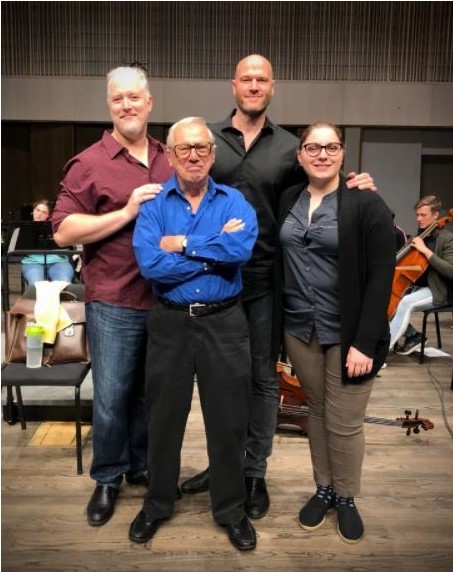
    PHOTO: A blue-shirted Moran, flanked by (clockwise from left) James Allen Anderson, Daniel Bubeck, and Maria Rusu

  • Gerald Fried Star Trek Music Interview

    Gerald Fried Star Trek Music Interview

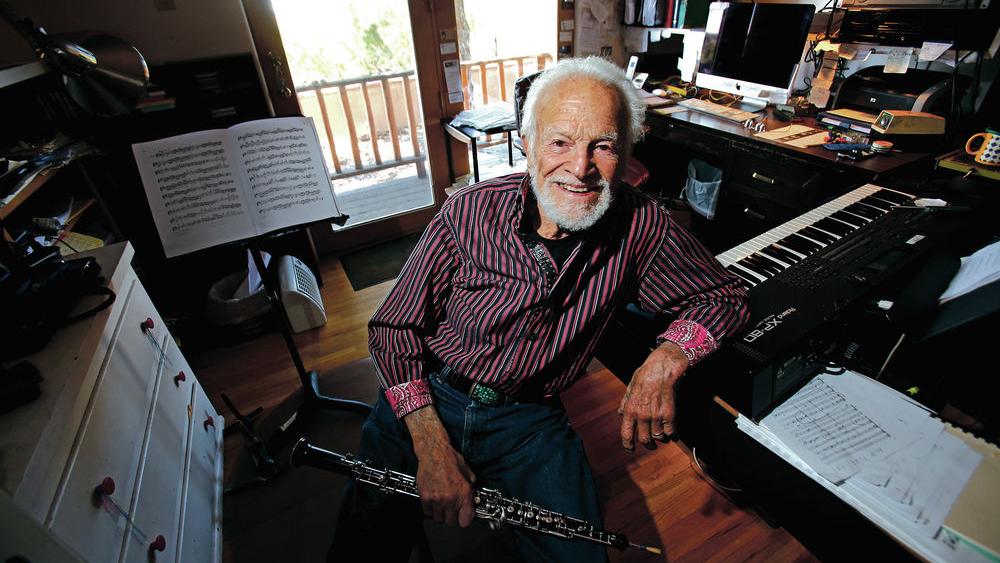
    I am very excited to announce that composer Gerald Fried will be our guest this weekend on Roy’s Tie-Dye Sci-Fi Corner.

    Fried began his career as an oboist with the Dallas Symphony Orchestra. Later, he followed his childhood friend, Stanley Kubrick, to Hollywood, where he composed scores for films like “The Killing” and “Paths of Glory.” He also worked extensively in television, writing music for “Riverboat,” “Shotgun Slade,” “Gilligan’s Island,” “The Man from U.N.C.L.E.,” and “Mission: Impossible.” His music for the documentary “Birds Do It, Bees Do It” earned him an Academy Award nomination in 1975. He was recognized with an Emmy for his work on the landmark miniseries “Roots” in 1977.

    Fried will join us on Sunday night to talk about his illustrious and prolific career. First, to whet the appetite for what’s bound to be a memorable conversation, Roy and I will chat about some of the music he composed for “Star Trek,” the original series, including that for “Shore Leave.” That’s the episode set on a planet where fantasies become reality, and Captain Kirk winds up grappling with his old nemesis Finnegan (resulting in a predictably tattered shirt). Our palavering preamble will take place on Friday.

    And I can’t imagine we’ll get through the weekend without some discussion of the immortal fight music from “Amok Time,” in which a crazed Spock engages Kirk in a “kun-ut kal-if-fee” battle to the death.

    Gerald Fried will set us free! Join us for Roy’s Tie-Dye Sci-Fi Corner – Fried’s “Star Trek” on Friday, and a conversation with the composer on Sunday – livestreamed on Facebook, both days, at 7:00 pm EST.

    https://www.facebook.com/roystiedyescificorner/


    Fried performs music from three of his classic “Star Trek” scores – including the iconic fight music from “Amok Time”:

    Finnegan:

    Spock vs. Kirk:

Tag Cloud

Aaron Copland (93) Beethoven (95) Composer (114) Film Music (136) Film Score (143) Film Scores (255) Halloween (94) John Williams (195) KWAX (229) Leonard Bernstein (103) Marlboro Music Festival (125) Movie Music (151) Mozart (88) Opera (208) Philadelphia Orchestra (89) Picture Perfect (174) Princeton Symphony Orchestra (108) Radio (88) Ross Amico (244) Roy's Tie-Dye Sci-Fi Corner (290) The Classical Network (101) The Lost Chord (268) Vaughan Williams (103) WPRB (396) WWFM (881)

DON’T MISS A BEAT

Receive a weekly digest every Sunday at noon by signing up here


RECENT POSTS