Category: Daily Dispatch

  • Leo Smit Philadelphia Composer Centennial

    Leo Smit Philadelphia Composer Centennial

    Leo Smit was born in Philadelphia 100 years ago today.

    Not to be confused with the Dutch composer of the same name (born in 1900), Smit was the son of Russian immigrants. His father was a violinist who performed with Leopold Stokowski in Philadelphia, Fritz Reiner in Cincinnati, and Arturo Toscanini in New York (with the NBC Symphony).

    A child prodigy, Leo took to the piano by the age of 5. When he was about 8, his mother took him to Moscow, where he studied for a year with composer Dmitri Kabalevsky.

    Back home, he was accepted into the Curtis Institute of Music. He was taught there by Isabella Vengerova. Vengerova was a Leschetizky pupil. Her other students included Gary Graffman, Gilbert Kalish, Leonard Pennario, Menahem Pressler, and Abbey Simon.

    Smit also learned from José Iturbi, the Spanish conductor, pianist, and harpsichordist, who achieved wider recognition in Hollywood films of the 1940s. Iturbi stood in for Cornel Wilde on the soundtrack to the Chopin biopic “A Song to Remember.”

    He received further instruction in composition from Nicolas Nabokov, who was the first cousin of Vladimir Nabokov.

    At 15 or 16, Smit became a rehearsal pianist for George Balanchine. He first worked with Igor Stravinsky while preparing for the world premiere of “Jeu de Cartes.” He was a devoted champion of the music of Aaron Copland, all of whose works for the keyboard he recorded. He once had the opportunity to play privately for Béla Bartók, for whom he turned pages at Carnegie Hall. Following the Carnegie concert, Copland introduced him to Leonard Bernstein. Smit also did much to revive the reputation of boogie-woogie master Pete Johnson.

    In 1951, the Boston Symphony Orchestra performed Smit’s First Symphony. He also composed two operas, “The Alchemy of Love,” on a libretto by British astronomer Fred Hoyle (who also provided the text for an oratorio about Copernicus), and “Magic Water.” Among his other compositions was a collection of 100 songs after poems of Emily Dickinson. His works were programmed by Bernstein, Stokowski, and Serge Koussevitzky.

    For three decades, he made his home in Buffalo, where he served on the faculty of the State University of New York. Earlier, he taught at Sarah Lawrence College and the University of California. As a photographer, he captured images of some of the era’s most notable musicians. He sometimes performed recitals to curated slide shows of his work.

    Smit died in 1999 at the age of 78.

    Leo Smit, Symphony No. 1:

    Interesting interview with Bruce Duffie, including a great recollection of Stravinsky:

    http://www.bruceduffie.com/leosmit.html

    Smit speaks with David Dubal, now host of WWFM – The Classical Network’s “The Piano Mattters”:

    Smit and Copland play “Danzon Cubano,” in its original two-piano version:


    PHOTO: Smit (standing), with Copland and Bernstein, photobombed by some guy in a hair helmet
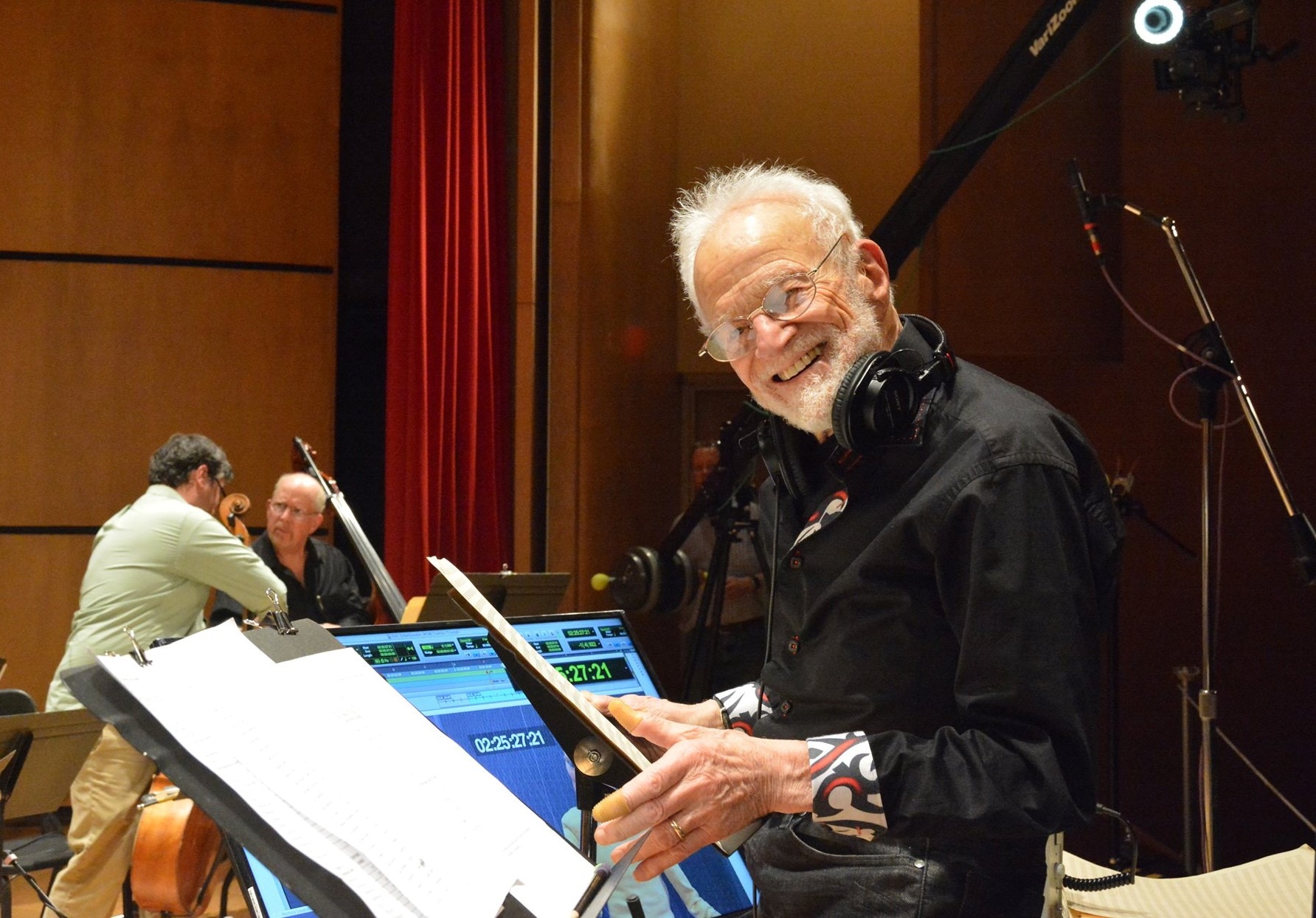
  • Gerald Fried Star Trek Legend Interview

    Out of respect for Gerald Fried, Roy and I didn’t sing the “Star Trek” fight music – but you know we were thinking it.

    Fried was our guest last night on Roy’s Tie-Dye Sci-Fi Corner. Click the video for recollections and insights from this screen legend.

    Fried is the composer of over 200 film and television scores, including those for Kubrick, “Star Trek,” and producer David L. Wolper. His collaborations with Wolper include the film “Birds Do It, Bees Do It” (which earned Fried an Academy Award nomination) and the landmark miniseries “Roots” (which won him an Emmy).

    Did I mention, Fried will be 93 on February 13? His most recent film, “Unbelievable!!!!,” received its online debut only months ago. In his spare time, he says, he’s now also writing screenplays. We are grateful to him for taking the time to share his fascinating reminiscences. Thank you, Gerald Fried!

  • Gerald Fried Composer Interview Roy’s Sci-Fi

    Gerald Fried Composer Interview Roy’s Sci-Fi

    Film and television composer Gerald Fried is our very special guest tonight on Roy’s Tie-Dye Sci-Fi Corner. Fried has had 70 years’ experience in film! Don’t miss this one. The chat begins, livestreamed on Facebook, at 7:00 EST.

    https://www.facebook.com/roystiedyescificorner/

  • Aurora Borealis Classical Music Sounds North

    Aurora Borealis Classical Music Sounds North

    All signs point north!

    This Sunday night on “The Lost Chord,” keep looking up, with musical responses to the uncanny, natural phenomenon known as the Aurora Borealis.

    Uuno Klami studied in Helsinki, with Erkki Melartin, then in Paris and Vienna. Following the premiere of his “Northern Lights” in 1948, some critics questioned whether the content of the piece lived up to the expectations engendered by its title. Klami remarked, “The northern lights can be much more than the superficial play of colors in the sky. They can be an expression of the infinite loneliness of the human spirit.” Personally, he thought it his best work.

    Geirr Tveitt was born in Bergen, Edvard Grieg’s native city. Though he was very much influenced by folk music of the Norwegian countryside, he too acquired further polish abroad. He studied first in Leipzig and then in Paris, with Arthur Honegger, Heitor Villa-Lobos, and Nadia Boulanger.

    In 1970, a very great tragedy occurred, when a fire swept through Tveitt’s home, a farmhouse in Nordheimsund, destroying most of his unpublished manuscripts – 300 pieces, stored in wooden chests – fully 4/5ths of his compositional output. It also crippled his ability to compose. Tveitt succumbed to alcoholism and died a broken man, with little hope of being remembered, in 1981.

    Happily, since then, a number of these “lost” works have been reconstructed. In the case of his Piano Concerto No. 4, subtitled “Aurora Borealis,” from 1947, the orchestral parts survived, along with a two-piano reduction and an archived broadcast recording.

    The restored concerto falls into three movements: “The Northern Lights awaken above the autumn colors,” “Glittering in the winter heavens,” and “Fading away in the bright night of spring.”

    I hope you’ll join me for an hour of radiant music, on “Aural Borealis,” this Sunday night at 10:00 EST, on WWFM – The Classical Network and wwfm.org.

  • Milton Babbitt a surprising composer

    Milton Babbitt a surprising composer

    In reading an interview with John Williams in The New Yorker only a few months back, I was amused to discover that he and Milton Babbitt enjoyed a friendship of sorts. I guess Babbitt was a Bernard Herrmann fan. Who knew?

    https://www.newyorker.com/culture/persons-of-interest/the-force-is-still-strong-with-john-williams

    Babbitt, who was born in Philadelphia on this date in 1916, was a fixture at Princeton University for many years. It’s telling that he joined both the music and mathematics faculties there. Later, he also served on the faculty of the Juilliard School.

    He gained widespread notoriety for his essay published under the title “Who Cares If You Listen?” The provocative slant was actually the result of an editorial decision. Babbitt’s original title had been “The Composer as Specialist” – not likely to generate nearly as much controversy.

    Broadly speaking, while he frequently composed in a serial style, his music is fairly lucid, without undo congestion, and with a minimum of soul-crushing dissonances. On the contrary, he often achieved a paradoxical simplicity under the guise of complexity.

    In the 1960s, Babbitt became interested in electronic music, apparently more for its rhythmic precision than for any unusual timbral considerations. I find it endearing to learn that he was also fond of jazz and musical theater. He himself was a saxophonist. In 1946, he penned a musical, “Fabulous Voyage,” a retelling of Homer’s “The Odyssey.”

    Babbitt was the recipient of an honorary Pulitzer Prize in 1982. He died in Princeton in 2011, at the age of 94.


    Listen here for “Penelope’s Night Song” from “Fabulous Voyage”:

    “Composition for Twelve Instruments” (1948):

    “Reflections” (1974) for piano and synthesized tape:

    Milton Babbitt on electronic music:

Tag Cloud

Aaron Copland (93) Beethoven (95) Composer (114) Film Music (136) Film Score (143) Film Scores (255) Halloween (94) John Williams (195) KWAX (229) Leonard Bernstein (103) Marlboro Music Festival (125) Movie Music (151) Mozart (88) Opera (208) Philadelphia Orchestra (89) Picture Perfect (174) Princeton Symphony Orchestra (108) Radio (88) Ross Amico (244) Roy's Tie-Dye Sci-Fi Corner (290) The Classical Network (101) The Lost Chord (268) Vaughan Williams (103) WPRB (396) WWFM (881)

DON’T MISS A BEAT

Receive a weekly digest every Sunday at noon by signing up here


RECENT POSTS