Category: Daily Dispatch

  • Princeton Symphony Plays Saint-Georges Mozart

    Princeton Symphony Plays Saint-Georges Mozart

    Music by violinist, conductor, and master swordsman Joseph Bologne, Chevalier de Saint-Georges, will open this weekend’s concert – the first of the new year – by the Princeton Symphony Orchestra. The virtual event will stream this Sunday at 4 pm EST.

    Born on Christmas Day, 1745, in the French colony of Guadeloupe, Saint-Georges gained renown as a soldier as well as a musician. Commander of the so-called “American Legion,” made up of free men of color, he ascended an all-too-brief thermal of opportunity in the decades leading up to and following the French Revolution. Among his fellow officers was a former fencing student, Thomas-Alexandre Dumas, father of the writer of “The Three Musketeers.” Saint-Georges also served as music teacher to Marie Antoinette. Future President of the United States John Adams, in Paris as commissioner to France, described him as “the most accomplished man in Europe.”

    Saint-Georges wrote operas, concertos, and chamber music. He also commissioned and led the first performances of Haydn’s “Paris” Symphonies.

    The PSO will open its Sunday program with Saint-Georges’ Symphony No. 1 in G major.

    In his lifetime, the composer was identified as “Le Mozart Noir.” He actually shared a summer residence with Mozart in 1778. Mozart, 11 years Saint-Georges’ junior was evidently jealous of the older man’s success.

    Be that as it may, the PSO will reunite the two artists by concluding the afternoon with Mozart’s Serenade for Winds in C minor, K. 388.

    In between, Ukrainian-born pianist (now a resident of Australia) Alexander Gavrylyuk will perform works by Mozart, Brahms, and Arkady Filippenko.

    Viewers will receive on-demand access to the concert for a period of one week, beginning on Sunday. To learn more and to register for admission, visit princetonsymphony.org.
  • Remembering William Scheide Princeton Benefactor

    Remembering William Scheide Princeton Benefactor

    Today would have been the 107th birthday of William H. Scheide.

    By coincidence, I was only just thinking about two concerts given in Princeton by Sir John Eliot Gardiner and his Monteverdi Choir. The first, in 2014, was devoted to Bach and Handel, and the second, in 2015, was a performance of Monteverdi’s “Orfeo.” These were among the most memorable concerts I ever attended. Both were made possible thanks to Scheide’s munificence.

    Scheide, who died in 2014 at the age of 100, was as generous as he was long-lived. He shared his abiding love for music, of course, especially that of Bach, of whom he was a respected interpreter and scholar; but he was also active in social causes, fighting against poverty, disease, hunger, ignorance, and discrimination. He touched many, many lives in the Princeton area and beyond.

    He also happened to enrich Princeton University’s Firestone Memorial Library with a trove of rare books and documents, including a Gutenberg Bible, some Shakespeare first folios, a copy of the Declaration of Independence, and manuscripts by Bach, Beethoven, and Lincoln, among others, the fruits of three generations of Scheide book-collecting.

    I had also, by chance, only just been thinking about a Scheide memorial program, a radio documentary of sorts, that I assembled for broadcast on WWFM – The Classical Network, for which I interviewed a number of his intimates and associates, including conductor Mark Laycock, radio personality Teri Noel Towe, and Bach scholar Christoph Wolff, in addition to Scheide’s widow, Judith. In the end, I had to pull a literal all-nighter in order to get it on the air in time, sounding the best it possibly could, on January 6, 2015, on what would have been Scheide’s 101st birthday.

    The year before, I had interviewed Gardiner, in advance of the first of his Princeton concerts, for an article in The Times of Trenton. Gardiner talked about his relationship with the famous Haussman Bach portrait, which then hung in the Scheide home. I also wrote a little more about Scheide’s relationship with Bach and Bach scholarship and his founding of the Bach Aria Group.

    Two Scheide-sponsored concerts, conducted by Laycock, were also mentioned. In 2013, Laycock conducted the Philadelphia Orchestra, in yet another landmark Scheide-sponsored event – the first time the orchestra had played in Princeton in nearly 50 years. His performance of Beethoven’s Symphony No. 9, with the Wiener KammerOrchester and the Westminster Symphonic Choir, on the occasion of Scheide’s 100th birthday, was broadcast nationally on PBS.

    https://www.nj.com/times-entertainment/2014/06/sir_john_eliot_gardiner_to_con.html

    Thanks for the musical memories, Mr. Scheide, and beyond that, thank you for making the world a better place.


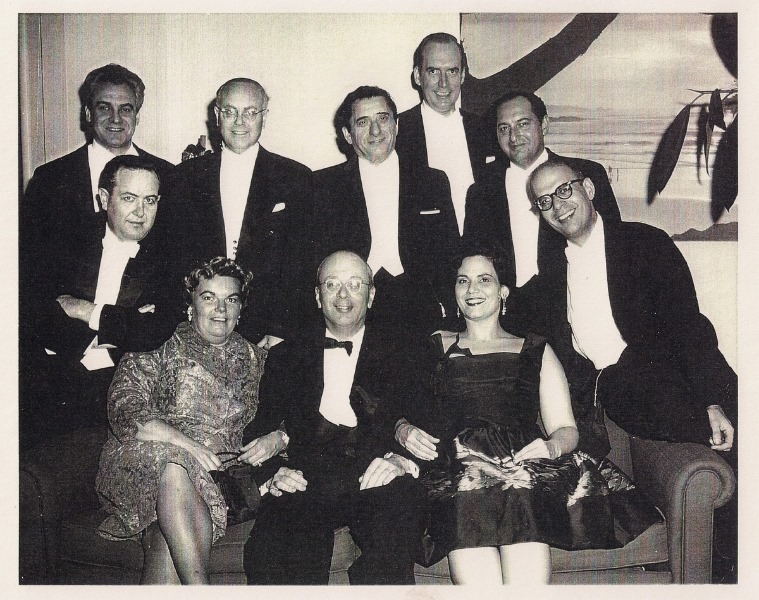
    PHOTO: William Scheide (center) with the Bach Aria Group he founded. Clockwise, from left, Eileen Farrell, Julius Baker, Robert Bloom, Paul Ulanowsky, Jan Peerce, Norman Farrow, Bernard Greenhouse, Maurice Wilk and Carol Smith

  • Alfred Brendel at 90: A Classical Music Titan

    Alfred Brendel at 90: A Classical Music Titan

    When Alfred Brendel was at his peak as a performer, the classical music industry was still going strong. In a happy coincidence, the compact disc appeared just as he had reached maturity, and allowed him to go back and document much of his core repertoire in clean, modern recordings.

    By extension, he was a regular presence on classical radio, and millions became familiar with him through his interpretations of Haydn, Mozart, Beethoven, Schubert, Schumann, Liszt, Brahms, and perhaps most interestingly, Schoenberg.

    Not always credited with being the most adventurous artist, he was invariably a thoughtful one. He made the first recording of Liszt’s “Weihnachtsbaum” (“Christmas Tree”), back in 1952, and unexpectedly, his first appearance on disc was as soloist in Prokofiev’s Piano Concerto No. 5. He was the first artist to record the complete piano works of Beethoven. He went on to document the complete sonatas no less than three times.

    Late in his career, he struggled against arthritis. When he retired in 2008, at the age of 78, he was at the top of his game, one of the few classical artists still guaranteed to pack halls. He appeared at Carnegie Hall no less than 81 times. Twice, he performed the complete Beethoven sonatas there.

    Bespectacled, crowned with a disheveled widow’s peak, and improbably tall and lank, Brendel often looks all the world like an absent-minded professor. His interpretations have sometimes been criticized for being “cold” or “cerebral.” But the man, better-read than most, also possesses a keen sense of humor. He is a fan of Edward Gorey and Charles Addams and Gary Larson. He collects kitsch and newspaper bloopers. He has gone on record as stating that his favorite occupation is laughing.

    Alongside his many thoughtful essays on musical subjects (including at least one on humor in music), he published two volumes of epigrammatic poetry, “One Finger Too Many” and “Cursing Bagels.”

    Happy birthday, Alfred Brendel, 90 years-old today.


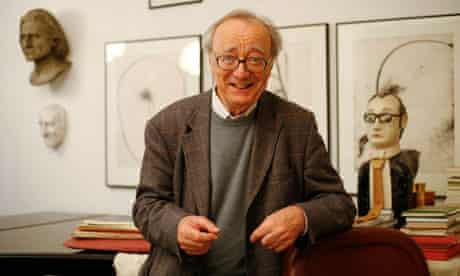
    PHOTO: Brendel, flanked by Liszt (left) and Eugene Jardin’s whimsical “Gipsbrendel”

  • Opera’s First Kiss: A History of Onstage Love

    Opera’s First Kiss: A History of Onstage Love

    Opera, of course, is full of passion. There is plenty of seething always, and doomed love, and not infrequently a corpse or two (or more).

    Thinking about first kisses today, I found myself wondering, what was the first operatic kiss? Meaning, when was it first deemed permissible to have the characters kiss on stage?

    I’m not talking about modern productions, which often have characters in Handel operas rolling around on the floor together. I’m speaking historically.

    As this article points out, there is abundant longing in so much of opera, but until a certain, fairly recent point in time, kissing itself was rarely depicted, or perhaps accepted.

    https://www.deutscheoperberlin.de/en_EN/opernsaenger-kuesst-man-nicht

    I’m not sure how authoritative the writer’s conclusions are, since my thoughts immediately turn to Bedřich Smetana’s “The Kiss,” which, as may be surmised from the title, hinges on a lip-lock as the entire motivation of its plot. Smetana’s opera, first performed in 1876, easily predates “Falstaff.”

    From that same year comes the wake-up smacker in Wagner’s “Siegfried.”

    Bizet’s “Carmen” was introduced in 1875. The amorality of its heroine (one critic described her as “the very incarnation of vice”), as well as the work’s antiheroic tone – the story is set among the common milieu of soldiers, cigarette girls, and toreadors – generated much hostility and indignation.

    On a lighter note, there’s “Were You Not to Ko-Ko Plighted,” from “The Mikado,” from 1885, with its refrain of “Oh this, oh this, this is what I’ll never, never do” (punctuated by kisses, naturally).

    Of course, by 1905, the genie is well out of the bottle, and we have Salome making out with the severed head of Jochanaan (John the Baptist).

    Can there not have been abundant kissing already in the 18th century, the age of Fragonard? How do you do “Così fan tutte” without at least a few pecks? Or was it all kissing of hands?

    Again, I am not talking about modern stagings of classic operas. Extensive Google-searching is turning up very little in the way of history and quite a lot in terms of anecdotes about singers’ first on-stage kisses. Here are a couple from a cute series put together by San Francisco Opera:

    Some shop talk on opera kissing:

    http://sestissimo.blogspot.com/2008/10/opera-kissing.html

    As always, Pavarotti takes the prize:


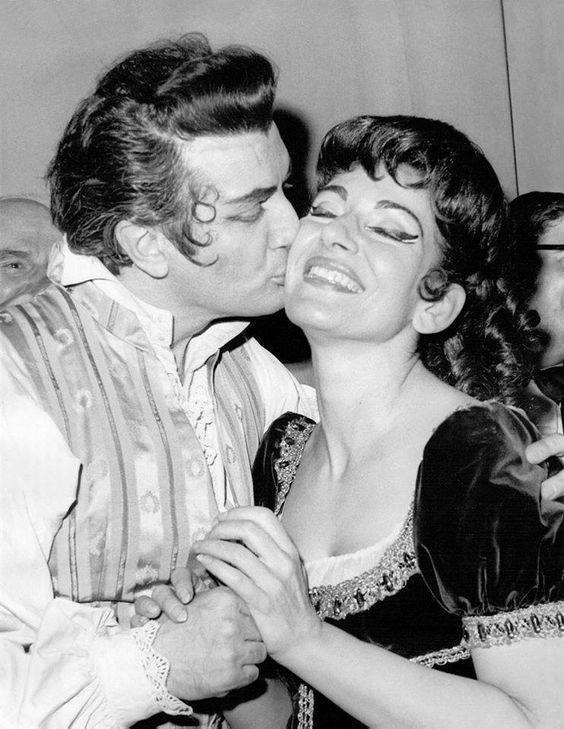
    Franco Corelli and Maria Callas at the Old Met in 1965

  • Viking Lore Sounds on “The Lost Chord”

    Viking Lore Sounds on “The Lost Chord”

    Experience the lore of the lur!

    This Sunday night on “The Lost Chord,” it’s a stoic start to the new year, with musical settings of the Icelandic Eddas.

    Enjoy selections from “The Rheingold Curse,” after the “Volsunga Saga,” the earliest written sources of the ancient Germanic myths (including those of Sigurd, Loki, and Fafnir). We’ll hear them in imaginative, though scholarly-informed, realizations by Benjamin Bagby and the ensemble Sequentia.

    Then we’ll turn to “The Creation of the World,” Part One of a bold, massive “Edda” oratorio by Icelandic composer Jón Leifs. Odin and his brothers defeat the giant Ymir, and from him fashion Earth, Sea, and Heavens, and soon after create the first man and woman from two trees. With its horn-helmeted, grunting choruses, laconic pounding, and austere poetry, this one will have you shouting for more mead.

    It’s a new year of swan’s bone flutes, tuned rocks, and Nordic lurs (reconstructions of ancient Viking horns), on “Cold Comfort,” this Sunday night at 10:00 EST, on WWFM – The Classical Network and wwfm.org.

Tag Cloud

Aaron Copland (93) Beethoven (95) Composer (114) Film Music (136) Film Score (143) Film Scores (255) Halloween (94) John Williams (195) KWAX (229) Leonard Bernstein (103) Marlboro Music Festival (125) Movie Music (151) Mozart (88) Opera (208) Philadelphia Orchestra (89) Picture Perfect (174) Princeton Symphony Orchestra (108) Radio (88) Ross Amico (244) Roy's Tie-Dye Sci-Fi Corner (290) The Classical Network (101) The Lost Chord (268) Vaughan Williams (103) WPRB (396) WWFM (881)

DON’T MISS A BEAT

Receive a weekly digest every Sunday at noon by signing up here


RECENT POSTS