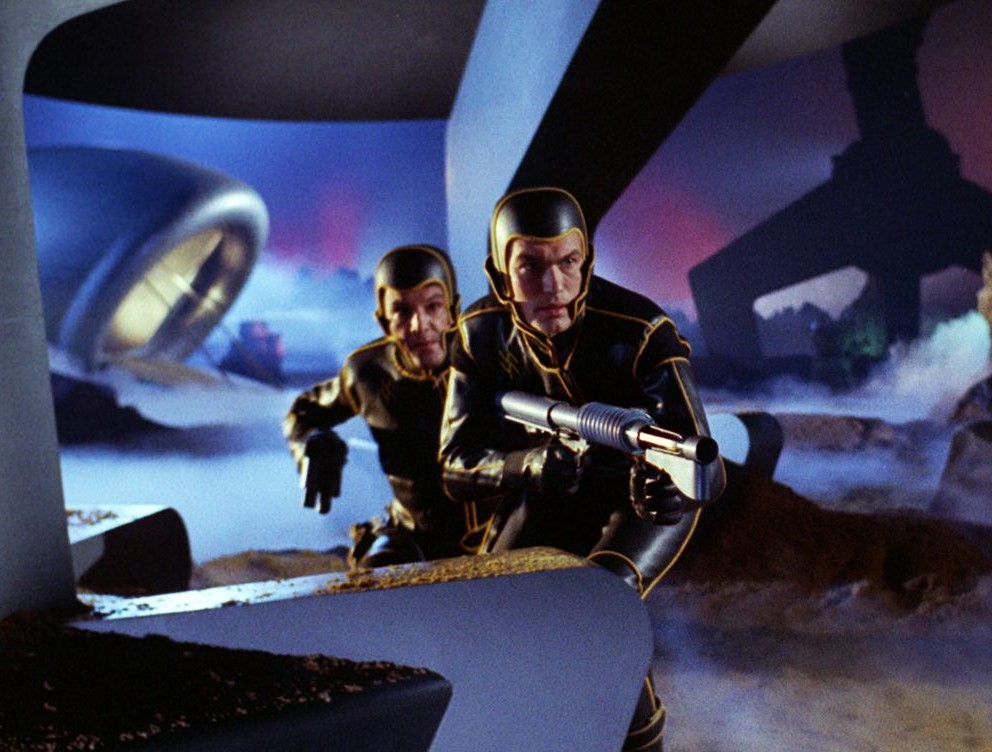
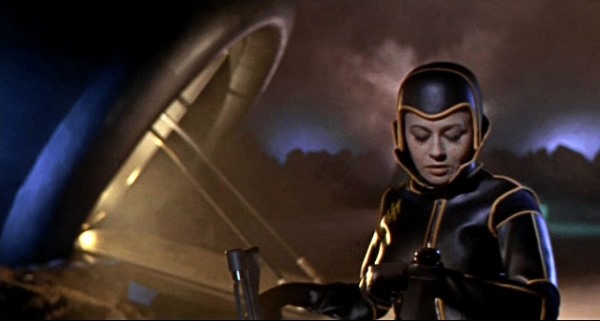
To be any pulpier than this, it would have to be a grapefruit!
Join Roy Bjellquist and me, as we fortify ourselves with plenty of vitamin C and holy water for “Planet of the Vampires” (1965).
Allegedly, this Mario Bava cult classic went through 15 working titles (the original, in Italian, was “Terrore nello spazio,” or “Terror in Space”) before arriving at the one under which it was finally released in the U.S. Interestingly, there aren’t any vampires in it! But don’t let that get in the way of a good time.
Roy and I will try to “liven things up” a bit with our batty conversation. Share your insights in the comments section. Roy’s Tie-Dye Sci-Fi Corner live-streams on Facebook this Friday evening at 7:00 EDT!
With the postal service more and more resembling “snail mail,” look back with nostalgia to “The King’s Stamp.” In 1935, Benjamin Britten composed a score for a short film about the design and production of a commemorative postage stamp to mark George V’s Silver Jubilee. It’s one of four documentaries with music by notable English composers (Britten, Ralph Vaughan Williams, William Alwyn, and Sir Arthur Bliss) that I’ll be highlighting this week on “Picture Perfect,” now at its new time, Saturday evening at 6:00 EDT, on WWFM – The Classical Network and wwfm.org.
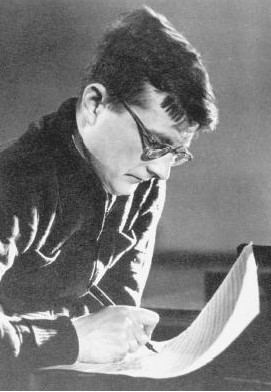
Dmitri Shostakovich, of course, is celebrated for his monumental symphonies and confessional string quartets, which are regarded as some of the most important of the 20th century.
But early on, he eked out a living as a pianist in movie houses, enlivening silent images with his mercurial improvisations. This was great practice for his later work with a number of notable Soviet filmmakers.
Shostakovich would go on to compose some 30 original film scores. Far and away his “greatest hit” in the field, at least in the West, is the romance from “The Gadfly” (1955), based on the novel of Ethel Lillian Voynich. The music enjoyed a revival of sorts in the 1980s as the theme for the miniseries “Reilly, Ace of Spies.”
But my personal favorite among his film scores is that for a zany fairy story after Pushkin, called “The Tale of the Priest and His Worker Balda.” Shostakovich, about 27 years-old in 1933, was hired by experimental animator Mikhail Tsekhanovsky to supply the manic underscore for his visionary creations. But Tsekhanovsky probably didn’t count on just how manic Shostakovich could be. The music flowed like water down the Neva, and Tsekhanovsky struggled to keep up, all the while pushing himself to create images worthy of his collaborator.
Then, in 1936, following the debut of the opera “Lady Macbeth of Mtsensk,” Shostakovich was condemned by the Soviet authorities in an infamous “Muddle Instead of Music” denunciation in Pravda, and the composer decided he had better cool his jets. The potentially inflammatory Symphony No. 4 went into a drawer, and he halted work on the film, which he had already been involved with, on and off, for nearly three years. When the denunciation came, he was in the process of wholly reorchestrating the existing music, at the studio’s request, for smaller forces.
While the feature would remain unfinished, Tsekhanovsky compiled what he had – some 40 minutes in all – and the work was put into storage at the Lenfilm archives. Unfortunately, nearly all of it would be destroyed by fire during the Nazi siege of Leningrad in 1941.
Only the bizarre bazaar scene survives. Watch this, and count your blessings.
Shostakovich regarded his music for “Balda” as some of the best he’d ever written. Here’s a complete recording, with restorations. Alas, it doesn’t have quite the pungency of the earlier suite recorded by Gennady Rozhdestvensky.
WHAT IT IS: a trippy, atmospheric, low-budget, Italian inspiration for “Alien.”
WHAT IT DEFINITELY IS NOT: a vampire movie!
Be that as it may, I hope you’ll join Roy Bjellquist and me tomorrow evening, as we sink our fangs into Mario Bava’s “Planet of the Vampires” (1965), a movie every bit as lurid as its title. Bloody reanimated corpses! Shapely foreign babes in form-fitting cat suits! Barry Sullivan!
SEE! High-collared, aviator-hatted space people of different nationalities badly-dubbed into English!
SEE! Deadly lava pits, forbidding skeletons, and the prototype for Ridley Scott’s space jockey!
LEARN! The singular importance of something called a Meteor Rejector!
The horror begins when we open our mouths. Your comments and insights add to the terror. Roy’s Tie-Dye Sci-Fi Corner live-streams on Facebook this Friday evening at 7:00 EDT!
Oh, where do the years go? Today is the 75th birthday of John Rutter.
Rutter, of course, is one of England’s most successful choral composers and conductors. It’s impossible to get through the Christmas season without hearing oodles of his work. The bigger pieces can be a little hit and miss (the “Gloria” gets a little too close to Walton at times, and “big” is not really Rutter’s forte), but when he hits, as in the lovely “Requiem,” he is well-nigh irresistible – at least for someone with a cotton candy soul like myself.
Perhaps his music is not your cup of tea, but the choir he built, the Cambridge Singers (founded in 1981), sounds like nobody else. For better or worse, like Ormandy’s Philadelphians, they bring their distinctive sound to everything they touch. The soft glow inspires contentment.
As a young man, Rutter collaborated with the legendary Sir David Willcocks on four volumes of the extraordinarily successful “Carols for Choirs” anthology series, now the most widely used source of carols in the British Anglican tradition, and very popular among choral societies. Willcocks went so far as to describe Rutter as the most gifted composer of his generation. Certainly, his gift for melody has proven inexhaustible.
Happy birthday, John Rutter, and many happy returns.
Rutter’s “Requiem” (1985), the perfect music for autumn, with the Cambridge Singers. Accept no substitutes.
“Candlelight Carol” (1984):
The composer offering insights into his “Requiem,” in 11 segments: