Category: Daily Dispatch

  • Beethoven’s Yom Kippur Connection?

    Beethoven’s Yom Kippur Connection?

    Beethoven for Yom Kippur?

    Somehow, in my 40-plus-year passion for classical music, I have never before stumbled across this theory. But now that I know, it’s definitely out there. A Google search turns up plenty.

    There are those who speculate that Beethoven’s String Quartet No. 14 in C-sharp Minor, Op. 131, contains a quotation from the Yom Kippur melody “Kol Nidre.” It’s certainly possible.

    When the first Reform synagogue opened in Vienna in 1825, the theory posits, Beethoven was approached to supply a cantata. He never committed, though it appears he did devote some time to the study of Jewish music. However, by 1825, he was already stone deaf.

    It’s also been speculated that, as a younger man, in Bonn, he happened to be sweet on Rachel Levin, the daughter of a wealthy jeweler, who traveled in artistic circles. The two met in Teplitz at a gathering of poets, musicians, and intellectuals. Levin’s parents were opposed to Beethoven pursuing a relationship. Levin would distinguish herself as a radical thinker, gaining notoriety for her rejection of bourgeois values. Ironically, she later converted to Christianity to marry the biographer Karl August Varnhagen von Ense. Was Beethoven looking back, perhaps still carrying the torch?

    The melody of “Kol Nidre” was first written down in Berlin in the 18th century, but its origins reach back deep into the Middle Ages, perhaps earlier. Legend has it that the tune has remained unchanged since Moses climbed down from Sinai.

    The alleged quotation appears in the sixth movement of Beethoven’s quartet. I’m not sure I’m entirely convinced. If it is indeed true, which would be very cool, I wish that the composer would have gone for broke, à la Max Bruch, rather than simply feinting at the melody.

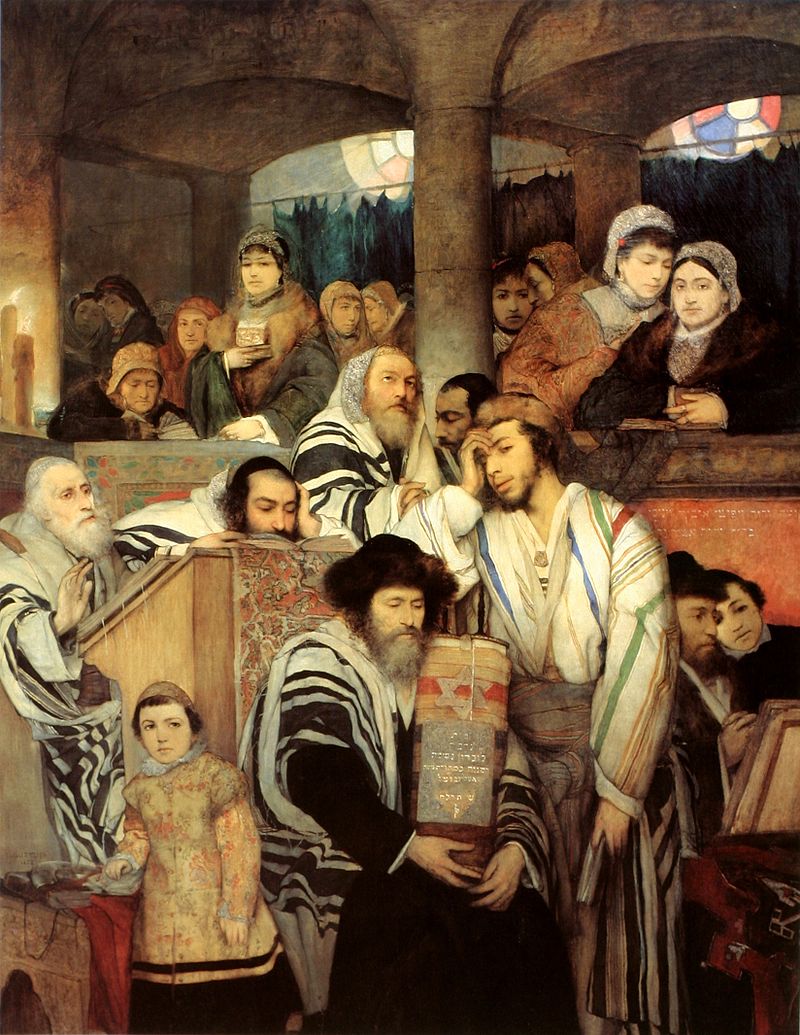
    Yom Kippur begins at sundown. The Day of Atonement marks the culmination of the Jewish High Holy Days, ten days of awe and repentance. Observed with fasting and prayer, it is the holiest day on the Jewish calendar.


    Beethoven, String Quartet No. 14, Movt. VI: Adagio quasi un poco andante (1826)

    Max Bruch, “Kol Nidrei” (1880)

    Jacob Weinberg, String Quartet No. 2, Movt. II: “Yom Kippur” (1950)

    Emil Nikolaus von Reznicek, “Symphonic Variations on Kol Nidre” (1929)

    Part I https://www.youtube.com/watch?v=jKA30FrX4jU
    Part II https://www.youtube.com/watch?v=bF_B66dAS04

    Arnold Schoenberg, “Kol Nidre” (1938)

  • Ginger Snaps Autumn Music Crossword Puzzle

    Ginger Snaps Autumn Music Crossword Puzzle

    It’s ginger snaps for breakfast! Celebrate autumn in music with this week’s Classic Ross Amico crossword.

    To fill out the puzzle, follow the link and select “solve online” at the bottom of the page. You’ll then be able to type directly into the squares. Once you feel you’ve exhausted the puzzle, you’ll find the solutions by clicking on “Answer Key PDF.”

    Take it or leaf it. Rake through this week’s colorful clues here:

    https://www.armoredpenguin.com/crossword/Data/2020.09/2707/27072447.189.html

  • Planet of the Vampires a Vampire-less Classic

    In case you missed it, here’s the video of Roy Bjellquist and me defying the living dead and “Planet of the Vampires” (1965), arguably the most influential vampire movie not to have any vampires. Perhaps there wasn’t enough money in the budget for plastic teeth?

    As always, spoilers are a part of the conversation. But the charm of “Planet of the Vampires” isn’t really in its plot, which we’ve seen many times now, most memorably in “Alien.” A distress beacon lures would-be rescuers to a creepy, unknown world, where an unseen threat aims to use them as hosts. Fortunately, Barry Sullivan is there in his rubber unitard to beat some sense into everyone. But the real magic is in director Mario Bava’s clever deployment of extremely limited resources, wringing every last drop out of the film’s dollar-ninety-eight budget.

    Roy’s Tie-Dye Sci-Fi Corner live-streams on Facebook every Friday and Sunday at 7 pm EDT. Roy will be taking off tomorrow, but on October 2 the gloves are off. Our Hallowe’en fest gets truly underway with Karen Black and “Trilogy of Terror!”

    https://www.facebook.com/roystiedyescificorner/

  • English Documentary Music Vaughan Williams Britten

    English Documentary Music Vaughan Williams Britten

    What has often been regarded in the United States as “hack work,” in England has been accepted as just another aspect of what it means to be a working artist. There is no disgrace in a composer earning a living, and some of the nation’s greatest musicians – including those in the employ of the Royal Family – have contributed finely-crafted scores to its body of cinema.

    This week on “Picture Perfect,” it’s an hour of English documentary music. We’ll hear selections by Ralph Vaughan Williams, from “The People’s Land” (1941), Benjamin Britten, from “The King’s Stamp” (1935), William Alwyn, from “The Green Girdle” (1941), and Sir Arthur Bliss, from “The Royal Palaces of Britain” (1966). All four films are patriotic utterances on distinctly English themes.

    You may not have seen any of these shorts, but the music is beautiful. I hope you’ll join me for music from English documentaries, this Saturday evening at 6:00 EDT, on WWFM – The Classical Network and wwfm.org.


    In the meantime, if you’re having a slow afternoon, why not get a taste of the films themselves?

    “The People’s Land,” score by Vaughan Williams:

    https://film.britishcouncil.org/resources/film-archive/the-peoples-land

    “The King’s Stamp,” score by Benjamin Britten:

    “The Green Girdle,” score by William Alwyn:


    PHOTO: It’s not about what you think

  • Gershwin’s Birthday Astaire’s “Damsel” Dance

    Gershwin’s Birthday Astaire’s “Damsel” Dance

    It’s George Gershwin’s birthday! Here’s the funhouse dance sequence from “A Damsel in Distress” (1937) – Fred Astaire, George Burns, and Gracie Allen monkey around in a barrel, on a lazy susan, down a slide, and opposite their distorted reflections – including some rather Milhaud-like bitonality in the funhouse mirror dance!

    Astaire had known Gershwin for years. He and his sister, Adele, headlined two Broadway musicals – “Lady Be Good!” (1924) and “Funny Face” (1927) – by George and his brother, Ira. Adele married in 1932 and retired from show business. Fred later starred not only in “A Damsel in Distress,” but also in the silver screen musical “Shall We Dance”(1937), both at least partially scored by Gershwin.

    Here are a couple of fascinating documents, set down in 1926, of Fred and Adele singing with Gershwin at the piano.

    Four months before the release of “A Damsel in Distress,” Gershwin died of a brain tumor at the age of 38. Reportedly, his last words were… “Fred Astaire.”

Tag Cloud

Aaron Copland (93) Beethoven (95) Composer (114) Film Music (137) Film Score (143) Film Scores (255) Halloween (94) John Williams (195) KWAX (229) Leonard Bernstein (103) Marlboro Music Festival (125) Movie Music (152) Mozart (88) Opera (208) Philadelphia Orchestra (89) Picture Perfect (174) Princeton Symphony Orchestra (108) Radio (88) Ross Amico (244) Roy's Tie-Dye Sci-Fi Corner (290) The Classical Network (101) The Lost Chord (268) Vaughan Williams (103) WPRB (396) WWFM (881)

DON’T MISS A BEAT

Receive a weekly digest every Sunday at noon by signing up here


RECENT POSTS