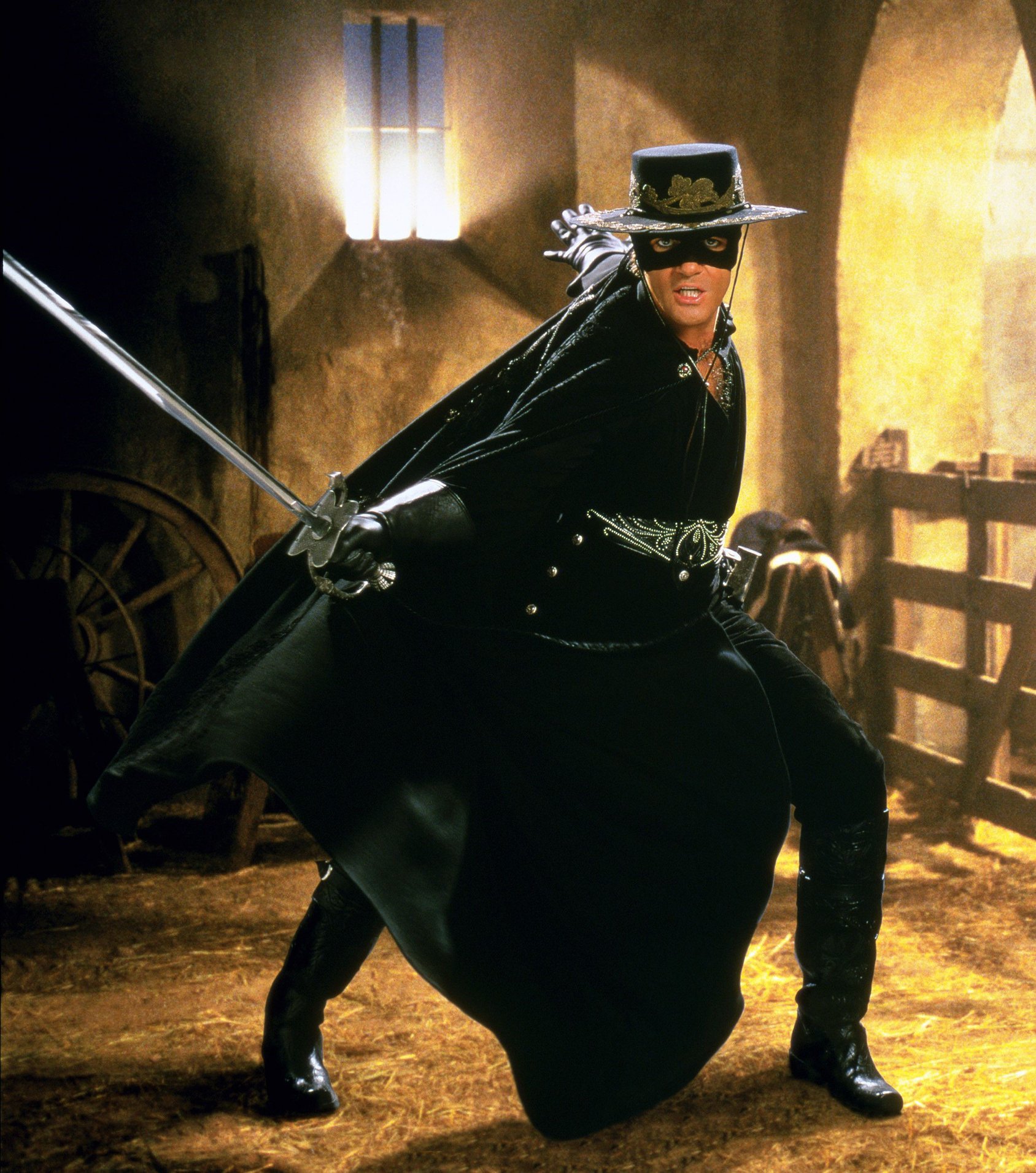
Due to a mix-up last week, in which my Ennio Morricone show was aired in place of the swashbuckler program I had earlier promoted, “Latin Swords” will be broadcast this evening at 6:00 EDT, on WWFM – The Classical Network and wwfm.org.
Tune in for rousing selections from “Captain from Castile” (Alfred Newman), “The Mask of Zorro” (James Horner), “Puss in Boots” (Henry Jackman), and “The Adventures of Don Juan” (Max Steiner).
On the other hand, if Morricone sounds like the very thing you’ve been hankering for, feel free to pile your plate high with spaghetti westerns at any time, by visiting the “Picture Perfect” webcast page.
Select the show, and then click on the “listen” icon:
Is there a more appropriate tale in time of COVID than “Robinson Crusoe?” Only if it’s “Robinson Crusoe on Mars.”
Once again, Roy Bjellquist and I will convene from our respective bunkers, through the power of Zoom, to discuss Byron “The War of the Worlds” Haskin’s 1964 Red Planet castaway narrative, starring Paul Mantee, a largely silent Victor Lundin (who started out as an opera singer), and Adam West (who receives third billing, barely, ahead of a monkey).
An American astronaut finds himself stranded on Mars with limited resources, but unlimited resourcefulness. The only thing he lacks for is companionship (save for the aforementioned monkey). Then he meets his man Friday.
51 years before Matt Damon became “The Martian,” there was “Robinson Crusoe on Mars.” Belly-up for a heapin’ helpin’ of water-plant sausage stew and oxygen-generating hot rocks, on the next Roy’s Tie-Dye Sci-Fi Corner. Keep us company with your comments. The interplanetary conversation will be live-streamed on Facebook, this Friday evening at 7:00 EDT.
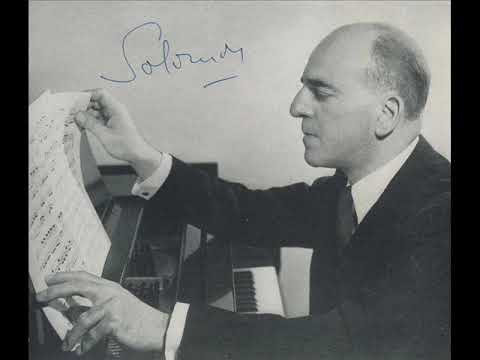
While no doubt wise, this is really Solomon the poet. Solomon of the Song of Songs.
Solomon Cutner was one of those rare classical musicians to be recognized by a single name. A child prodigy who studied with Mathilde Verne, herself a pupil of Clara Schumann, Solomon made his London debut at the age of eight. Verne pushed him hard – perhaps too hard – so that at nine, he was playing Beethoven’s Piano Concerto No. 3 and Liszt’s “Hungarian Fantasy.” At twelve, he appeared on no less than six Prom concerts, as soloist in concertos by, among others, Grieg and Tchaikovsky. The concertos of Schumann and Brahms followed.
Eventually, Verne’s motives were called into question. As the head of her own piano school, she stood to profit from the boy’s preternatural success. However, the relentless pace drove Solomon to exhaustion, anxiety, and a nervous breakdown. Once his five-year contract with her expired, he refused to have any contact with her ever again. In his 70s, he would reflect on how miserable his childhood had been.
Simon Rumschinsky, a pupil of Theodor Leschetizky, helped Solomon to rebuild his technique – and his confidence – so that he was able to pursue further studies in Paris and relaunch his adult career. Solomon’s acclaimed recitals took him far from his native London, to the United States, Australia, South Africa, South America, and Japan. Perhaps he never totally shook the specter of Verne, since he continued to practice for eight or nine hours a day.
Solomon gave the world premiere of Sir Arthur Bliss’ Piano Concerto at Carnegie Hall in 1939 (on the same program that introduced Vaughan Williams’ “Five Variants of Dives and Lazarus” and Sir Arnold Bax’s Symphony No. 7). The concert was presented in conjunction with “British Week” at the New York World’s Fair. He also entertained British troops throughout World War II, in such far-flung locations as North Africa, Palestine, India, Singapore, and Bangkok.
As an interpreter, he was particularly renowned for his Beethoven. Sadly, while in the midst of recording a complete cycle of the sonatas, in 1956, he suffered a stroke that deprived him of the use of his right arm. Though he lived another 32 years, Solomon never recorded or performed in public again. For a pianist who died as recently as 1988, it’s sobering to reflect, little of his repertoire was documented in stereo.
Broadly speaking, Solomon’s was a non-interventionist approach. It was his desire not to place himself too much between the composer and the audience. Therefore, his interpretations can sometimes come across as having more polish than personality. But at his best, he was a great poet of the keyboard.
Here, Solomon performs possibly my favorite Beethoven piano sonata, and an appropriate one, I think, for a late-summer afternoon. I’ve always been particularly fond of the exquisite third movement.
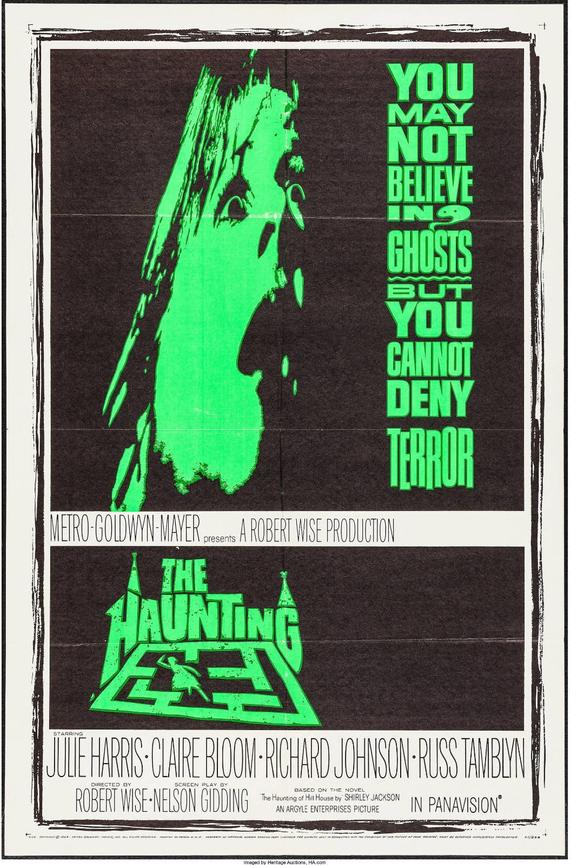
My favorite haunted house movie is still “The Haunting.” Not the overegged 1999 Steven Spielberg-produced remake, with every “chill” projected boldly in state-of-the-art CGI, but the spine-tingling Robert Wise original from 1963 – black and white, insinuating, and creepy as hell.
The direction, cinematography, editing, screenplay, and acting are all first-rate (Russ Tamblyn’s wisecracking Luke aside), and the film still makes for an effective hair-raiser, when viewed alone, late at night, with the lights out.
“In the night… in the dark,” as Mrs. Dudley says.
Adding another dimension to the piece is the unsettling score of Humphrey Searle. Searle manages to take “The Haunting” to a whole other level with his weird atonality and menacing avant-gardisms.
As a concert composer, Searle, two years younger than Benjamin Britten, is about as far from the pastoral tradition of Ralph Vaughan Williams and Gerald Finzi as any English composer of his generation could possibly be (with the possible exception of Elizabeth Lutyens). Britten was contemporary, and cosmopolitan, but Searle was radical, propelled by “Wozzeck” and Franz Liszt (a composer whose works he catalogued, and about whom he wrote an influential book). Searle’s principle mode of expression may have been dodecaphonic (i.e. twelve-tone), but he liked to characterize himself as romantic.
All of Searle’s symphonies have been recorded, but to date, there has been no commercial release of his music for “The Haunting.” For me, this is on my short list of scores I hope one day to be able to purchase. It remains one of the most effective horror scores I have ever heard. Thankfully, for the present, some of it has been posted on YouTube:
I understand that Searle’s symphonies may not be everyone’s cup of tea. They can be austere, grumpy (or perhaps Searle-y), acerbic, tough, and even violent. But the Second, written to the memory of his first wife, Lesley, suggests a tonal center of D and is therefore perhaps a tad more orienting.
For a serialist (who was introduced to Anton Webern by Schoenberg pupil Theodor Adorno), Searle was not without a sense of humor. Here is his “Punkt Contrapunkt,” written under the pseudonym of Bruno Heinz Jaja, a musical joke composed for one of the notorious Hoffnung Music Festival concerts. The speakers are Gerard Hoffnung and John Amis.
And a setting of “Young Lochinvar,” after Walter Scott, also composed for Hoffnung, with Gerard Hoffnung and Yvonne Arnaud.
By coincidence, it was as Searle was on his to Liverpool to attend the premiere of his Symphony No. 2 (link posted above) that he learned of Hoffnung’s death, of a heart attack, at the age of 34.
Searle also composed scores for Hammer Films’ “The Abominable Snowman,” with Forrest Tucker and Peter Cushing, and the Doctor Who serial “The Myth Makers,” with William Hartnell.
Happy birthday, Humphrey Searle!
CLOCKWISE FROM LEFT: “The Haunting;” Searle at work; and Searle, seldom without cat or cigarette, caricatured by Gerard Hoffnung
A wistful glimpse at a time when commercial television was still committed to “educational entertainment,” cultural enrichment, and the broader good. Leonard Bernstein on conducting, on “Omnibus.” The series won dozens of awards, including eight Emmys and two Peabodys.