Category: Daily Dispatch

  • Bernstein Honegger Summer Music Beethoven

    Bernstein Honegger Summer Music Beethoven

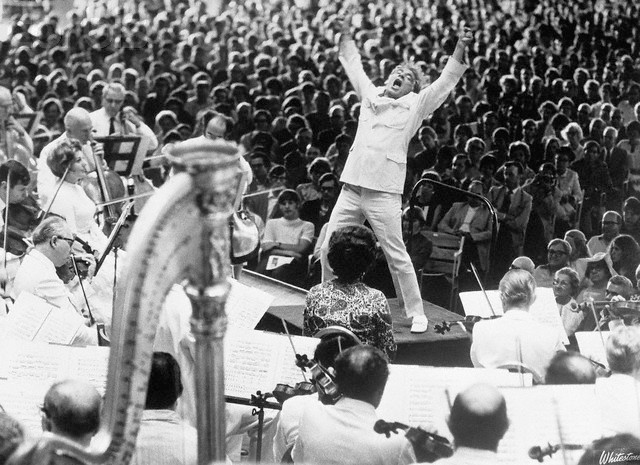
    I’m not a big fan of compilation CDs, but this one happens to contain a beautiful performance of Arthur Honegger’s “Pastorale d’été” (“Summer Pastorale”), perfect music for a summer’s afternoon, conducted by Leonard Bernstein, on his birthday. Listen for Honegger’s allusion to Beethoven’s “Pastoral” Symphony.

    And, while we’re on the subject, Bernstein talks about and conducts the “Pastoral” Symphony, here:

    https://www.youtube.com/watch?v=iPd4jc-c_qY

  • Leonard Bernstein Omnibus TV’s Golden Age

    Leonard Bernstein Omnibus TV’s Golden Age

    A wistful glimpse at a time when commercial television was still committed to “educational entertainment,” cultural enrichment, and the broader good. Leonard Bernstein on conducting, on “Omnibus.” The series won dozens of awards, including eight Emmys and two Peabodys.

    https://www.youtube.com/watch?v=XeP_dsGoImw

  • Happy Birthday Lenny Bernstein Candide Lives

    Happy Birthday Lenny Bernstein Candide Lives

    Happy birthday, Lenny!

    Leonard Bernstein has seen the future… and it is YES.

    When Lenny and “Candide” were still young:

  • Asteroid Schumann & the Election of 2020

    Asteroid Schumann & the Election of 2020

    NASA’s projected arrival of Asteroid 2018 VP1 on November 2, the eve of the Presidential Election, reminds me of Robert Schumann and Clara Wieck’s 1840 legal victory over her father. The two had initiated a long and acrimonious lawsuit against Friedrich Wieck, Schumann’s former teacher, in the hope of overriding his opposition to their marriage. By the time the court ruled in their favor, and they were allowed to tie the knot, it was the last day of Clara’s 20th year. One more day, and she would have attained majority status. At 21, as a matter of course, the decision to marry would have been legally hers.

    Where was this asteroid in 2016, when we really needed it?*


    Kaija Saariaho’s “Asteroid 4179 – Toutatis”

    Schumann’s “Widmung” (“Dedication”), a gift to his new bride


    *Not to worry, it’s only 6 to 12 feet wide and likely to burn up, mostly, or explode in the atmosphere.

    https://en.wikipedia.org/wiki/2018_VP1

  • César Franck and His Belgian Disciples

    César Franck and His Belgian Disciples

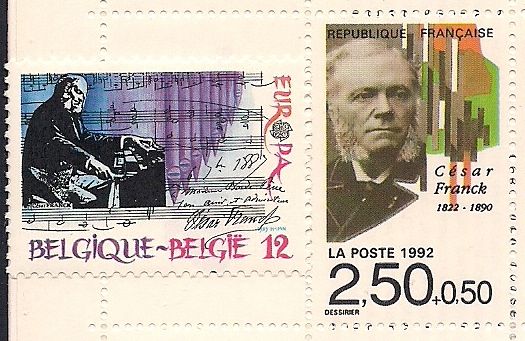
    César Franck was a strangely charismatic outsider. A Belgian abroad, he was required to take French citizenship in order to teach at the Paris Conservatory. A renowned organist, his unexpected genius for composition blossomed late.

    His enduring fame rests on a handful of fairly late works. He managed to reinvigorate the French symphonic and chamber music traditions through his use of “cyclic form,” with themes throughout generated from a single motif. He also embraced the symphonic poem. In these regards he certainly bore the influence of Franz Liszt. In turn, he himself became highly influential among a generation of French and Belgian composers.

    This Sunday night on “The Lost Chord,” we’ll examine music by two Belgians who fell under his sway.

    Armand Marsick, born in 1877, trained as a violinist at the Liège Conservatory, before studying abroad in Nancy with Franck enthusiast Guy Ropartz. Then he moved to Paris, where he studied with another Franckian, Vincent d’Indy. His career led him to Athens, and then Bilbao, where he founded a conservatory and an orchestra. He returned to Liège at the age of 50, settling in to teach and direct the concert society there. He died in 1959. The bulk of Marsick’s compositional output, which consisted of some forty works, was written between the ages of 23 and 37. We’ll enjoy a symphonic poem from 1908, titled “La Source.”

    Guillaume Lekeu was born in Verviers in 1870. He studied with Franck in Paris, then, like Marsick, with d’Indy following Franck’s death. Lekeu, unfortunately, is also remarkable for his very short life. He became ill with typhoid fever after consuming contaminated sherbet at a restaurant, and died in 1894, one day after his 24th birthday. Despite his sadly shortened existence, he managed to make important contacts and to write music of considerable promise. At the time of his death, he had already been composing for nine years, from the age of 15. In 1891 he was recipient of a second prize in the celebrated Prix de Rome competition.

    In all, Lekeu composed about 50 works. We’ll hear his Violin Sonata from 1892, written for the great Belgian virtuoso Eugene Ysaye, and his Adagio from 1891, originally composed for quartet and string orchestra. The score to the latter bears an epigraph from a poem by Georges Vanor, “The pale flowers of memory.”

    I hope you’ll join me for music by these Belgian followers of César Franck. That’s “Franckly Belgian,” this Sunday night at 10:00 EDT, on WWFM – The Classical Network and wwfm.org.

Tag Cloud

Aaron Copland (93) Beethoven (95) Composer (114) Film Music (137) Film Score (143) Film Scores (255) Halloween (94) John Williams (195) KWAX (229) Leonard Bernstein (103) Marlboro Music Festival (125) Movie Music (152) Mozart (88) Opera (208) Philadelphia Orchestra (89) Picture Perfect (174) Princeton Symphony Orchestra (108) Radio (88) Ross Amico (244) Roy's Tie-Dye Sci-Fi Corner (290) The Classical Network (101) The Lost Chord (268) Vaughan Williams (103) WPRB (396) WWFM (881)

DON’T MISS A BEAT

Receive a weekly digest every Sunday at noon by signing up here


RECENT POSTS