Category: Daily Dispatch

  • Latin Swords Swashbuckling Film Scores

    Latin Swords Swashbuckling Film Scores

    Feeling a little out of shape? Boxed in? Blue? This week on “Picture Perfect,” put some swagger back into your step with an hour of audacious music from Latin swashbucklers.

    Alfred Newman gets the blood pumping with his virile soundtrack for “Captain from Castile” (1947), in which Tyrone Power flees persecution at the hands of the Inquisition to join Cortés’ expedition to conquer Mexico. The film was shot on location with one sequence set against the backdrop of an erupting volcano!

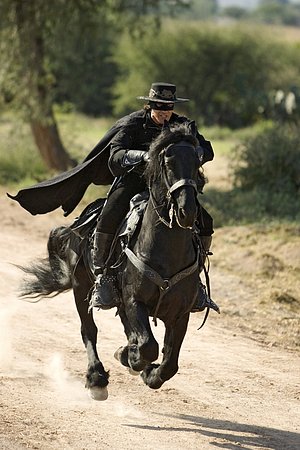
    Power, of course, was one of the screen’s great Zorros. However, with “The Mask of Zorro” (1998), Antonio Banderas becomes the Zorro for our time. He’s aided and abetted by Anthony Hopkins, as the elder Zorro who mentors him. (TWO Zorros in one movie! I could expire of joy.) Catherine Zeta-Jones is radiant, and the music by James Horner literally hits all the right notes.

    This film was already a throw-back upon release, with plenty of real-life, real-time swordplay and stunts galore, with the barest minimum of computer-generated bells and whistles. I wish to God popcorn entertainment could still be like this. “The Mask of Zorro” was like a belated last gasp of the 1980s; easily the best swashbuckler of the ‘90s – though, really, was there much competition?

    Banderas got a chance to send-up his image in the Dreamworks’ computer-animated feature, “Puss in Boots” (2011), a spin-off from the Shrek series that actually turned out to be a better sequel than “The Legend of Zorro” (2005).

    The film sports plenty of Zorro in-jokes, which extend even to Henry Jackman’s entertaining score. How is it that animated movies are just about the only movies these days that seem to keep up the great orchestral tradition of classic film scoring?

    Finally, Errol Flynn has one last swash left in his buckle for “The Adventures of Don Juan” (1948), his last wholly satisfying period adventure. Max Steiner rises to the occasion and provides one of his best scores, just about on the same level as those of the master of the genre, Erich Wolfgang Korngold.

    A cape, a plume, and seven-league boots are guaranteed mood-elevators. Forget your cares! Join me for Latin swords, on “Picture Perfect,” music for the movies. We ride hell-for-leather, this Friday evening at 6:00 EDT, on WWFM – The Classical Network and wwfm.org

  • Why Classical Music Gives You Thrills The Science Behind Chills

    Why Classical Music Gives You Thrills The Science Behind Chills

    Sex, drugs, and classical music.

    Not exactly new (the study was conducted ten years ago), but I’ve been saving this for a slow day. Just in case you ever wondered why you sometimes get chills when you listen to Mahler.

    https://www.mcgill.ca/newsroom/channels/news/musical-chills-why-they-give-us-thrills-170538

    Details of the study, along with a list of the music used, here:

    https://journals.plos.org/plosone/article?id=10.1371/journal.pone.0007487#s5


    PHOTO: The late, lamented “Mozart in the Jungle” – not always the last word in authenticity, but it played “with the blood”

  • Kolchak’s Secret Past Darren McGavin as Chopin Extra

    Kolchak’s Secret Past Darren McGavin as Chopin Extra

    Does anyone else remember the time Kolchak the Night Stalker met Frederic Chopin?

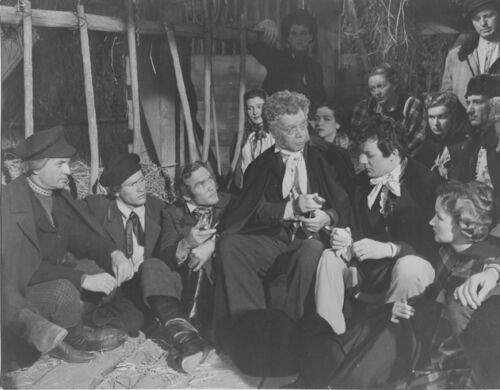
    I always assumed Kolchak was a Slavic name, but here’s photographic evidence that, indeed, he was a student with the famed Polish pianist and composer.

    Darren McGavin was hard at work painting scenery at Columbia Pictures in 1945, when he caught wind of auditions being held for a Chopin biopic, titled “A Song to Remember.” Cornel Wilde would play the immortal pianist-composer, and Paul Muni his teacher. McGavin’s role would be so small, he wouldn’t even receive screen credit, but his very casting was momentous, since it would mark his film debut. Once he rinsed the paint out of his brush that day, he never looked back.

    He had already clocked countless hours on stage, film, and especially television, by the time he donned the rumpled seersucker and crumpled raffia as Kolchak, muckraker of the macabre, in the early 1970s.

    Here, McGavin appears second from the left. Wilde is second from the right, with Muni, center, as Prof. Joseph Elsner.

    The great irony, of course, is that “A Song to Remember” is such a generic title that it is easy to forget – or at least to confuse with “Song of Love” (1947, about the Schumanns) and “Song without End” (1960, about Liszt).

    Follow the link for McGavin. He’s on the left side of the room, wearing a cap, already a scene-stealer, at one point trying to draw attention to himself by scratching his head with a piece of straw, which he then holds in his mouth. The entire scene lasts a mere 90 seconds.

  • Celebrating Salieri: Beyond Mozart Rivalry

    Celebrating Salieri: Beyond Mozart Rivalry

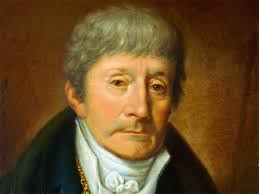
    Happy birthday, Antonio Salieri! I hope you’ll join me in celebrating 270 years of “mediocrity.”

    Salieri lives on in the popular imagination, of course, as the envious rival of Wolfgang Amadeus Mozart. But was he really?

    Rumors of Salieri’s involvement in Mozart’s death were seized upon by Alexander Pushkin as early as 1831, when he came to write the tragedy “Mozart and Salieri,” which appeared only few years after Salieri himself had passed. This was later set as an opera, in 1898, by Nikolai Rimsky-Korsakov.

    Of course, the slander has been kept alive and given even broader currency thanks to Peter Schaffer’s play, “Amadeus,” and the even more widely seen film, directed by Milos Forman. While I have no objection to dramatic license (Shakespeare would not be Shakespeare without it), it is too bad that such a generous figure – and a fine composer to boot – should live on, for the most part, in infamy.

    Salieri was a generous teacher, who fostered Beethoven, Schubert, Liszt, and even the son of the genius he was rumored to have poisoned. Franz Xaver Mozart was born four months after his father’s alleged murder.

    Salieri’s first act, when he was appointed Austrian Imperial Kapellmeister in 1788, was to revive Mozart’s “The Marriage of Figaro.” He was responsible for arranging first performances of his alleged nemesis’ Piano Concerto No. 22, the Clarinet Quintet, and the Symphony No. 40, and he had nothing but praise for “The Magic Flute.”

    Sadly, he found no one to return the favor. Already during his later years, his own enormous compositional output (37 operas, in addition to orchestral works, concertos, chamber music, and sacred pieces) gradually faded from public memory. Ironically, it is the scandalmongers who kept his name alive.

    But, as the saying goes, there is no such thing as bad publicity. In a way, “Amadeus” was the best thing to happen to Salieri in nearly 200 years. How many people remember Mozart’s string quartet partners (with Haydn), Carl Ditters von Dittersdorf and Jan Křtitel Vaňhal, both also talented and prolific composers? I’m sure they would agree – with apologies to Wilde – that the only thing worse than being talked about is not being talked about.

    Happy birthday, Patron Saint of Mediocrity!

    Russian film version of Rimsky’s “Mozart and Salieri” (without subtitles): https://www.youtube.com/watch?v=ilw7oIkrDj4

    In English, if a bit fuzzy:

    Salieri’s Concerto for Flute, Oboe and Orchestra:

    A Mozart and Salieri collaborative effort, the cantata “Per la ricuperata salute di Ofelia,” only recently rediscovered:

    “I absolve you.”

  • Martian Chronicles Dissected Stargate Special Effects

    In case you missed it (and I know you did), here’s Roy and my epic dissection of the 1979-1980 miniseries after Ray Bradbury’s “The Martian Chronicles,” which turned out to be nearly as long as the series itself (although, I think you’ll agree, much more entertaining).

    Roy’s Tie-Dye Sci-Fi Corner streams live on Facebook every Friday and Sunday at 7 pm EDT. We’ll actually be taking a break this Friday (it’s Roy’s wife’s birthday), but the week after that, we’ll be discussing “Robinson Crusoe on Mars.”

    This Sunday, Roy’s special guest will be Bruce Woloshyn, special effects supervisor on television shows such as “Stargate SG-1” and “Stargate: Atlantis.” Among his other, big screen credits are “Abraham Lincoln: Vampire Hunter,” “Mission to Mars,” and “Night at the Museum.”

    Tune in for the conversation this Sunday at 7 pm:

    https://www.facebook.com/roystiedyescificorner/

Tag Cloud

Aaron Copland (93) Beethoven (95) Composer (114) Film Music (137) Film Score (143) Film Scores (255) Halloween (94) John Williams (195) KWAX (229) Leonard Bernstein (103) Marlboro Music Festival (125) Movie Music (152) Mozart (88) Opera (208) Philadelphia Orchestra (89) Picture Perfect (174) Princeton Symphony Orchestra (108) Radio (88) Ross Amico (244) Roy's Tie-Dye Sci-Fi Corner (290) The Classical Network (101) The Lost Chord (268) Vaughan Williams (103) WPRB (396) WWFM (881)

DON’T MISS A BEAT

Receive a weekly digest every Sunday at noon by signing up here


RECENT POSTS