Category: Daily Dispatch

  • Freedom’s Responsibility: Reclaiming Patriotism

    Freedom’s Responsibility: Reclaiming Patriotism

    “Freedom makes a huge requirement of every human being. With freedom comes responsibility. For the person who is unwilling to grow up, the person who does not want to carry his own weight, this is a frightening prospect.”

    Eleanor Roosevelt


    It is frustrating to log on to the internet every day and find the concepts of “patriotism” and “liberty” being so perverted. “Freedom,” or the children’s book version, is used as a cudgel by the selfish and self-righteous, and insecurity and division are sewn by unscrupulous politicians, who wave “America” like a red cape in a bull ring.

    So many have sacrificed so much for this country and the living dream of how great America can be. Now, it seems, we can’t even manage to be decent, compassionate, and respectful of our neighbors. Clearly, the important lessons need to be re-learned. The question is, why have they not been handed down?

    The bravery and sacrifice of the soldier at war is unfathomable. I think especially of those souls who were called up in the days of the draft, or who volunteered. What horrors were thrust upon them, and how well they acquitted themselves. I am thankful to those, like my grandfather, who did the heavy lifting, so that the rest of us wouldn’t have to.

    The least we can do now is assume responsibility as a nation, pull ourselves together, and ensure that their sacrifices continue to resonate.


    In Flanders fields the poppies blow
    Between the crosses, row on row,
    That mark our place; and in the sky
    The larks, still bravely singing, fly
    Scarce heard amid the guns below.

    We are the Dead. Short days ago
    We lived, felt dawn, saw sunset glow,
    Loved and were loved, and now we lie
    In Flanders fields.

    Take up our quarrel with the foe:
    To you from failing hands we throw
    The torch; be yours to hold it high.
    If ye break faith with us who die
    We shall not sleep, though poppies grow
    In Flanders fields.


    “In Flanders Fields” remembered:
    http://www.greatwar.co.uk/poems/john-mccrae-in-flanders-fields.htm?fbclid=IwAR2R5bVThWh1_p1CADTCNnzZ5RDSXiWGKbqxlnuDiPtMq0rIwtk9V74nT9o

    Charles Ives’ setting:

    Ives’ “Tom Sails Away”

    Ives’ “He Is There!”

    Germany’s perception of the American soldier in World War I:
    https://www.mentalfloss.com/article/57121/42-quotes-germans-about-american-troops-after-world-war-i?fbclid=IwAR0enSmw2rP_N6QaFNn5vqK-cHTMd_hgURbzcPPaG9mQq-0Vk4a5yZBKlu8
  • Sandburg’s America Music for Memorial Day

    Sandburg’s America Music for Memorial Day

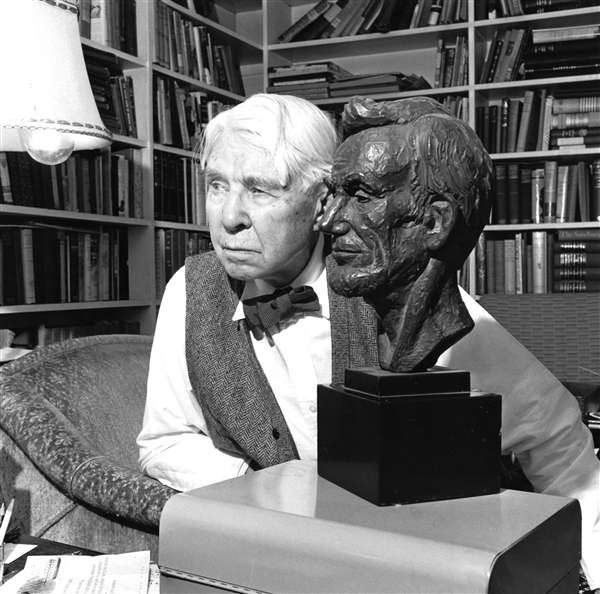
    Carl Sandburg was the recipient of three Pulitzer Prizes: two for his poetry, and a third for his biography of Abraham Lincoln. He was also known for his 1927 anthology “The American Songbag,” espousing our native folk song and anticipating the folk song revivals the 1940s and ‘60s. On top of everything else, he was awarded a Grammy for his recording of Aaron Copland’s “Lincoln Portrait.” When Sandburg died in 1967, at the age of 89, Lyndon Johnson observed that “Carl Sandburg was more than the voice of America, more than the poet of its strength and genius. He WAS America.”

    This Sunday night on “The Lost Chord,” we’ll hear music inspired by this popular – and populist – figure, with two works especially appropriate for Memorial Day and, in between, a piece after a poem evocative of the American heartland.

    Philadelphia composer Romeo Cascarino (1922-2002), who had served in the U.S. Army, composed a plaintive elegy, “Blades of Grass,” in 1945, just after World War II. He expressed a preference, on several occasions, that Sandburg’s poem “Grass” be read before performances. You’re probably familiar with it:

    Pile the bodies high at Austerlitz and Waterloo.
    Shovel them under and let me work—
    I am the grass; I cover all.

    And pile them high at Gettysburg
    And pile them high at Ypres and Verdun.
    Shovel them under and let me work.
    Two years, ten years, and passengers ask the conductor:
    What place is this?
    Where are we now?

    I am the grass.
    Let me work.

    Leo Sowerby (1895-1968) was born in Grand Rapids, MI, and spent much of his career in the Midwest. Sometimes referred to as the “Dean of American church music,” he was the recipient of the Pulitzer Prize for Music in 1946 for his cantata, “The Canticle of the Sun.”

    The published score of his symphonic poem after Sandburg, titled “Prairie,” from 1929, bears the following lines:

    “Have you seen a red sunset drip over one of my cornfields, the shore of night stars, the wave lines of dawn up a wheat valley?

    “Have you heard my threshing crews yelling in the chaff of a strawpile and the running wheat of the wagonboards, my cornhuskers, my harvest hands hauling crops, singing dreams of women, worlds, horizons?”

    Last, but certainly not least, Roy Harris, who shared Lincoln’s birthday (though born 89 years later), was reared in a log cabin in Lincoln County, OK, only adding to his sense of destiny. Indeed, he went on to become one of America’s greatest composers.

    Harris’ Symphony No. 6 is subtitled “Gettysburg.” It’s one of a number of works the composer wrote with a Lincoln connection. Each movement of the symphony bears a superscription taken from the Gettysburg Address: the first, “Awakening (‘Fourscore and seven years ago…’);” the second, “Conflict (‘Now we are engaged in a great civil war…’);” the third, “Dedication (‘We are met on a great battlefield of that war…’);” and the fourth, “Affirmation (‘…that we here highly resolve that these dead shall not have died in vain…’).”

    Prior to composing the work, Harris read – you guessed it – Sandburg’s biography of Lincoln.

    I hope you’ll join me for “Lincoln Logger,” an hour of music inspired by Carl Sandburg, this Sunday night at 10:00 EDT, on WWFM – The Classical Network and wwfm.org.


    Although not on tonight’s show, here, as an added bonus, is Sandburg narrating Aaron Copland’s “Lincoln Portrait”:

  • Memorial Day Crossword Remember & Reflect

    Memorial Day Crossword Remember & Reflect

    Americans tend to regard Memorial Day as the unofficial start of summer. But the holiday isn’t really about burgers, beaches, and beer.

    Lockdown allows us an unusual opportunity for reflection. Take some time this weekend to appreciate the sacrifice of those who gave their lives for the greater good. Our freedom and security have been purchased and maintained at an exorbitant cost.

    Memorial Day is the theme of this week’s Classic Ross Amico crossword. Test your knowledge of war songs, commemorative works, and composers who served.

    To fill out the puzzle, follow the link and select “solve online” at the bottom of the page. You’ll then be able to type directly into the squares. Once you feel you’ve exhausted the puzzle, you’ll find the solutions by clicking on “Answer Key PDF.”

    https://www.armoredpenguin.com/crossword/Data/2020.05/2405/24055522.558.html

  • Backstage with James Morris at Opera

    Backstage with James Morris at Opera

    Stop me if I told you this before.

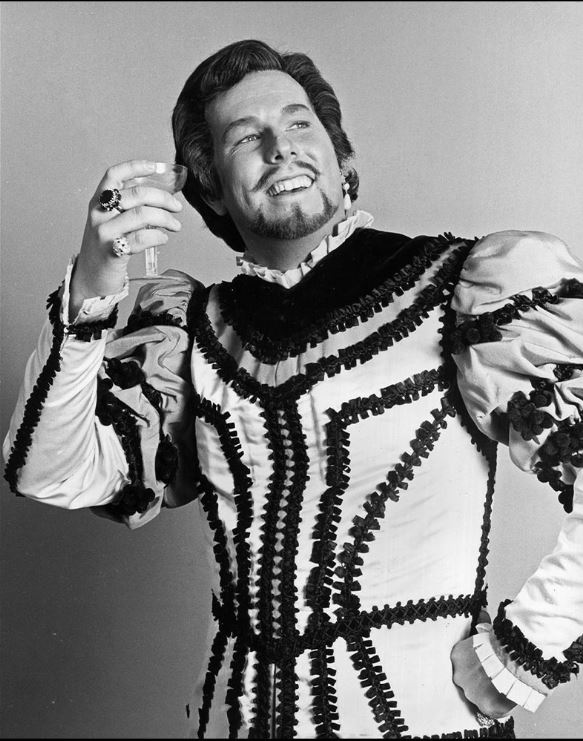
    Last night, I watched the first act of the Met stream of “Don Giovanni,” a performance from 1978, with Joan Sutherland, Julia Varady, Huguette Tourangeau, Gabriel Bacquier as Leporello, and a 31 year-old James Morris as the Don. I would have never thought that Morris’ voice could ever have been so supple. I became familiar with him only later, from his more ponderous roles, especially Wotan.

    I actually had the opportunity to work with him once, at the old Opera Company of Philadelphia (since rebranded Opera Philadelphia). He played the Count in a production of “The Marriage of Figaro,” during the brief window in which I was employed as an assistant stage manager. Really, I was more of a glorified gofer, without the glory, but I did get to wear a headset backstage and cue the singers when it was time for them to make their entrances, or to have a union laborer shatter a flower pot in a barrel. I was very green, and you had to be a total self-starter. The extent of my direction would be “Go and find me a sword,” or “We need you to rent a truck,” and that was that. It could be a little stressful.

    At first, Morris was flattered that I was awed by his presence, having just watched him in the PBS “Ring” broadcast (he even signed my copy of “Das Rheingold”), but later, he started to get a little annoyed when things didn’t always go as smoothly as they did at the Met. In particular, I don’t think he was happy with my entrance cues. I had to wait, with my hand up in a “get ready” position, until I received clearance from the stage manager, through my headset, so that I could give the go-ahead. (Well, I did delay a little bit on the flower pots, because it got a bigger laugh from the audience if they would shatter a beat later than expected.)

    Morris would stand there and look at me, with his hand on a plywood door, and finally, when he couldn’t take it anymore, in exasperation, he would jump the cue. I’d tell the stage manager, the stage manager would mutter to himself, and he’d make a note in the score to cue the entrance a few bars earlier. But it never seemed early enough for Morris.

    Also, I remember one night, just as he was going down on his knee for his big moment, in the second of silence before “Contessa, perdono,” somebody’s watch beeped in the wings. He was livid. His adorable wife, Susan Quittmeyer, who sang Cherubino, was forever smoothing his feathers and sending me out for the balm of coffee.

    My favorite memory is when, in rehearsal, they asked me to stand in as a super. I was to be one of the Count’s servants, and I got to do a scene with Morris. This led to some moments of unintentional hilarity, since I really didn’t know what was expected of me, and I would repeatedly miss my marks (which, to be fair, were not indicated). Morris would laugh and guide me into place.

    I only worked there for three weeks, the duration of a single production, since the job only paid a hundred dollars a week, and they expected you to be available at all hours. There were morning, afternoon, and evening rehearsals. Obviously, that was unsustainable for someone in his early 20s. I’m glad I had the experience, though. I wonder if it’s how George Plimpton felt when he played for the Detroit Lions or stepped in to the percussion section of the New York Philharmonic?

    It was also during that production that I was late for rehearsal once, and nearly knocked Charles Dutoit on his can in the Academy green room. (Dutoit was guesting that week with the Philadelphia Orchestra.)

    I’ve got some other juicy stories of backstage goings-on with some of the other singers, but I think it’s probably best, from a legal standpoint, if I wait until everyone is dead.

    It’s a rainy day, and I’m up for Act II. The Met “Don Giovanni” streams free, through about 6:00 tonight, at metopera.org

  • Elmer Bernstein Western Film Scores

    Elmer Bernstein Western Film Scores

    “Fill your hands, you son of a b****!”

    Western film scores of Elmer Bernstein, on “Picture Perfect,” music for the movies, this Friday evening at 6:00 EDT, on WWFM – The Classical Network and wwfm.org.

Tag Cloud

Aaron Copland (93) Beethoven (95) Composer (114) Film Music (137) Film Score (143) Film Scores (255) Halloween (94) John Williams (195) KWAX (229) Leonard Bernstein (103) Marlboro Music Festival (125) Movie Music (152) Mozart (88) Opera (208) Philadelphia Orchestra (89) Picture Perfect (174) Princeton Symphony Orchestra (108) Radio (88) Ross Amico (244) Roy's Tie-Dye Sci-Fi Corner (290) The Classical Network (101) The Lost Chord (268) Vaughan Williams (103) WPRB (396) WWFM (881)

DON’T MISS A BEAT

Receive a weekly digest every Sunday at noon by signing up here


RECENT POSTS