Category: Daily Dispatch

  • Korngold Hollywoods Golden Age Composer

    Korngold Hollywoods Golden Age Composer

    Happy birthday, Erich Wolfgang Korngold!

    This week on “Picture Perfect,” we’ll celebrate one of the most influential composers of Hollywood’s Golden Age, by way of two of his most popular scores, both of them for film adaptations of the novels of Rafael Sabatini.

    Though Sabatini’s own popularity has faded somewhat with the passage of time, in his day the Italian-English writer might have been regarded as heir apparent to Alexandre Dumas. His bestselling novels are full of romance and derring-do. However, I’m not sure if any of them have really endured in the consciousness of the wider public.

    Sabatini’s incident-filled pages seem ready-made for the silver screen. Film adaptations of “Scaramouche,” “The Sea Hawk” and “Captain Blood” were made during the silent era. A long-lost John Gilbert classic, adapted from Sabatini’s “Bardelys the Magnificent,” has only recently been rediscovered. Several of these, of course, were remade, more or less, to great success during the era of talking pictures.

    We’ll hear Korngold’s music for the Errol Flynn classics “Captain Blood” (1935) and “The Sea Hawk” (1940). The former provided Flynn with his breakout role; the latter actually has nothing at all to do with Sabatini’s original plot, despite the writer’s prominent onscreen credit.

    We’ll also enjoy Alfred Newman’s rollicking main title music for the pirate opus “The Black Swan” (1942), which starred Tyrone Power, and one of Victor Young’s most rousing and melodically inventive scores, for “Scaramouche” (1952), which featured Stewart Granger in probably the best swashbuckler of the 1950s.

    Polish up those seven-league boots and don your gaudiest plumage. Then join me, as we set sail with Erich Wolfgang Korngold and friends, and the novels of Rafael Sabatini, on “Picture Perfect,” music for the movies, this Friday evening at 6:00 EDT, on WWFM – The Classical Network and wwfm.org.
  • Berlioz’s Faust: Opera or Concert Piece?

    Berlioz’s Faust: Opera or Concert Piece?

    Arrigo Boito takes a lot of heat for his opera “Mefistofele” being so episodic. But I must say, Boito is a model of continuity next to Hector Berlioz, whose “La damnation de Faust” – let’s face it – really has no business at all being staged.

    That assessment has no bearing on the quality of the music, which has plenty of the hallmarks of quintessential Berlioz we mad Romantics hold so dear. Certainly, it has its share of standout moments. Alongside the recognizable orchestral highlights – “Minuet of the Will o’ the Wisps,” “Dance of the Sylphs,” the “Rákóczy March” – there’s the episode in Auerbach’s Cellar, Marguerite’s melancholy “Autrefois un roi de Thulé,” and the climactic ride to the Abyss. But I’m sorry, these disparate tableaux just don’t add up to much of an opera.

    “Faust” tanked horribly during its premiere run at Paris’ Opéra-Comique in 1846. It’s sad that the composer didn’t live to see the work redeemed – and his talent vindicated – at its first concert performance, decades later, in 1877.

    I won’t deny being entertained by the Robert Lepage production, streamed on the website of the Metropolitan Opera on Monday night. The conception is undeniably engaging, even if the multi-tier structure at its heart sometimes put me in mind of “Hollywood Squares.” (I kept expecting to see Paul Lynde or Wayland Flowers.) The action also reminded me at times of “moving” images viewed through a massive zoetrope. All in all, I can’t imagine anyone in the house having very much opportunity to drift off.

    But it still doesn’t change my assessment that this is music best appreciated in the concert hall, of a piece with Berlioz’s “Romeo and Juliet.” The Met itself would seem to agree. Lepage’s staging was scrapped for its revival this season, in favor of concert version sung, in its purest form, from the Metropolitan stage. The extravagant apparatus – projections, pullies, and all – proved to be more trouble than it was worth.

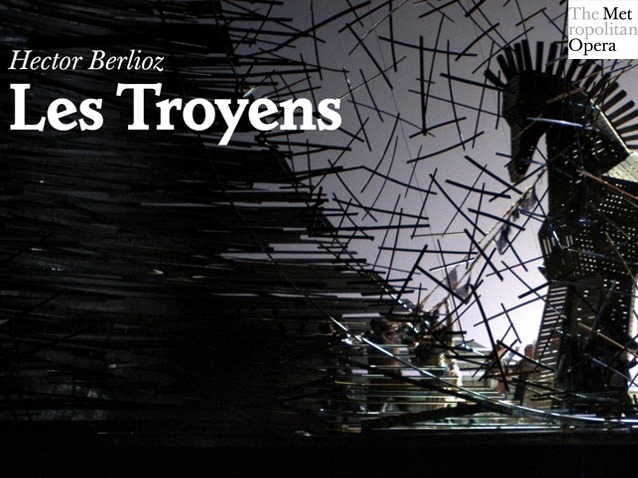
    I have not yet seen the Met’s “Les Troyens,” Berlioz’s distillation of Virgil, but based on Susan Graham’s reputation as a Berlioz interpreter – and her standout Marguerite on Monday night – she could very well be the high point of the evening. (That is, if we discount the Trojan Horse.) I can only imagine what “Faust” would have been like had Berlioz allowed it to breathe at twice its length.

    Get ready for four hours of Berlioz. “Les Troyens” is tonight’s “HD Encore” stream from the Metropolitan Opera. A different opera is streamed each day for 23 hours, beginning around 7 p.m. EDT (though my experience has been that they actually make the switchover a little earlier than that). You’ll find more information at metopera.org.


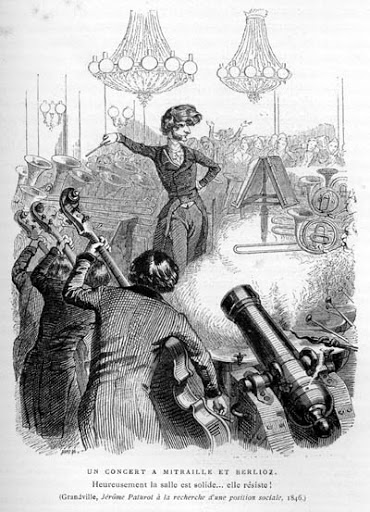
    IMAGE: Berlioz cartoon from 1845, “Un concert à mitraille et Berlioz” (“A concert of cannons and Berlioz”), by Jean Ignace Isidore Gérard (a.k.a. Grandville)

  • Vaughan Williams’ Covid-Era Music Precedent

    Vaughan Williams’ Covid-Era Music Precedent

    Another precedent for time of Covid:

    In 1940, Ralph Vaughan Williams suggested that composers should write works for “combinations of all manner of instruments which might be played by people whiling away the waiting-hours of war.”

    Putting this into practice, he composed “Household Music” in 1940-41. The work exists in a version for string quartet, but the parts can also be played by flute, oboe, clarinet, bassoon, bass clarinet, saxophone, recorder, cornet, euphonium, or anything else at their respective pitches.

    The work bears the subtitle “Three Preludes on Welsh Hymn Tunes.” This should not be confused with an earlier, more popular triptych of that name, composed in 1920, for solo organ. The tunes are totally different.

    Here are flutist Kathleen Nester and violist Brett Deubner of the New Jersey Symphony Orchestra, and cellist Bronwyn Banerdt of the Pittsburgh Symphony, to perform the third movement, “Aberystwyth”:

    Vaughan Williams also arranged the piece for medium-sized orchestra:


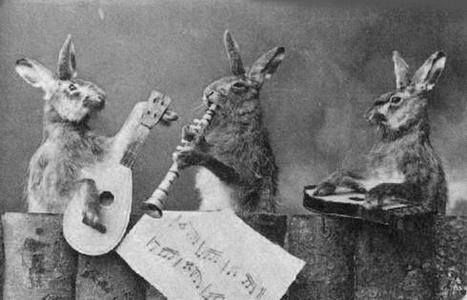
    PHOTO: “Household Music,” performed by isolating rabbits, on lute, clarinet and autoharp.

  • Schubert’s Symphony No 9 Nickname Revealed

    Schubert’s Symphony No 9 Nickname Revealed

    What was Franz Schubert’s less-than-flattering nickname? Find out when you read my program note on this week’s “At Home with the PSO.”

    “At Home with the PSO” is the Princeton Symphony Orchestra’s gateway to original online content, including performance webcasts, photo albums, a virtual gallery, musicians’ recipes, and more, with fresh material being added weekly.

    Schubert’s Symphony No. 9 – also known as “The Great” C major symphony – is the focus of this week’s PSO “Play It Forward.” Watch music director Rossen Milanov’s spoken introduction, read my program note, and enjoy a complete performance from the PSO archive.

    HOT TIP: In the amount of time it takes to listen to the symphony, you could actually bake double-bassist Dan Hudson’s “Dangerously Easy Blondies.” Simply open another window and call up princetonsymphony.org on a second screen. (You’ll need two screens, because if you back out of the page, the audio will stop!) Look for the recipe listed under “Cooking with the PSO.” More musician recipes are archived at the bottom of the page.

    DON’T MISS: The PSO will present a special “At Home” event, this Sunday at 4 p.m. EDT.

    The virtual get-together will include performances by violinist Daniel Rowland and cellist Maja Bogdanović, a conversation with Milanov, and an appearance by PSO concertmaster Basia Danilow. Registration is free. Details are available on the PSO homepage, princetonsymphony.org.

    If it’s “Great,” it must be pretty good. Check out Franz Schubert’s “Great” C major symphony on this week’s “At Home with the PSO.”


    “Play It Forward” (the PSO plays Schubert):
    https://princetonsymphony.org/home-pso/music-play-it-forward

    “Cooking with the PSO” (Dangerously Easy Blondies):
    https://princetonsymphony.org/home-pso/cooking-pso

    A direct link to my program note:
    https://princetonsymphony.org/schubert-symphony-no-9-program-note

    Sunday registration:
    https://princetonsymphony.org/

  • Met Opera Week: Free Berlioz Operas!

    Met Opera Week: Free Berlioz Operas!

    TWO Berlioz operas in one week!

    Here’s a complete schedule of this week’s Met “Live in HD” encores. You know the drill. The operas stream free, for approximately 23 hours, beginning each day around 7:30 p.m. EDT at metopera.org. Though I have noticed that the switch more often takes place around 6:00. That said, once you hit play, even if it’s 5:00 or 5:30, it’s been my experience that you can watch until the end, provided you don’t try to break. “Manon” is available, allegedly, through 6:30 this evening.

    Here’s a complete schedule of this week’s offerings. You’ll find teasers and bonus materials when following the link.

    https://www.metopera.org/user-information/nightly-met-opera-streams/week-11/

    Monday, May 25
    Berlioz’s La Damnation de Faust
    Starring Susan Graham, Marcello Giordani, and John Relyea, conducted by James Levine. From November 22, 2008.

    Tuesday, May 26
    Verdi’s Ernani
    Starring Angela Meade, Marcello Giordani, Dmitri Hvorostovsky, and Ferruccio Furlanetto, conducted by Marco Armiliato. From February 25, 2012.

    Wednesday, May 27
    Puccini’s Manon Lescaut
    Starring Renata Scotto, Plácido Domingo, and Pablo Elvira, conducted by James Levine. From March 29, 1980.

    Thursday, May 28
    Berlioz’s Les Troyens
    Starring Deborah Voigt, Susan Graham, Bryan Hymel, and Dwayne Croft, conducted by Fabio Luisi. From January 5, 2013.

    Friday, May 29
    Viewers’ Choice: Bellini’s La Sonnambula
    Starring Natalie Dessay and Juan Diego Flórez, conducted by Evelino Pidò. From March 21, 2009.

    Saturday, May 30
    Donizetti’s L’Elisir d’Amore
    Starring Pretty Yende, Matthew Polenzani, Davide Luciano, and Ildebrando D’Arcangelo, conducted by Domingo Hindoyan. From February 10, 2018.

    Sunday, May 31
    Strauss’s Salome
    Starring Karita Mattila, Ildikó Komlósi, Kim Begley, Joseph Kaiser, and Juha Uusitalo, conducted by Patrick Summers. From October 11, 2008.

Tag Cloud

Aaron Copland (93) Beethoven (95) Composer (114) Film Music (137) Film Score (143) Film Scores (255) Halloween (94) John Williams (195) KWAX (229) Leonard Bernstein (103) Marlboro Music Festival (125) Movie Music (152) Mozart (88) Opera (208) Philadelphia Orchestra (89) Picture Perfect (174) Princeton Symphony Orchestra (108) Radio (88) Ross Amico (244) Roy's Tie-Dye Sci-Fi Corner (290) The Classical Network (101) The Lost Chord (268) Vaughan Williams (103) WPRB (396) WWFM (881)

DON’T MISS A BEAT

Receive a weekly digest every Sunday at noon by signing up here


RECENT POSTS