Category: Daily Dispatch

  • Stream Ethel Smyth’s “The Wreckers” Online

    Stream Ethel Smyth’s “The Wreckers” Online

    Bard College is now streaming its 2015 production of Dame Ethel Smyth’s “The Wreckers.”

    This English seaside opera predates Benjamin Britten’s “Peter Grimes” by decades, a tale of doomed love set against the backdrop of plundering land pirates, who lure unsuspecting ships onto the rocks of coastal Cornwall. The “pirates,” in this instance, are common villagers who justify their misdeeds as righteous Methodists. (Alas, some things never change.)

    “The Wreckers,” Smyth’s third opera, is a product of the so-called English musical renaissance, a flowering that took place around the turn of last century, after an alleged dearth of native talent that reached back centuries – tradition holds, since the death of Henry Purcell – a charge that really was without basis. In 1904, Germany had only just derided England as “Das Land ohne Musik” (“The Land without Music”). Ironic, then, that “The Wreckers” would be given its first performance there, in Leipzig, in German translation, in 1906.

    Why the timidity, England? Smyth’s second opera, “Der Wald,” which also received its premiere in Germany, had made it as far as New York City’s Metropolitan Opera in 1903. It would be the only opera by a woman composer presented by the Met for over a century! Why no performances at home? Eventually, “The Wreckers” would receive its English premiere in 1909, under the direction of Sir Thomas Beecham.

    Smyth was not only a formidable talent, she was a formidable personality. Few were the men who could stand up to this tweed-wearing, cigar-smoking suffragette. After Smyth was arrested for putting out the windows of politicians who opposed a woman’s right to vote, Beecham visited her in prison, only to find her leading her sisters-in-arms in an anthem she composed, “March of the Women,” which she conducted through the bars of her cell with a toothbrush.

    Beecham would conduct “The Wreckers” again in 1934 to celebrate Smyth’s 75th birthday. Sadly, by then she was unable to enjoy it, as by that time she was stone deaf.

    Leon Botstein led the first U.S. performance of the opera, with the American Symphony Orchestra, in New York City, as recently as 2007! These forces brought “The Wreckers” to Bard College, of which Botstein is president, and where he is co-director each summer of the Bard Music Festival.

    This year’s festival, which was to have been devoted to another remarkable woman, Nadia Boulanger, has been postponed to the summer of 2021.

    For now, enjoy Dame Ethel Smyth’s “The Wreckers”:

    https://fishercenter.bard.edu/events/ups-the-wreckers/?utm_source=wordfly&utm_medium=email&utm_campaign=2020-06-24-UPS-Wreckers&utm_content=version_A#the-wreckers

    A talk about the opera, with Leon Botstein:

    https://fishercenter.bard.edu/events/ups-the-wreckers/?utm_source=wordfly&utm_medium=email&utm_campaign=2020-06-24-UPS-Wreckers&utm_content=version_A#opera-talk

  • Terry Riley at 85 Minimalist Music Pioneer

    Terry Riley at 85 Minimalist Music Pioneer

    Terry Riley is 85 years-old today.

    Riley’s music may not be everyone’s cup of “tea” (or cannabis, as the case may be), but there’s no denying his influence on the development of Minimalism, progressive rock, and the avant-garde.

    Riley himself has acknowledged his debt to Indian singer Pran Nath. The composer made a number of trips to India to study with and accompany Nath. He returned to share his experiences, teaching Indian classical music at Mills College. Riley has also cited the influence of John Cage and contemporary jazz artists, such as John Coltrane, Miles Davis, and Bill Evans.

    Already in the 1950s, Riley began experimenting with looped tape and time-lag techniques. He also composed using just intonation and microtones. His electronic album “A Rainbow in Curved Air” (released in 1969) became something of a landmark, attracting musicians from across a variety of genres.

    Riley’s best-known work is probably “In C,” often credited as the first widely-acknowledged Minimalist composition. The piece was given its premiere at the San Francisco Tape Music Center in 1964, by an ensemble that included Steve Reich, Jon Gibson, Pauline Oliveros, Stuart Dempster, and Morton Subotnick, among others.

    Much ink has been spilled – and acid dropped – over Riley’s music.

    Happy birthday, Terry Riley!


    “In C”
    https://www.youtube.com/watch?v=DpYBhX0UH04

    “A Rainbow in Curved Air”

    Riley at Holland Festival, with interview, 1977

    Riley’s trippy website
    http://terryriley.net/

  • Dancing Plague The Medieval Dance Mania

    Dancing Plague The Medieval Dance Mania

    Gotta dance!

    Probably the last thing anyone wants to do after a long night of leaping over bonfires for St. John’s Eve is to cut a rug – but in 1374, that’s precisely what happened. Against their collective will, hundreds found themselves swept up in an involuntary dance mania.

    It was not the first time, nor was it the last, but it seems largely to have been a phenomenon of the Middle Ages. Participants danced until they collapsed from exhaustion. Some dropped down dead. The cause of the frenzy has never been adequately explained.

    Read more about St. John’s Dance (often attributed to St. Vitus) here:

    https://blog.europeana.eu/2015/06/st-johns-dance-why-cant-they-stop-dancing/

    And here:

    https://en.wikipedia.org/wiki/Dancing_mania

  • Rachmaninoff’s Francesca da Rimini Online

    Rachmaninoff’s Francesca da Rimini Online

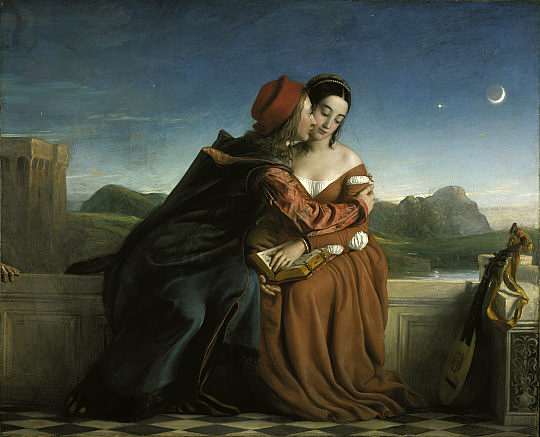
    As a kind of addendum to its month of Sunday operas, The Princeton Festival is offering, for today only, Sergei Rachmaninoff’s rarely-heard one-acter “Francesca da Rimini,” streamed as part its special COVID-imposed “Virtually Yours” season.

    When “Francesca” was presented at McCarter Theatre in 2012, it was as the first half of a double-bill with Puccini’s “Gianni Schicchi” – clever programming, since both works have ties to Dante.

    As always with the Princeton Festival, the production was well-performed and staged, with, in this instance, evocative medieval sets and costumes. Also, in its vision of Hell, I remember thinking at the time that it was very much of a piece with the famous paintings and illustrations inspired by “Inferno.”

    The lighting is a bit dim in this archival video, but it’s still worth watching, and certainly worth hearing. All in all, a good opera to get you in the spirit for St. John’s Eve…

    https://princetonfestival.org/digital-event/rachmaninoffs-francesca-da-rimini/

    Here’s a preview I wrote for the Trenton Times:

    https://www.nj.com/times-entertainment/2012/06/princeton_festivals_operatic_t.html

    The last of this year’s Princeton Festival operas, “The Flying Dutchman,” featuring bass-baritone Mark Delavan, will stream this Sunday at 1 p.m. EDT. For more information and a complete schedule, look online at princetonfestival.org.

  • Gogol St. John’s Eve Summer Reading

    Gogol St. John’s Eve Summer Reading

    So Saturday was the first day of summer?

    The calendar I’m using this year doesn’t have any holidays printed on it, which I suppose is only appropriate for life in Coronaworld, where every day runs into another.

    Be that as it may, the seasons are not governed by the calendar, and like a creature of the wild, I know it’s summer when my blood pressure begins to rise with the sun. Surely, this is something the ancients also felt, which is why we have St. John’s Eve.

    It was the Romans who marked the summer solstice as June 24th. This meant the night of the 23rd was yet another excuse for a great big toga party. Pagans throughout the empire lit bonfires against evil spirits, and even dragons, and folk traditions sprang up related to prognostication and fertility.

    Later, the Church coopted the 24th for its observance of the Feast Day of St. John. This worked out very nicely, since St. Luke suggested that the birthday of John the Baptist fell six months before that of Jesus. As with Hallowe’en, a pagan festival was hitched to a holy one (in that case, All Saints Day). Sometimes diverting a stream is easier than outright dam(n)ing it.

    As a classical music lover, for years I have been curious about “Evenings on a Farm Near Dikanka,” as the title is usually translated. Nikolai Gogol’s collection of tales, steeped in Ukrainian folklore, are overstuffed with devils, witches, water nymphs, and roistering Cossacks. The stories formed the basis for operas by Modest Mussorgsky (“Sorochinsky Fair”), Nikolai Rimsky-Korsakov (“May Night” and “Christmas Eve”), and Peter Ilych Tchaikovsky (“Cherevichki”).

    Well, this year I finally got around to reading it, and it wasn’t quite what I expected. Amusingly, the supernatural elements, which are plenty, are offset by frequent satirical observations and earthy farce. There’s a lot of drinking and a lot of hiding from husbands in coal sacks. Even lusty devils receive their comeuppance. All the same, there are one or two shockingly gruesome moments.

    Gogol can be wry. He can certainly be garrulous. But he is also very much a poet, as evidenced by his lyrical observations on the Dnieper and soft Ukrainian summer nights. That said, one of the stories takes place on Christmas Eve. At least two are set on St. John’s Eve.

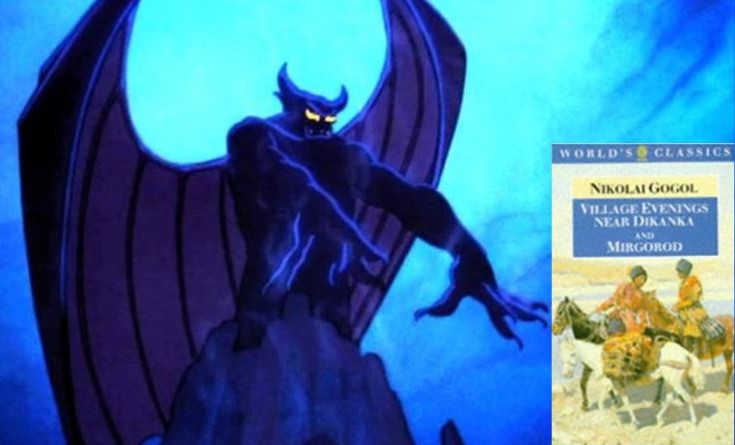
    It wasn’t easy to find an affordable copy of this Oxford paperback (pictured), which has gone out of print. I’ve been fond of these World’s Classics editions since reading Oxford’s “The Count of Monte Cristo,” “The Three Musketeers,” and “Queen Margot,” which were full of helpful notes. (Oxford’s “The Pickwick Papers,” I must say, was much more slovenly notated.) In this instance, there’s not really a lot you need to know that isn’t on the page. I don’t read Russian, it’s true, but the translation “sounds” very well, and it seems idiomatic.

    The Oxford edition also includes the collection “Mirgorod,” which I have yet to tackle. Its most famous tale is “Taras Bulba,” which became the basis for the orchestral rhapsody by Leoš Janáček.

    I should probably also mention that while there is nothing in “Dikanka” that is outright antisemitic, Gogol never misses an opportunity to single out Jews – to be fair, by way of his admittedly rustic characters. And while there is nothing openly derogatory in their treatment, it is evident that they are regarded as outsiders. They are always referred to as “a Jew” or “the Jew.” This is, after all, the world of the Cossacks. But, remarkably, there appears to be no disdain. Certainly, the Poles and the Tatars come in for a lot worse!

    For as entertaining as I found the collection, with its unexpected humor, the experience really underscored how much Mussorgsky, Rimsky, and Tchaikovsky fleshed out Gogol’s narratives with their music. All three composers managed to conjure the author’s poetic flights in a way no libretto possibly could.

    Interestingly, the most famous music connected to the book is “A Night on Bald Mountain,” a comparatively youthful work, written when Mussorgsky was 28 years-old. The composer completed the piece, about a witches’ sabbath on St. John’s Eve, ON St. John’s Eve in 1867. It then went through several versions, as it was inserted into the collaborative opera-ballet “Mlada” and then “Sorochinsky Fair,” inspired by the Gogol story. Sadly, despite his obvious affection for this music, Mussorgsky never heard it performed, in any of its incarnations, during his lifetime.

    Following the composer’s death, however, Rimsky-Korsakov further shaped the material, and arranged the well-known orchestral fantasy, employing as raw material Mussorgsky’s final version, as it appeared in “Sorochinsky Fair.” It is in Rimsky’s revision that it became Mussorgsky’s best-known music – at least until Leopold Stokowski got a hold of it and did his own arrangement for Disney’s “Fantasia.”

    This is a perfect example of just how effective music can be at conjuring a palpable atmosphere of menace, or even terror, as compared to words on a page. There’s not even a Bald Mountain in Gogol’s original, though the supernatural element that looms over the collection as a whole more than justifies Mussorgsky’s artistic license.

    All in all, it’s a book worth getting to know – with the shutters secured and a bucket of horilka at your side. Happy St. John’s Eve!

Tag Cloud

Aaron Copland (94) Beethoven (95) Composer (114) Film Music (152) Film Score (143) Film Scores (255) Halloween (107) John Williams (198) KWAX (233) Leonard Bernstein (105) Marlboro Music Festival (125) Movie Music (167) Mozart (91) Opera (221) Philadelphia Orchestra (91) Picture Perfect (174) Princeton Symphony Orchestra (110) Radio (90) Ross Amico (244) Roy's Tie-Dye Sci-Fi Corner (290) The Classical Network (101) The Lost Chord (269) Vaughan Williams (107) WPRB (397) WWFM (881)

DON’T MISS A BEAT

Receive a weekly digest every Sunday at noon by signing up here


RECENT POSTS