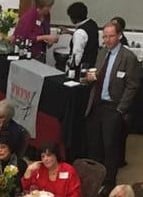
For anyone who missed it, here I am, haunting the bar at last night’s WWFM Gratitude Gala – to my knowledge, the only documented proof of my attendance. (That’s coffee in the cup, by the way.)
If you are a supporter of the station, thank you. I met some very nice people and made a few contacts that may allow me to produce further installments of “Picture Perfect.”
If you think it’s not in your budget to contribute enough to make a difference as an underwriter, we are now offering the option of supporting our specialty shows as part of a consortium. That means the station will act as matchmaker, pooling donations from multiple sources in order to fund individual programs.
If that sounds like something you would like to do, to spruce up and ensure the future of your favorite shows, contact the station at 609-587-8989, during business hours – be sure to specify “Picture Perfect” or “The Lost Chord,” if that is your intention – or private message me here.
It was great fun to jawbone with George Marriner Maull, of the Discovery Orchestra and “Inside Music,” and Joseph Horowitz and Angel-Gil Ordóñez, of the PostClassical Ensemble. It was also good to reconnect with some of the other hosts I myself seldom see.
Of course, nothing eclipses a nice compliment, of which I gratefully received several. I am always deeply appreciative, humbled even, by sincere praise from obviously engaged listeners. Last night, one of them even sang the theme from John Williams’ “Dracula” for me. That’s NOT one of his better-known scores. Thanks to all those who attended.
PHOTO: Classic Ross Amico, all blurred-out like Sasquatch
November 22 is the feast day of Saint Cecilia – the patron saint of music.
Join me this afternoon at 4:00 on The Classical Network, as we celebrate with musical tributes by William Boyce, Benjamin Britten, Anthony Collins, Charles Gounod, George Frideric Handel, Henry Purcell, Joaquin Rodrigo, and Alessandro Scarlatti. We’ll also hear the “Serenade to Music” by Ralph Vaughan Williams and “The Young Person’s Guide to the Orchestra,” narrated by Sean Connery.
At 6:00, look ahead to Thanksgiving on “Picture Perfect,” with selections from “Friendly Persuasion” (Dimitri Tiomkin), “Our Town” (Aaron Copland), “Plymouth Adventure” (Miklós Rózsa), and the building-the-barn sequence from “Witness” (Maurice Jarre).
There’s always plenty to be thankful for, musically speaking, from 4 to 7 p.m. EST, on WWFM – The Classical Network and wwfm.org.
“Do any human beings ever realize life while they live it? Every, every minute?”
This poignant observation, from Thornton Wilder’s “Our Town,” stands as a timely reminder that there are things we should all be thankful for, while they – and we – are here to appreciate them.
This week on “Picture Perfect,” we’ll set the table for Thanksgiving.
None other than Aaron Copland wrote the music for the big screen adaptation of Wilder’s Pulitzer Prize winning play. The composer was at the height of his “populist” period. “El Salon Mexico” and “Billy the Kid” had already been written, and “Fanfare for the Common Man,” “Lincoln Portrait,” “Rodeo” and “Appalachian Spring” would follow within just a few years. Clearly, there was no better choice in capturing the essence of small town America.
The concert version of “Our Town” has been in circulation for decades, but it was only in 2011 that a complete recording of the score was made available, briefly, as a digital download.
Gary Cooper and Dorothy McGuire star in “Friendly Persuasion” (1956), based on the novel by Jessamyn West. The film’s portrayal of family and the resolution of moral conflict, as pacifist Quakers deal with issues both big and small – from the American Civil War, to the introduction of a “sinful” musical instrument into the household – make “Friendly Persuasion,” in my opinion, a good choice for this time of year.
The film was up for six Oscars, with Dimitri Tiomkin’s score nominated twice. The title song went on to become the popular hit “Thee I Love.” Only Dimitri Tiomkin would use balalaikas to depict Quaker life!
“Witness” (1985) may seem like an unusual choice for Thanksgiving, with its themes of police corruption and violence, but when honest cop Harrison Ford goes on the lam, he experiences the “plain” lifestyle of a close-knit Amish community. The highlight of Maurice Jarre’s score is a sequence called “Building the Barn,” in which the community comes together to raise a barn for a newly married couple.
Finally, we’ll hear selections from “Plymouth Adventure” (1952), with its depictions of William Bradford, John Alden, Miles Standish and Priscilla Mullins. Spencer Tracy stars as the cynical captain of The Mayflower, Gene Tierney is his forbidden love interest, Van Johnson appears as Alden, and Lloyd Bridges is the first mate.
The music is by Miklós Rózsa, who already, at this stage of his career, was MGM’s go-to composer for historical drama. Seven years later, Rózsa would take home his third Academy Award for his classic score to “Ben-Hur.”
It’s never too early to give thanks. There’s not a turkey among them, this Friday evening at 6:00 EST, on WWFM – The Classical Network and wwfm.org.
Martha Scott and William Holden in “Our Town” (1940)
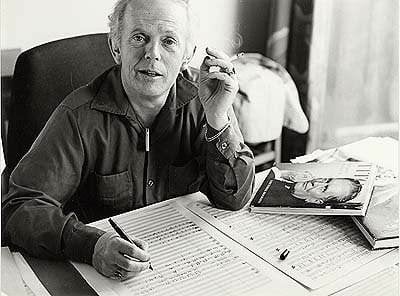
With Netflix having “dropped” (or made available for streaming) its third season of “The Crown,” and with the first episode having already included a subplot involving Sir Anthony Blunt, Surveyor of the Queen’s Pictures, one can only hope for an appearance by Malcolm Williamson.
If you haven’t seen the series, and you’re a little rusty on your Royals history, I’ll leave it at that, re: Blunt, but suffice it to say that there is plenty of drama inherent in Williamson’s relationship to Buckingham Palace.
Malcolm Williamson was installed as Master of the Queen’s Music in 1975. Since the 17th century, musicians have held the post with the expectation that they would write music for important milestones in the lives of the Royal Family and for ceremonial occasions. Past Masters of the Queen’s (or King’s) Music have included John Eccles (who served four monarchs), William Boyce, John Stanley, Sir Edward Elgar, Sir Arnold Bax, and Sir Arthur Bliss. The appointment is an honor, to be sure, but the responsibility brings with it a certain amount of pressure.
When Williamson, Australian by birth, was named the successor to Bliss in 1975, there was grumbling among his colleagues. Sir William Walton attributed the choice to a utilitarian need for “cementing the cracks in the Commonwealth.” He confided to Sir Malcolm Arnold (who most certainly would have brought his own set of problems) that “they had got the wrong Malcolm.” Arnold, a sporadically brilliant composer, was also a manic depressive (and possibly bipolar), who survived alcoholism and multiple suicide attempts.
Williamson’s great sin was that he was very bad with deadlines (and for that, he certainly has my sympathy). Most particularly, he failed to complete a symphony in time for the Queen’s Golden Jubilee in 1977. His ambitious “Mass for Christ the King,” also intended for the occasion, was also delivered late. Significantly, he was the first Master of the Queen’s (or King’s) Music in over a century not to be knighted.
Following the Jubilee debacle, his output slowed, though he was seldom unproductive. In all, he wrote seven symphonies, concertos for piano, violin, organ, harp and saxophone, and numerous other orchestral, choral, chamber and instrumental works. Like many of his colleagues, he also composed music for the cinema, for films of varying quality. It’s always amusing to find his name in the opening credits of Hammer productions like “The Brides of Dracula” and “The Horror of Frankenstein.”
Williamson suffered from ill health in his later years. He too turned to the bottle, and it can only be speculated if depression and the stress of trying to hold his head high as a colonial outsider at the Royal court contributed to his decline. Those close to him assert that toward the end of his life, Williamson never drank, but rather struggled with aphasia, the result of a series of strokes.
What’s certain is that he was the first non-Briton to be named Master. Following his death in 2003, the parameters of the appointment were revised. The position is no longer one for life, but rather a fixed, ten-year term. Sir Peter Maxwell Davies was the first to serve under the new guidelines. He was succeeded in 2015 by Judith Weir, the first woman to hold the post (and yes, she is still referred to as “Master”).
Season 3 of “The Crown” dramatizes the Windsor saga up through 1976. Might Season 4 bring a supporting role for Malcolm Williamson? Or will Princess Margaret continue to steal the limelight? If you were the casting director, who would you nominate for the role?
In the meantime, happy birthday, Malcolm Williamson!
As the day wanes, I’ll do my best to keep your late afternoon and early evening bright, here on The Classical Network.
At 4:00, I’ll lead off with Arthur Foote’s “At Dusk.” This will commence an All-American hour, which will include a set of works by New England composers, all born in the 19th century. Then we’ll have a couple of pieces by Meredith Monk (on her birthday) and Robert Moran, respectively.
“Music from Marlboro” gets an early start, at 5:50 p.m., to accommodate a complete performance of Franz Schubert’s Octet in F major, D. 803.
What comes in between – in the gloaming, so to speak – is anyone’s guess.
For now, I can pretty much guarantee a quintet of Americans and an octet of Schubert, from 4 to 7 p.m. EST, on WWFM – The Classical Network and wwfm.org.