Category: Daily Dispatch

  • Thomas Tallis Tudor Survivor’s Birthday Remembered

    Thomas Tallis Tudor Survivor’s Birthday Remembered

    On this date, we observe the birthday of Thomas Tallis. Tallis, the most powerful English musician of his time, lived from around 1505 to 1585.

    An unreformed Roman Catholic, he somehow managed to negotiate a period of tremendous religious upheaval and even to maintain the unflagging respect of four monarchs, as Gentleman of the Chapel Royal. He must have been a remarkably pragmatic, diplomatic, and levelheaded personality, not to have lost his head, as he shrewdly tailored his music to suit the religious requirements of Henry VIII, Edward VI, Mary I, and Elizabeth I.

    Queen Mary provided him with housing and a comfortable income. Elizabeth granted him the exclusive right to print and publish music. With William Byrd (c. 1540-1623), he shared a 21-year monopoly on the writing of polyphonic music. Tallis and Byrd were also the only ones allowed to use the paper on which music was printed.

    Byrd too gravitated to Catholicism, in the 1570s, a time when allegiance to the Church of Rome was viewed by the Tudor authorities as incendiary, if not outright seditious. Unlike Tallis, Byrd found himself in some rather precarious straits. Tip for Tudor composers: one should take care never to attend meetings with architects of the Gunpowder Plot.

    Tallis not only navigated the shoals of this turbulent chapter in English history, his music is still widely performed, with frequency, half a millennium later.

    Well played, Thomas Tallis.


    Tallis’ greatest hit, the 40-part motet, “Spem in alium”:

    Third tune from Archbishop Parker’s Psalter (the basis for Ralph Vaughan Williams’ “Fantasia on a Theme by Thomas Tallis”):

    Vaughan Williams’ “Fantasia”:


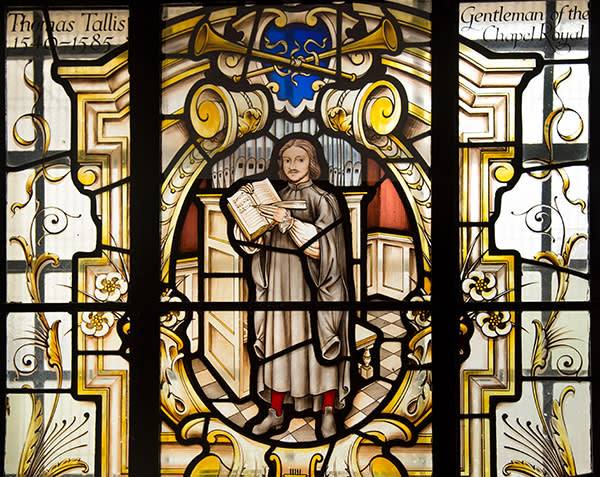
    A composer for all seasons: Tallis enshrined in glass at St. Alfege Church, Greenwich, London

  • WWFM Webcasts Silk Road & Didjeridoo Now Online

    WWFM Webcasts Silk Road & Didjeridoo Now Online

    Crouching Tiger, Hidden Webcast.

    Last weekend’s specialty shows have now been posted. These include “Silk Road Adventures” (on “Picture Perfect”) and “Didya Hear the One About the Didjeridoo” (on “The Lost Chord”).

    Apologies for the delay. After my resolution to have both shows up on the station website (wwfm.org) by Monday mid-afternoon, with all the Mozart membership business earlier in the week, it completely escaped my mind.

    Here again are the links:

    https://www.wwfm.org/programs/picture-perfect-ross-amico

    https://www.wwfm.org/programs/lost-chord-ross-amico

    Select the show of your choice and click on the “Listen” button.

  • Classical Music Birthdays & Butterflies Today

    Classical Music Birthdays & Butterflies Today

    Purely by chance (well, also because I happen to like the music), our first hour on The Classical Network this afternoon will be all-English, as we celebrate the birthdays today of Frederick Delius and Havergal Brian. Along the way, we’ll also take a trip to a butterfly’s ball and enjoy a grasshopper’s dance.

    In Hour No. 2, we’ll celebrate the anniversaries of the births of Danish composer Ludolf Nielsen, French operatic master Daniel-François-Esprit Auber, and Chinese-American violinist Cho-Liang Lin.

    It will be an all-French program, avec piano, on “Music from Marlboro,” with chamber music by Francis Poulenc and Gabriel Fauré, from the legendary Marlboro Music Festival, tonight at 6.

    Pull up a chair or cut a rug. It’s not just be the butterflies and grasshoppers who’ll be having a ball, from 4 to 6 p.m. EST, on WWFM – The Classical Network and wwfm.org.

  • Poulenc vs. Fauré: A Musical Feud

    Poulenc vs. Fauré: A Musical Feud

    Francis Poulenc once described Gabriel Fauré’s music as physically unbearable. Florent Schmitt, who studied with Fauré, hated Poulenc’s Sextet for Piano and Winds. At its premiere, he described it as wandering and vulgar.

    Turnabout is fair play, on this week’s “Music from Marlboro.”

    Poulenc labored over his Sextet for the better part of a decade. He began work on the composition in 1931, when he was in his early 30s. Then he subjected it to a complete overhaul, so that he came to regard it as a completely different piece. In 1939, with Europe on the brink of war, Poulenc extensively revised it again. The sextet reached its definitive form, with France under Nazi occupation, in 1940.

    The outer movements are frantic, but at the work’s core is the soul of the composer, jovial, wistful, and altogether irresistible. Some have regarded it as an affectionate parody of the 18th century divertimento. (It is described by the composer as a divertissement.) In particular, it seems to inhabit a world not all that far from Mozart’s slow movements.

    We’ll hear Poulenc’s reviled Sextet, performed at the Marlboro Music Festival in 2015, by flutist Marina Piccinini, oboist Mark Lynch, clarinetist Narek Arutyunian, bassoonist Brad Balliett, hornist Lauren Hunt, and pianist Zoltan Fejérvári.

    Then we’ll turn to music by Poulenc’s musical nemesis. Fauré completed his Piano Quartet No. 2 in G minor in 1887, when he was 42, just about a year older than Poulenc was when his Sextet reached its definitive form.

    The work may come as something as a surprise to anyone expecting the fairly chaste atmosphere of the Requiem, begun around the same time. In contrast to the Elysian serenity conjured in his great choral opus, the quartet is passionate and personal. The evocative slow movement, which the composer described as “a vague reverie,” was inspired by the memory of evening bells at the village of Cadirac, in the south of France, which he knew as a child.

    The quartet was performed at Marlboro in 2001, by pianist Gilbert Kalish, violinist Catherine Cho, violist Melissa Reardon, and cellist Raman Ramakrishnan.

    While it’s true that, as a young man, Poulenc had a violent reaction to Fauré’s music, it is one that became tempered with experience. “I hated Fauré until I was 30 and then I realized that he was a very great composer. So I made an effort with myself and began to admire him. It’s an attitude I’ve maintained and built on, but physically it is for me an unbearable kind of music, what can I do about it?”

    Um, and things were going so well, until that last little bit…

    It’s an uneasy truce, on the next “Music from Marlboro,” this Wednesday evening at 6:00 EST, on WWFM – The Classical Network and wwfm.org.

    Marlboro School of Music and Festival: Official Page

    Poulenc: The more I listen to Fauré, the more I love my dog

  • Classical Music’s Birthday Shadows

    Classical Music’s Birthday Shadows

    As I am still sweeping up the crumbs from Mozart’s birthday cake, my thoughts light upon poor Edouard Lalo. Lalo was born on Mozart’s birthday in 1823. Chances are, if you were to stop by the Lalo residence on any January 27, you would find him sitting all alone with his party favors.

    This afternoon on The Classical Network, I thought we’d take a few hours to salute those who have lost classical music’s greatest popularity contests. In addition to Lalo, we’ll hear works by Modest Mussorgsky (born on Bach’s birthday, March 21, in 1839) and Zoltán Kodály (born on Beethoven’s birthday, December 16, in 1882) – all worthy composers, who have no hope of ever emerging from the shadows of Olympus.

    To fill in around the edges, we may also hear from Juan Crisóstomo Arriaga – described (facetiously?) as “The Spanish Mozart” – born February 27, 1806, François-Adrien Boieldieu, born December 16, 1775, and Rodion Shchedrin, born December 16, 1932.

    All were quite adept at their craft. Some were even historically important. Their only sins were not being Bach, Mozart or Beethoven – compounded by the fact that they happened to share their birthdays. Mediocrities everywhere, I absolve you!

    First, on today’s Noontime Concert, you’ll find nothing mediocre about flutist Carol Wincenc. She’s been delighting audiences with her musicianship for five decades. Among the composers with whom she has worked directly are Aaron Copland, Olivier Messiaen, and Philip Glass. She has also had music written specifically for her by Christopher Rouse, Henryk Górecki, Lukas Foss, Thea Musgrave, and Joan Tower.

    Wincenc’s 50th Anniversary Celebration took place at the Morgan Library and Museum on November 12. The program opened with Claude Debussy’s “Syrinx” for solo flute and included two world premieres – Wincenc commissions – by composers Jake Heggie and Pierre Jalbert. Heggie and Jalbert were on hand to offer commentary. Oh yeah, and there was also a flute quartet by MOZART!

    You’ll have a chance to hear this concert this afternoon. All in all, there’s much to celebrate, from 12 to 4 p.m. EST, on WWFM – The Classical Network and wwfm.org.

Tag Cloud

Aaron Copland (94) Beethoven (95) Composer (114) Film Music (152) Film Score (143) Film Scores (255) Halloween (107) John Williams (198) KWAX (233) Leonard Bernstein (105) Marlboro Music Festival (125) Movie Music (167) Mozart (91) Opera (222) Philadelphia Orchestra (91) Picture Perfect (174) Princeton Symphony Orchestra (110) Radio (90) Ross Amico (244) Roy's Tie-Dye Sci-Fi Corner (290) The Classical Network (101) The Lost Chord (269) Vaughan Williams (107) WPRB (397) WWFM (881)

DON’T MISS A BEAT

Receive a weekly digest every Sunday at noon by signing up here


RECENT POSTS